Facebook
 Google
 GitHub
 Linkedin
How Are Renewables Faring in the US Generation Mix So Far in 2023?
While electrical generation from renewables remained relatively flat in the first half of 2023, utility-scale solar thermal and photovoltaic (PV) facilities and small-scale PV systems tracked notable growth.
Renewables and conventional hydropower accounted for 23.7% of net electrical generation at utility-scale facilities in the first half of 2023 (January to June), according to new statistics collected by the U.S. Energy Information Administration (EIA). The share of renewables (17%) covers wind, solar thermal and photovoltaics (PV), wood and wood-derived fuels, other biomass, and geothermal sources.

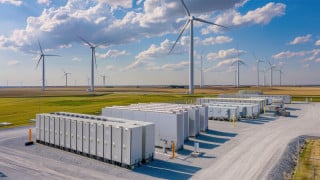
Solar panels and a windmill. Image used courtesy of Pexels
However, counting small-scale distributed solar PV systems, such as rooftop solar panels, boosts the combined share of renewable and hydroelectric generation to 25%, about the same as last year. It’s worth including small-scale facilities because generation in this category increased by 25.6% compared to the first half (H1) of 2022, surpassing all other resources.
Zooming out, solar PV’s total share (small- and utility-scale) is still only a fraction of the full mix, hovering at around 5.8% compared to 5% last year. Meanwhile, production fell across all categories of fossil fuels except natural gas.
Let’s dive into some of the trends.
Utility-Scale Renewable Generation
The EIA’s latest Electric Power Monthly report shows that utility-scale renewable generation (excluding hydroelectric) fell by 2.7% in H1 2023, compared to the same period last year. Wood and wood-derived fuels registered the largest drop (-10.4%), followed by other biomass (-5.6%), wind (-5.2%), and geothermal (-2.7%). Solar thermal and PV represent the only category of non-hydro renewables that grew, at +7.3%.
The two largest renewable energy sources—wind and solar—accounted for 17% of total generation compared to 16.7% last year. This is consistent with the EIA’s predictions earlier this year that both would claim 16% of the mix in 2023, up from 14% in 2022.
Now, let’s consider hydropower and nuclear: Generation from conventional hydroelectric facilities claimed 6% of the mix, but production dropped 10.8% compared to H1 2022. Nuclear’s share was 19%, down 0.7% year-over-year.
Declining Fossil Fuel Output
Coal, petroleum liquids and coke, natural gas, and other gasses claimed 57% of the total generation mix from January to June 2023. Despite that dominance, most fossil fuel categories registered year-to-date declines, with coal falling by 27.3%, petroleum liquids down by 22.6%, petroleum coke by 49.3%, and other gas by 4.5%. Natural gas was the only category with a higher output than last year, charting an 8.3% increase.
The EIA previously projected that generation from coal would fall from a 20% share in 2022 to 18% in 2023, while natural gas would drop from 39% to 38%. So far this year, coal’s decline has outpaced those projections, with a 15% share compared to 19% H1 2022. Natural gas comprises 41% of the mix compared to 36.6% last year.
Capacity Growth
As mentioned, solar thermal and PV generation grew 7.3% in H1 2023 amid rapid growth in the industry. Another recent report from the EIA shows that 5.9 gigawatts (GW) of utility-scale generating capacity came online in H1 2023, 35% of the total 16.8 GW added across all sources.
Behind solar, natural gas claimed the second highest share with 34%, adding 5.7 GW of capacity in H1. Two large-scale natural gas-fired plants came online recently: Ohio’s 1.8 GW Guernsey Power Station and the 1.25 GW CPV Three Rivers Center in Illinois.

Cumulative utility-scale electric generating capacity additions in 2023. Image used courtesy of the EIA
Wind accounted for about one-fifth of capacity additions, followed by 11% of battery storage.
Developers plan to add 35.2 GW of additional capacity in the second half of 2023: More than half is solar (19.3 GW), followed by battery storage (7.8 GW) and wind (nearly 5 GW).
The EIA’s latest Electric Power Monthly report is available online.