Facebook
 Google
 GitHub
 Linkedin
‘Honeycomb’ Floating Solar Panels To Lead PV Project in France
Floating solar panels will become part of a hybrid photovoltaic project in France, continuing a growing trend for renewable energy in tight spaces.
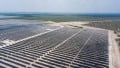
A 31-hectare former gravel pit in Lescheroux, France, will host a hybrid photovoltaic project combining floating solar panels and ground-mounted solar arrays. The project features Ciel & Terre’s Fusio honeycomb-structured floating solar panels. The 14 MWp project, initiated by Trina Solar France Systems, which began construction in October, repurposes the site to meet local energy needs while preserving the environment and supporting continued agricultural use.
Floating solar is especially timely as a Mordor Intelligence report projects the compound annual growth rate (CAGR) of the floating solar panel market is on track to grow by 26% in the next four years, demonstrating increasing interest in the technology.
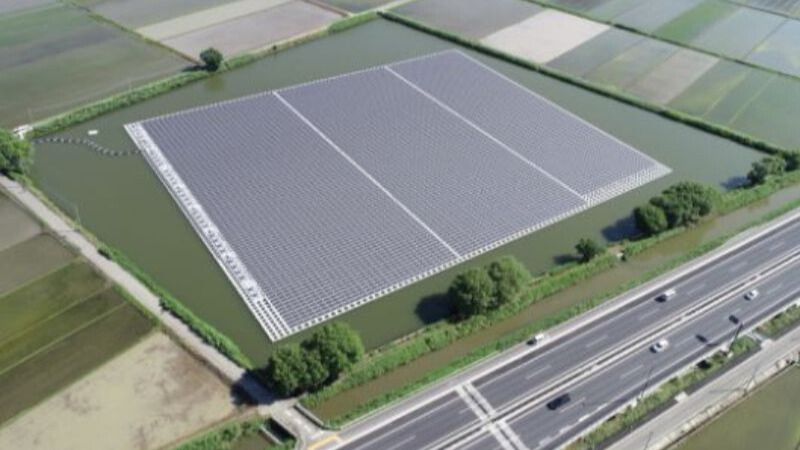
The floating solar energy system. Image used courtesy of Ciel & Terre
Solar Firsts All Around
Solutions30, a European engineering, procurement, and construction firm, is overseeing the project through grid integration, in collaboration with Ciel & Terre for the floating solar infrastructure and its subsidiary So-Tec for the ground-mounted systems. Ciel & Terre is deploying its latest-generation floating technology, adapted to the site’s specific hydrodynamic and anchoring conditions.
The project will install approximately 20,000 bifacial photovoltaic panels rated at 710 Wp each, for a total capacity of 14 MWp. Annual production is estimated at 16,500 MWh—enough to supply electricity to around 7,000 residents. Construction is expected to continue through the first quarter of 2026, with commissioning scheduled for the spring.
The project marks several firsts. It is the first floating solar plant in the Ain department of France, the first solar park of this scale within the Grand Bourg Agglomération, and among the first hybrid floating and ground-mounted projects in the Auvergne-Rhône-Alps region.
Ciel & Terre’s Floating Solar Technology
Floating solar, referred to as the third pillar of the solar industry alongside ground-mounted and rooftop photovoltaic systems, involves installing solar panels on bodies of water using specially designed floating structures. In 2020, floating solar installations accounted for 2 GW of global capacity.
The system combines PV modules on buoyant platforms, which anchor securely to the seabed, the banks, or both, depending on site conditions. This technology enables renewable energy production in areas where available land is limited, complementing other energy generation forms nearby.
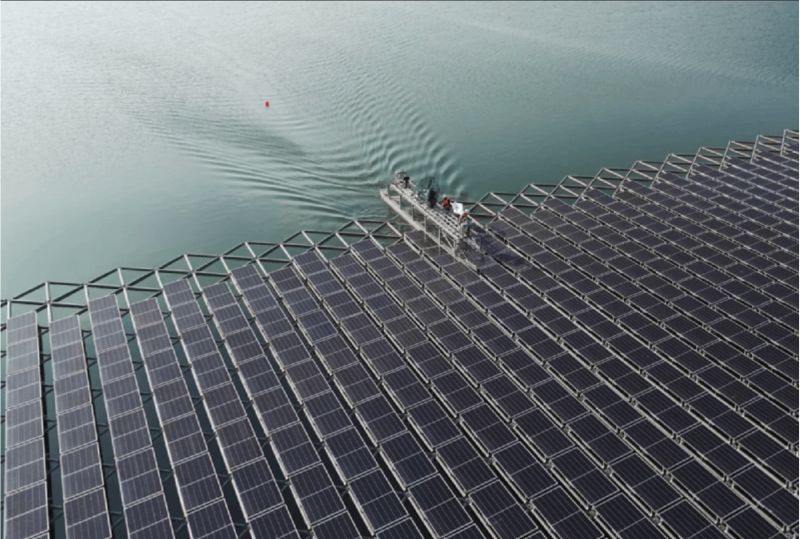
Ciel & Terre’s catamaran moves over the solar panels to streamline operations. Image used courtesy of Ciel & Terre
Ciel & Terre’s latest technology deployment, Fusio, is an innovative solution featuring a modular honeycomb structure designed to maximize photovoltaic performance through a neutral, passive cooling effect. Its unique architecture enables simpler and more cost-effective operation while facilitating maintenance on large-scale installations.
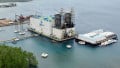
Fusio uses a catamaran-based operation system. A specialized boat navigates directly over the floating structure, eliminating the need for operators to walk on the array or manually transport equipment across the plant. It enables fast, efficient, and secure access to each panel and attached technologies, enhancing safety and operational performance.
Successful Anchoring of Floating Solar Systems
A reliable floating solar installation begins with a thorough site assessment. Understanding the water body’s depth, shape, and fluctuation levels, along with the lakebed’s soil composition, ensures the right anchoring design and technology are selected.
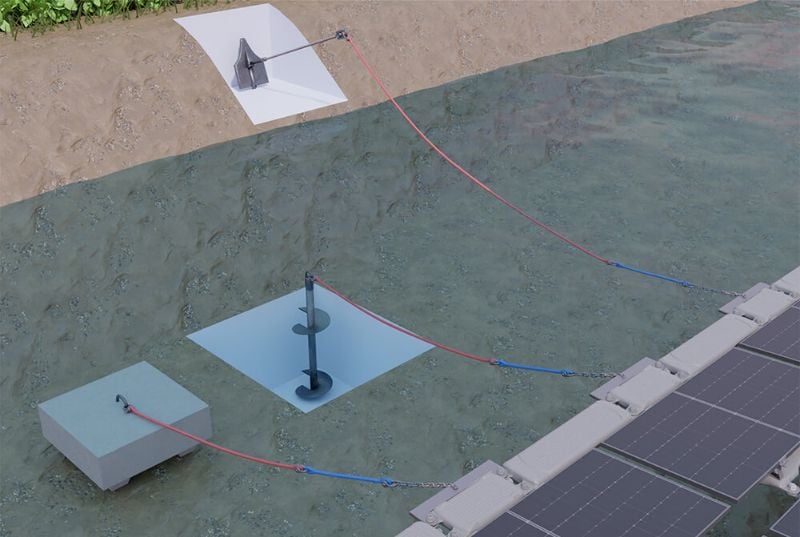
Example of anchor systems. Image used courtesy of Ciel & Terre
Environmental and topographical studies covering bathymetry, wind, and current conditions determine mooring line length, layout, and anchor positioning. Advanced simulations, including computational fluid dynamics modeling, guide precise engineering that meets international standards.
Depending on site conditions, systems may use bottom, bank, or hybrid anchoring, supported by mooring lines made of durable materials like polyester ropes, galvanized chains, or stainless-steel cables.
Anchoring components resist corrosion, UV exposure, and mechanical fatigue, ensuring more than 25 years of stable, low-maintenance performance. Together, these elements form the foundation for safe, efficient, and long-lasting floating solar systems.
Floating Solar Growth
Mordor Intelligence has released a report analyzing the growth of the floating solar market from now through 2030. For 2025, the market size is assessed at $1.06 billion and is estimated to grow to $3.39 billion by 2030, a CAGR increase of 26.20 percent.
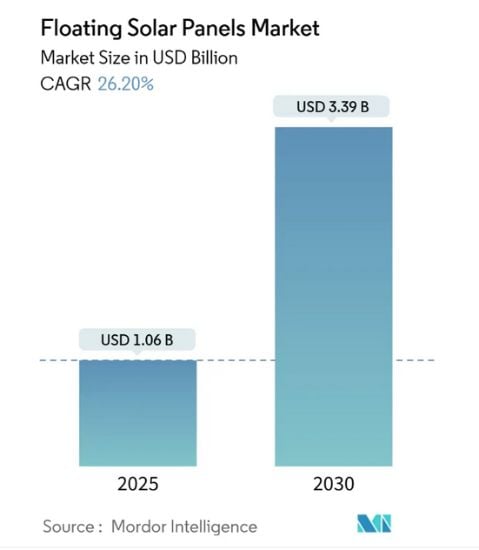
Floating solar projected growth. Image used courtesy of Mordor Intelligence
Major drivers of floating solar’s robust growth include increasing land-use constraints, stricter utility decarbonization mandates, and the proven energy-yield advantages from water-based cooling effects. The Asia Pacific region is already leading the global market and accelerating the adoption through reservoir-hydropower hybrid projects that expand renewable generation without additional land requirements.
Dual environmental benefits further support the sector’s momentum. Enhanced solar efficiency and significant water conservation make floating solar an increasingly attractive solution for water-stressed regions worldwide.