Facebook
 Google
 GitHub
 Linkedin
‘Gas Battery’ Generates Electricity by Capturing CO2
A Sungkyunkwan University-led team has built a hydrogel-and-carbon device that turns greenhouse gas adsorption into continuous DC power.
A research team at Sungkyunkwan University (SKKU), South Korea, has demonstrated a device that produces electricity directly from capturing carbon dioxide and nitrogen oxides from the air.
The researchers are proposing their Gas Capture and Electricity Generator (GCEG) as a counterpoint to the energy-hungry carbon capture, utilization, and storage (CCUS) systems currently deployed at industrial sites.
Conventional CCUS rigs spend considerable electricity to compress, transport, and inject captured gases. The SKKU-led concept inverts that flow. As CO2 or NO2 molecules are adsorbed onto the device's electrodes, they trigger charge redistribution and ion migration, producing measurable DC voltage and current at the terminals with no external bias applied.
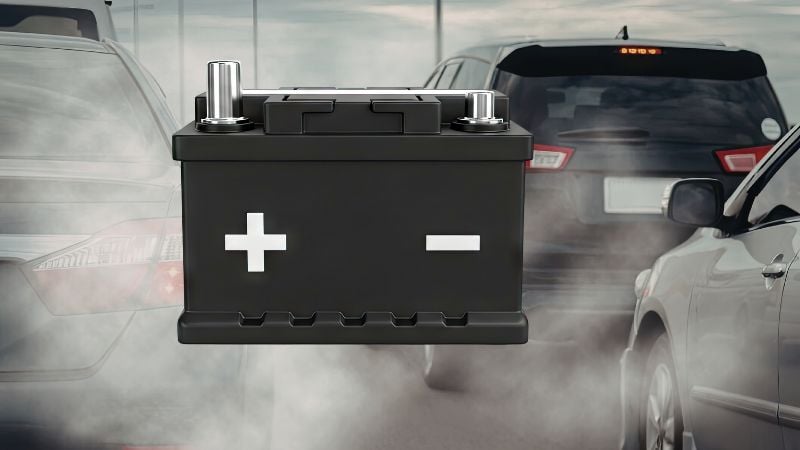
Concept of "gas battery.” Adapted from images used courtesy of Canva
Inside the GCEG
The device is unusually low-tech in its bill of materials, using only a carbon-black-coated mulberry paper electrode paired with a polyacrylamide hydrogel, asymmetrically dip-coated onto one side of the structure. But it’s that asymmetry that’s central to how it works.
When a target gas reaches the device, hydrogen-bond interactions between the gas molecules and the hydrogel modulate the electrical double layer at the electrode interface differently on each side, and the resulting potential gradient pushes ionic current through the cell. Scientists used infrared spectroscopy and atomistic simulations to confirm the hydrogen-bonding mechanism.
Both NOX and CO2 are within the device's selectivity window, a particularly important detail because flue gas from combustion plants typically contains both. A single GCEG unit produced 0.8 V at an NO2 exposure of 50 ppm, according to the researchers, with a current output of around 55 microamps.
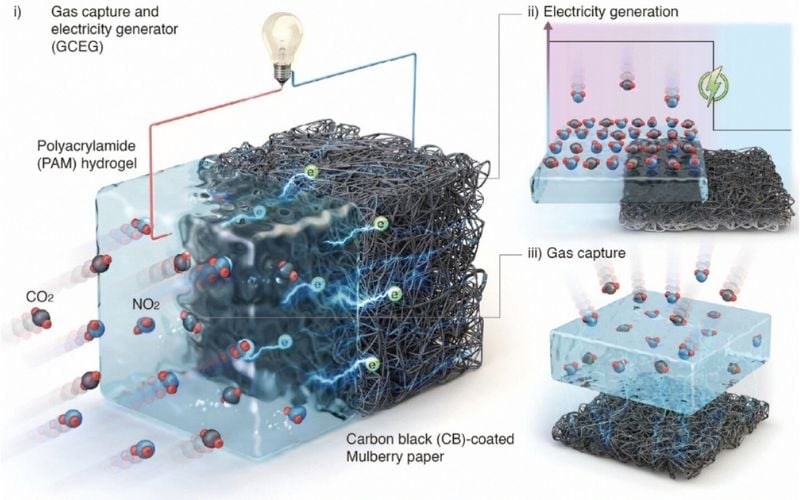
The working principle of the GCEG. Image used courtesy of Yun et al.
By wiring units in series and parallel, the team reported an integrated stack delivering 3.8 V and 140 microamps, enough to drive small low-power loads directly without an intervening battery.
Trickle-Power Range
These figures sit firmly in the trickle-power range, which is a fair read on where the CGEG tech lands today. A few volts and tens to low hundreds of microamps are too little to feed any meaningful industrial load. Still, it’s well-matched to the kinds of always-on monitoring electronics that are already migrating onto energy-harvesting front ends. Examples include gas concentration sensors at the perimeter of a chemical plant, leak detectors on an LNG terminal, and distributed air quality probes near a freeway.
The GCEG also benefits from using mulberry paper, carbon black, and polyacrylamide, which are commodity materials. Dip coating also scales easily. The researchers chose the paper due to its porous fiber network, which helps wick the hydrogel into intimate contact with the carbon and offers a high surface area for gas adsorption.
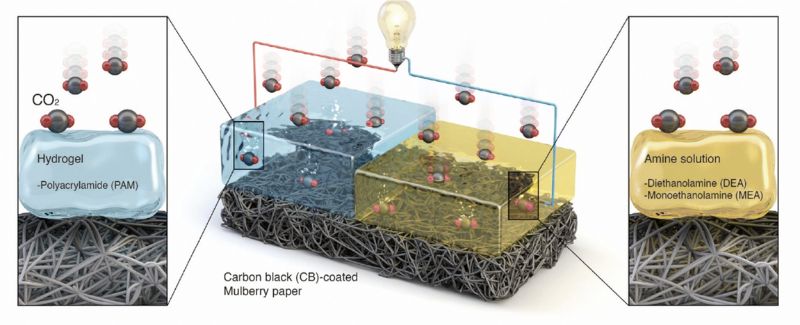
The GCEG’s structure. Image used courtesy of Yun et al.
Durability is an obvious open question. Long-term cycling under realistic flue gas mixtures, where materials such as sulfur compounds and particulates can poison sensitive electrochemical interfaces, is a challenge the researchers will need to address in the future.
A New Energy Resource?
In practical terms, gas capture is no longer guaranteed to be a pure energy sink. A device that adsorbs targeted gases while feeding a microwatt-class harvester opens the door to monitoring and control electronics at industrial sites that no longer need a battery swap or a hardwired supply.
Whether the GCEG eventually moves up the power curve to address larger loads will depend on electrode area, gas exchange rates, and how gracefully the chemistry tolerates real-world contaminants.
The study appeared in Energy & Environmental Science.