Facebook
 Google
 GitHub
 Linkedin
eVTOL Battery Technology: Trends and Challenges for Energy Engineers
Engineers are working to develop efficient, long-lasting batteries for electric vertical take-off and landing aircraft’s unique power needs.
Electric vertical take-off and landing (eVTOL) aircraft have transformed urban air mobility's future. Central to this change are the advanced battery technologies powering these innovative aircraft. eVTOLs present unique challenges for battery performance and longevity, pushing current technology’s boundaries.
Overcoming these challenges drives future innovations in eVTOL batteries, highlighting the critical roles of energy and power system engineers.
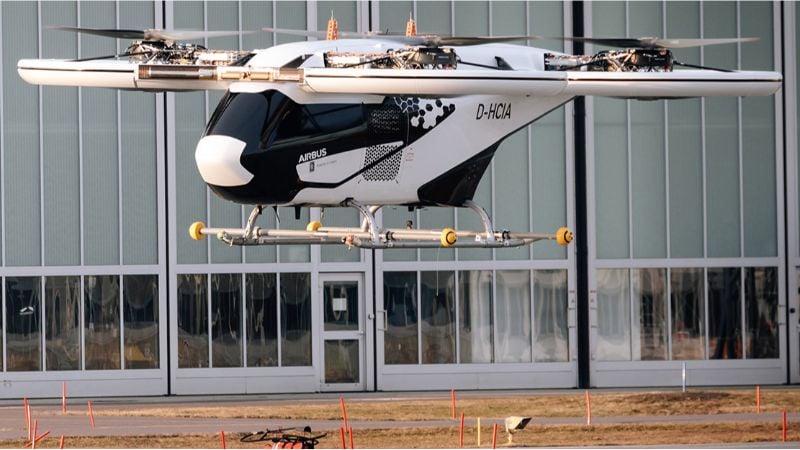
eVTOL hovering over city street. Image used courtesy of Wikimedia Commons
Understanding the Unique Demands on eVTOL Batteries
eVTOL aircraft operate under demanding conditions, significantly impacting battery performance and lifespan. Unlike ground-based electric vehicles, eVTOLs require rapid energy discharge for vertical take-off and landing, leading to intense thermal stress and accelerated battery degradation.
These unique operational demands require developing specialized battery technologies to withstand high power outputs while maintaining efficiency and safety. For example, whereas typical electric vehicle batteries, like those in the Tesla Model S, utilize lithium-ion technology capable of providing up to 535 km in range on a single charge, eVTOL batteries must handle far more vigorous charge and discharge cycles. eVTOLs like the Joby Aviation S4, which aims for a 150-mile range with vertical take-off and landing capabilities, require batteries that can support quick, intense power bursts while avoiding overheating and minimizing weight to maximize operational efficiency.
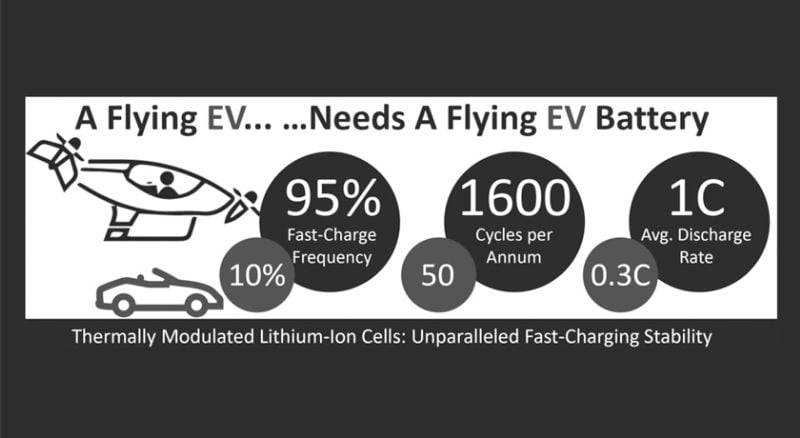
Battery needs of eVTOLs compared to electric vehicles. Image used courtesy of Penn State University
Moreover, advancements in solid-state batteries help address these challenges. Companies like QuantumScape are developing solid-state batteries offering greater energy density and improved safety features by eliminating liquid electrolytes, a significant fire hazard in high-stress environments.
Innovations in eVTOL Battery Technology
To meet the stringent demands of eVTOL operations, researchers are pursuing significant advancements in battery technology. Historically, eVTOLs relied primarily on traditional lithium-ion batteries, similar to those used in consumer electronics. These batteries balanced energy density and reliability but were limited to rapid charging and thermal management.
Energy Density and Thermal Management
Traditional lithium-ion batteries have faced challenges in aviation due to their limited energy density and susceptibility to thermal stress. Advancements such as solid-state batteries have significantly improved these aspects. Solid-state batteries replace the liquid electrolyte with a solid one, which reduces flammability risks and increases energy density. For example, QuantumScape’s solid-state batteries offer up to 50% higher energy density than conventional lithium-ion batteries.
Other companies advancing battery technology include:
- Lilium has developed high-performance battery packs using lithium-ion cells with silicon-dominant anodes. These anodes allow higher energy, power, and fast-charging capabilities than graphite anode cells. Lilium’s battery packs are designed to meet stringent aircraft safety requirements, including shock resistance and heat management.
- Overair, in collaboration with Hanwha Systems and Hanwha Aerospace, is developing advanced battery packs for its Butterfly eVTOL. These battery packs are designed to support high energy density and power requirements.
- BETA Technologies is developing the ALIA-250 eVTOL, which will feature batteries designed to optimize energy storage and weight. The Charge Cube system provides efficient power for eVTOLs and ground-based electric vehicles.

Concept of Lilium jet. Image used courtesy of Lilium
Fast-Charging Technologies
Traditional lithium-ion batteries often require hours to recharge, which is impractical for eVTOL operations. New fast-charging technologies are being developed to address this issue:
- Innovative electrolyte designs. Pacific Northwest National Laboratory researchers have developed electrolyte formulations with controlled solvation structures, significantly improving fast-charging capabilities. These electrolytes enable high-energy-density lithium-ion batteries to charge at 4C (15-minute charging) and 5C (12-minute charging), outperforming traditional electrolytes. This advancement addresses the technical challenges in enhancing lithium transport during charging, thus improving the overall efficiency and lifespan of the batteries.
- Extreme fast charging technologies. The National Renewable Energy Laboratory’s XCEL team is working on enhancing electrolyte transport through improved formulations, advanced electrode designs, and optimized thermal controls. Their research aims to meet the U.S. Advanced Battery Consortium's goals of achieving 80% charge in less than 15 minutes for cells with 275 watt-hour/kilogram energy density and a 1000-cycle, 15-year lifetime. The focus is on overcoming the limitations of thick-electrode cells, which, while offering cost and energy advantages, suffer from severe lithium-concentration gradients during fast charging.

Visualization of lithium ions moving through the battery’s electrolyte. Image used courtesy of NREL
Key Areas of Focus For Engineers
eVTOL battery technology’s future is poised for transformative advancements to significantly enhance performance, safety, and sustainability. Engineers working on eVTOL battery systems need to understand several critical areas to enhance these advanced energy systems’ reliability. Here are detailed insights into key areas supported by recent research:
- It’s essential to know battery chemistries and materials that can withstand high power outputs while maintaining safety and efficiency. Advanced materials such as silicon-dominant anodes and solid-state electrolytes have shown significant improvements in energy density and safety. For instance, silicon-dominant anodes can achieve higher energy capacities than traditional graphite anodes, which is critical for eVTOLs’ performance demands.
- Understanding effective thermal management is crucial to prevent overheating and ensure battery longevity. Traditional air and liquid cooling methods have limitations in managing advanced batteries’ high heat dissipation. Recent advancements include
- phase change material (PCM) cooling and direct liquid cooling. PCM cooling utilizes the latent heat during phase changes to maintain temperature uniformity. Combining this with structures like heat pipes and microchannel cooling plates enhances its effectiveness. Direct liquid cooling provides superior thermal conductivity and heat capacity than air cooling, making it more suitable for high-capacity battery systems.
- Advanced knowledge of battery management systems (BMS) is vital for monitoring and managing battery cells’ performance, safety, and health, especially under the high-stress conditions typical of eVTOL operations. BMS must address issues such as state of charge, state of health, and thermal runaway. For example, NREL’s adaptive electrochemical protocols and optimal thermal controls help manage fast-charge acceptance and extend battery life.
By understanding and leveraging these advancements, engineers can significantly enhance the performance, safety, and reliability of eVTOL battery systems.
eVTOL Batteries’ Future
Upcoming eVTOL batteries are being designed to address the challenges posed. Lilium’s battery packs using lithium-ion cells with silicon-dominant anodes offer higher energy, power, and fast-charging capabilities than graphite anode cells. Factorial Energy is advancing solid-state battery technology, with the recent production of 100Ah quasi-solid-state battery cells that passed UN 38.3 testing. These batteries promise higher energy densities and faster charging times and are set to reach A/B sample validation levels in 2024, paving the way for commercialization.
Next-generation batteries such as lithium-sulfur and lithium-air are expected to achieve energy densities significantly higher than current lithium-ion batteries, potentially reaching up to 600 Wh/kg. Additionally, recent innovations have shown that solid-state batteries can recharge in about 10 minutes, thanks to new materials and designs preventing dendrite formation. Future BMS will integrate sophisticated machine learning algorithms to enhance battery performance monitoring and management.
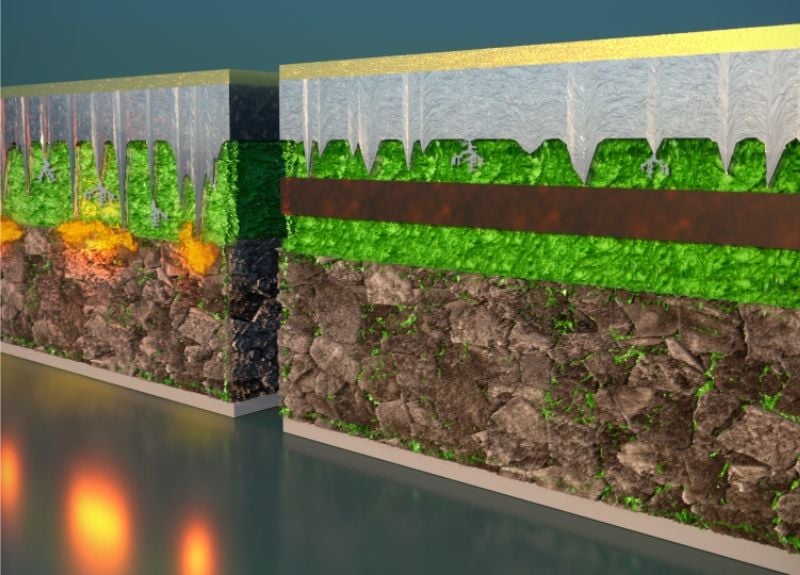
Developing dendrite-resistant electrolytes. Image used courtesy of Harvard School of Engineering
Collaborative efforts, such as those between NASA and Archer Aviation, are focusing on testing and refining these advanced BMS technologies for commercial eVTOL operations. These advancements highlight the ongoing commitment to overcoming the technological hurdles of eVTOL battery systems, ensuring a future of safer, more efficient, and more reliable urban air mobility.