
 Facebook
 Google
 GitHub
 Linkedin
Energy from Dirt? Scientists Create Reliable Soil-Based Battery
Northwestern University researchers developed an optimized “dirt battery” that reliably powers sensors across all soil conditions, making it a promising solution for agricultural sensors.
Northwestern University researchers developed an optimized “dirt battery” that reliably powers sensors across all soil conditions, making it a promising solution for agricultural sensors.
Soil-based microbial fuel cells (SMFCs)—“dirt” batteries—have been around since 2011, but inconsistent power performance has hindered their adoption. This is primarily because these cells require both moisture and oxygen to function, which is difficult to maintain underground in dry soils.
However, Northwestern University researchers have created an SMFC through an iterative design process that shows more promise and better practical performance for precision agriculture and environmental monitoring applications.
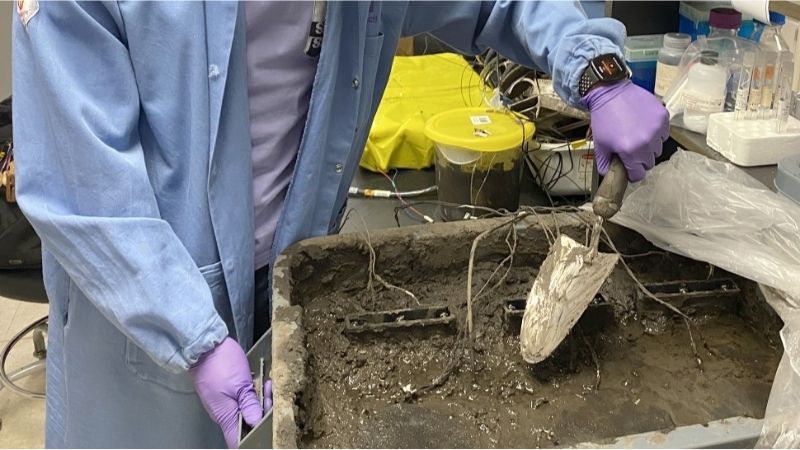
“Dirt battery.” Image used courtesy of Northwestern University
Interest in Soil Microbial Fuel Cells for Agricultural Applications
SMFCs will displace conventional batteries in most uses, but instead, are targeted for agricultural applications where conventional batteries will run out and need replacing. In agriculture, sensors placed in the soil track the moisture, nutrients, and contaminants to help improve crop yields. These sensors require regular battery replacements. Solar cells can’t be used because the soil would dirty them quickly and reduce efficiency.
Unlike traditional cells, SMFCs don’t need replacing or recharging. In agricultural settings, they offer the potential for a more environmentally friendly energy storage option because no electronic waste is left in the ground, either due to failure to remove the cells or through explosions or battery leakage that leach out heavy metals and toxic chemicals into the soil.
Lithium prices and supply chain shortages are also driving the need to make the sensors from cheaper, more available materials.
However, SMFCs are still at a low technology readiness level, and technical developments remain in infancy. In many cases, a lack of robustness to environmental factors and low power outputs has stunted research into these systems for practical applications.
NU researchers set out to change that situation.
Soil Microbial Fuel Cells Explained
SMFCs harness microbes to generate electricity from soil. They produce a low-power level suitable for small sensors. They work similarly to batteries, with an anode, cathode, and electrolyte.
However, they don’t use conventional electrochemical reactions. Instead, they use microbes that naturally release electrons. They require a specific type of microbe called an exoelectrogen, which releases electrons and breaks down organic matter.
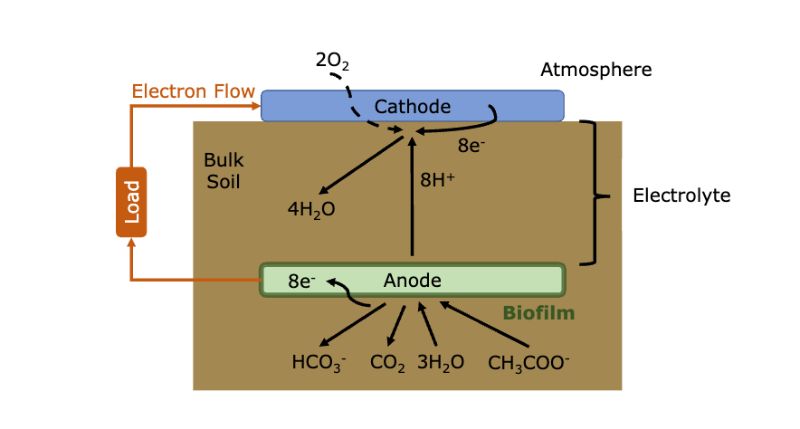
Structure of a soil battery. Image used courtesy of Yen et al.
SMFCs don’t use a membrane; instead, they rely on redox reactions. The anode is embedded in the soil, and the cathode is placed in an area exposed to oxygen. The microbes oxidize the organic matter, which releases both protons and electrons, forming a biofilm on the anode’s surface.
The biofilm increases microbial activity on the anode surface, allowing efficient electron transfer. Electroactive bacteria at the anode capture electrons released during oxidation and transfer them to an external circuit. At the same time, the cathode undergoes a reduction process, reducing oxygen to water because the released protons (equivalent to H+ hydrogen ions) move to the cathode and combine with the oxygen to make water.
The electrodes act as a surface for the microbes to live on, and the cells don’t degrade over time. The electrodes can also be made from any conductive material. Almost all soil environments contain exoelectrogens. As long as the soil contains usable organic carbon, the cell will continue to produce power.
Iterative Design Cycle Finds Optimal Design
The study was a two-year, iterative design process to find a way to make SMFCs practical for powering small sensors. SMFCs have typically been trialed for contaminant removal, so the literature reflected this in their design. To develop an optimal design for powering small electronics, the researchers developed a framework that broke the SMFC into individual modules. Testing these modules individually could improve each aspect, shortening the design cycle.
Using this framework, the team gathered nine months of deployment data across four design experiments examining different cell geometries. Over four versions, the geometry was computationally optimized to produce usable energy output in low-moisture environments. This culminated in selecting a final design geometry that generates power across a wide soil moisture range, which the researchers selected for outdoor testing.
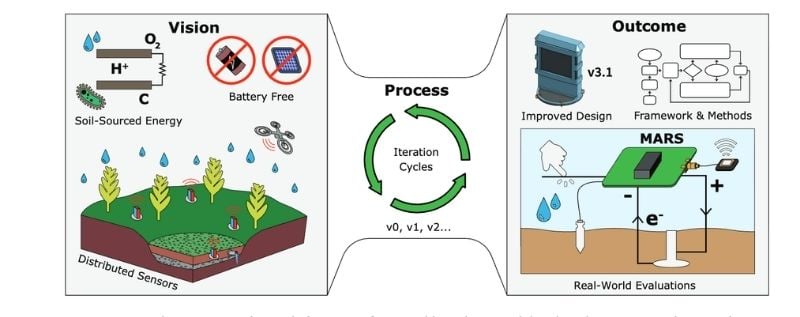
The design process and vision. Image used courtesy of Yen et al.
This final design contained a horizontal anode and a vertical cathode with one side permanently exposed to air (instead of parallel electrodes). The carbon felt anode was completely submerged beneath the soil, while the carbon cathode was composed of a conductive metal that extended to the surface.
The design worked because the vertical cathode serves two key functions. The top part remains exposed to air, enabling a steady oxygen supply to reach the electrode for the reduction reaction, while the bottom part is embedded in moist soil that provides continuous moisture in dry conditions. The cell also uses a protective cap to shield it from debris and an air chamber that facilitates airflow.
Testing the Cells Outdoors
The researchers tested the SMFC in outdoor environments without continually moist soil. First, they incubated the cell in the lab. When it reached 600 mV, they deployed it in a residential area with a dry, hot-summer Mediterranean climate, chosen to observe how the SMFC performs without irrigation. This simulates dry agricultural environments, a key application environment for agricultural sensors.
The SMFC powered the backscatter sensors that measured soil moisture and touch. Touch sensors can be used for wildlife monitoring (such as animals moving through a field), while the moisture sensors are suitable for volumetric water content sensing and flood detection, especially in wetlands. The researchers installed a small antenna on the cell to transmit data via radio frequency waves to a nearby base station.
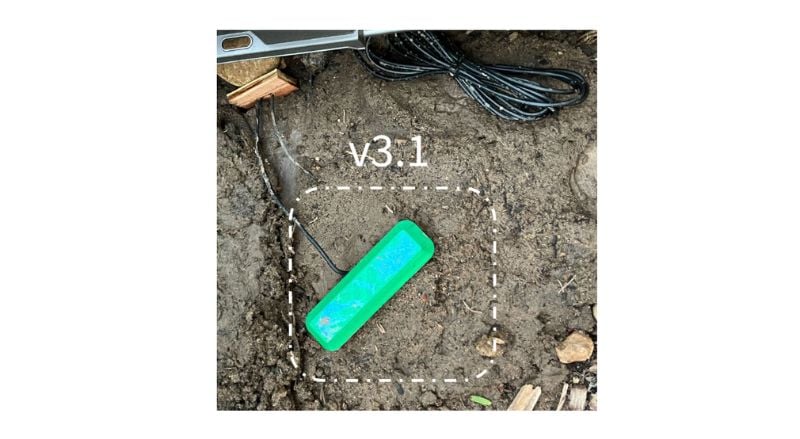
The outdoor experiment in unirrigated soil. Image used courtesy of Yen et al.
The scientists concluded the SMFC worked in both wet and dry conditions. While its power dropped after removal from the lab incubation, it was still sufficient to power the sensors. The SMFC also lasted 120% longer than similar technologies. The researchers have suggested that the SMFC is robust enough for real-world deployment in agricultural fields.
Next Steps for the Fuel Cell
The researchers are continuing to build on the SMFC by continuing to improve its efficiency and stability while exploring different biodegradable designs to further reduce the environmental impact of the devices. The current components can be sourced from common hardware materials, but switching to fully biodegradable versions could help to circumvent complex supply chains.
The study was published in Proceedings of the Association for Computing Machinery on Interactive, Mobile, Wearable and Ubiquitous Technologies.









Very informative article about industrial lightning safety systems. Choosing a reliable ESE Lightning Arrester Manufacturer & Supplier in India is extremely important for protecting electrical equipment, buildings, and industrial infrastructure from lightning strikes. SG Power provides advanced lightning protection solutions for industrial and commercial applications.
https://sgpower.co.in/our-products/lightning-protection-system/ese-lightning-arrester