Facebook
 Google
 GitHub
 Linkedin
Do Water Facilities Have Untapped Energy Storage Potential?
Stanford research suggests water facilities could add grid flexibility as grid-scale energy storage technologies.
Traditional grid balancing strategies have relied heavily on lithium-ion storage, natural gas peaker plants, and demand curtailment programs. However, these solutions face constraints related to capital cost, lifecycle degradation, and regulatory hurdles.
While water treatment and distribution systems account for nearly 5% of total U.S. electricity use, most operate independently of real-time grid conditions. Many believe that these systems’ physical infrastructure and control architectures offer untapped potential for demand-side flexibility. To determine the impact, Stanford University has introduced a systematic method to quantify, compare, and value water systems’ flexibility within established grid assets.
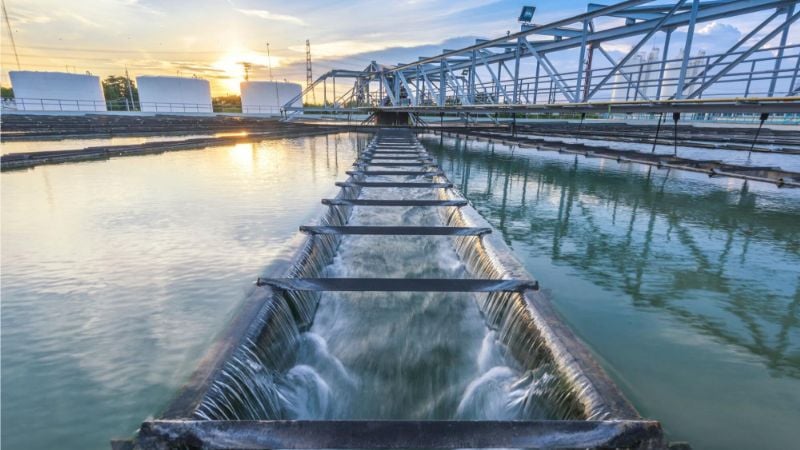
Water plant. Image used courtesy of Adobe Stock
Why Water Systems for Grid Flexibility?
Water infrastructure systems are well suited for demand-side grid flexibility. Whereas many industrial processes require continuous power input, operations in water systems, like pumping and desalination, can often be temporally shifted without compromising service levels. By decoupling energy input and output delivery, these systems can act as controllable loads that can be scheduled to coincide with low electricity prices or high renewable energy availability.
Water treatment and distribution systems have significant embedded storage. Treated water reservoirs, elevated tanks, and network storage buffers offer the potential to shift inflows and outflows. Operators can run high-energy processes during off-peak hours or when renewable use is high. For example, reverse osmosis desalination systems can adjust recovery rates or idle high-pressure pumps without affecting water quality or quantity constraints.
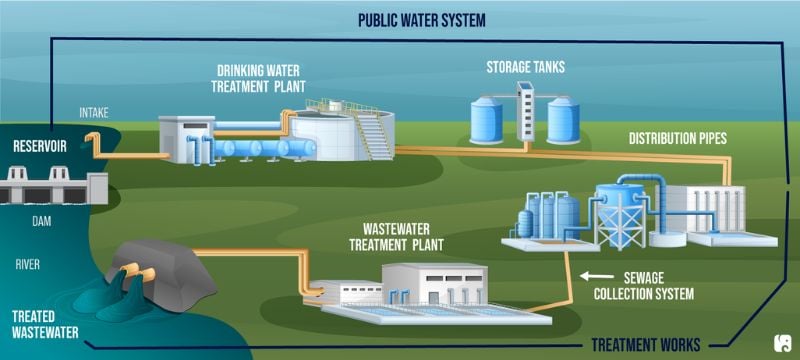
Typical public water infrastructure. Image used courtesy of U.S. Senate
Many water processes have control systems that monitor flow rates, pressures, and chemical concentrations in real time. These SCADA-based systems can implement dynamic load control without the need for extensive retrofits. The average electricity demand of large-scale desalination facilities can exceed 4-6 kWh/m^3 of treated water, with total power capacities often in the multi-megawatt range. Wastewater treatment plants operate similar high-load blowers and pumps that can be modulated for short durations.
This flexibility aligns with grid needs for services such as frequency regulation, load following, and demand response. Unlike batteries, water systems do not degrade with use, and their round-trip efficiency relies more on operational scheduling.
Valuing Water’s Flexibility
The Stanford team developed a quantitative framework to measure the energy flexibility of water infrastructure using standardized energy storage metrics. The framework aims to characterize and evaluate water systems like desalination and wastewater treatment plants as flexible grid assets. The operating schema models how facilities can modulate electricity load and water flow over time to align with grid needs. The model compares this to charge-discharge cycles in batteries, where load reduction during peak demand is conceptualized as an energy “discharge.”
The researchers calculated energy performance through three parameters: round-trip efficiency (%), energy capacity (MWh), and power capacity (MW). These parameters allowed direct comparisons to lithium-ion batteries and other grid-scale storage. The economic model considered capital upgrade costs, accelerated maintenance expenses, flow curtailment penalties, electricity cost savings, and ancillary service benefits. These inputs were then used to compute the net present value (NPV), levelized cost of water ($/m^3), and levelized value of flexibility ($/MWh).
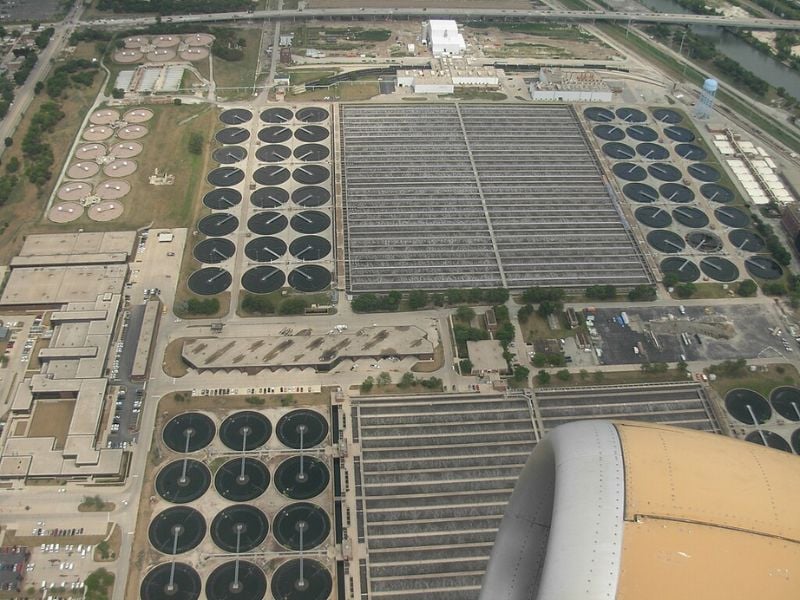
Wastewater treatment facility in Illinois. Image used courtesy of Wikimedia Commons
Using this framework, the researchers conducted case studies across three facility types and four U.S. states. Results showed that water systems could shift up to 30% of electricity consumption during critical grid periods without compromising water delivery targets. Desalination plants exhibited the highest dispatchability, especially under time-of-use tariffs. The techno-economic analysis revealed that, in most cases, investments to enable flexible operation, such as process controls and storage integration, were more cost-effective than deploying on-site battery storage.
A New Approach to Grid Flexibility
Using water systems for grid flexibility challenges assumptions about which infrastructure assets can provide energy services. As utilities seek solutions beyond electrochemical storage, energy sectors with programmable, high-load processes are becoming more relevant. Standard researchers integrated thermodynamic, hydraulic, and economic dimensions into a unified valuation model, which could encourage stakeholders to consider investments across infrastructure classes.