Facebook
 Google
 GitHub
 Linkedin
Charge Fast, Drive Long: 4 Advances in EVs
The latest innovations in electric vehicle technology could lead to longer range, faster charging, and better performance.
The EV landscape is rapidly evolving, with groundbreaking research and innovative developments emerging regularly. From advances in charging infrastructure to new battery technologies, the EV industry is undergoing a transformative period that could shape the future of transportation. Manufacturers and researchers are working tirelessly to address challenges like range anxiety, battery efficiency, and vehicle affordability.
From industry giants pushing the boundaries of battery performance to startups developing cutting-edge solutions for longer-lasting EVs, these innovations showcase the dynamic growth of the electric vehicle market. Here’s a roundup of four promising developments.
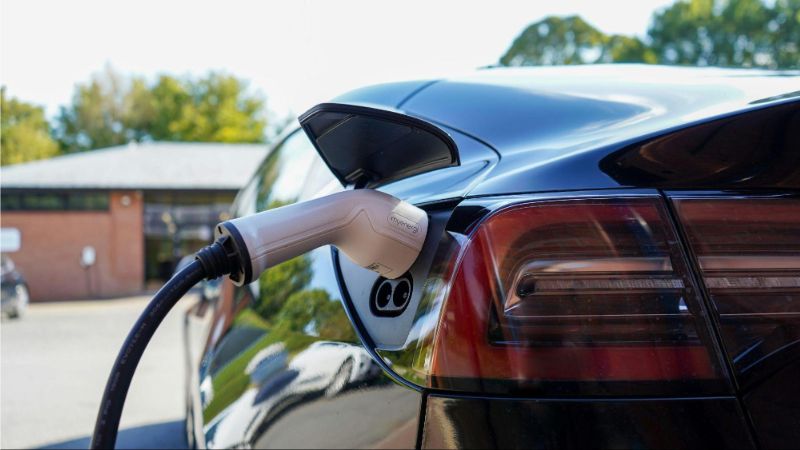
Hyundai electric vehicle at a charging station in Denmark. Image used courtesy of Unsplash
1. An EV Battery That Charges in 10 Minutes
Forge Nano, a Colorado-based company, has developed a groundbreaking lithium-ion battery using about 90% of U.S.-sourced parts. This innovation bypasses complex and costly foreign supply chains. The battery can fully charge in 10 minutes without reducing its life span.
The battery, produced by its subsidiary Forge Battery, has generated significant customer interest and has begun shipping to various sectors, including electric trucks and aerospace, following a safety vetting. Key materials include lithium, manganese, cobalt, and graphite. The company has managed to reduce production costs by 20% per kilowatt-hour.
The Atomic Armor nano-coating technology prevents performance issues caused by harmful chemical reactions. Forge Battery aims to mass-produce these batteries at a North Carolina facility in 2026.
2. High-Current Charging To Boost Battery Performance and Longevity
A study funded by the Toyota Research Institute has discovered a method to enhance lithium-ion battery life span by 50%-70%.
Published in Joule, the study highlights that charging batteries at high speeds during the first charge — known as the “formation” process — improves their longevity. This process is critical in stabilizing the battery’s components before use.
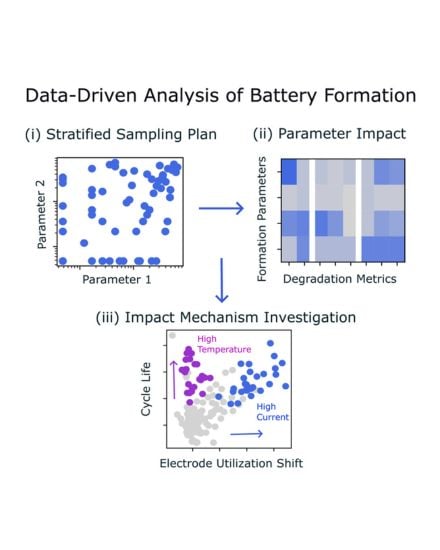
Electrode utilization during battery formation. Image used courtesy of Toyota Research Institute
Researchers from the SLAC Stanford Battery Center found that an initial high-current charge consumes more lithium—around 30%—than traditional methods but forms a protective layer on the negative electrode. This protective layer, part of the solid electrolyte interphase, ultimately extends battery life.
The study’s findings contradict the conventional practice of charging batteries slowly during formation, a time-consuming process that can limit production efficiency. This approach can potentially speed up battery production and improve performance, presenting a promising innovation for EV battery technology.
3. An EV With a 560-Mile Range
Hyundai is developing an EV called the extended range electric vehicle (EREV) to address range anxiety, a common concern among consumers. The EREV uses an internal combustion engine to generate electricity and recharge the battery when its charge is low, extending its driving range. This innovative powertrain and power electronics systems also enable the vehicle to have four-wheel drive with two motors.
The EREV is projected to travel up to 560 miles on a single charge, far surpassing the range of current EVs. For comparison, the longest-range EV, such as the Lucid Air, offers up to 410 miles per charge. Additionally, the EREV could be more affordable due to its smaller battery size.
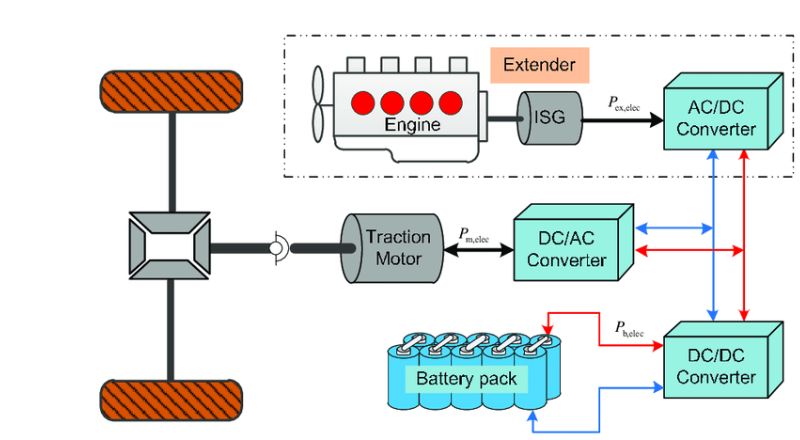
EREV technology. Image used courtesy of Xi et al.
Hyundai plans to launch its first EREV in 2027, with mass production starting in North America and China by 2026. The technology will likely debut in Hyundai and Genesis-D-class SUVs, like the Sante Fe and GV70. The company aims to sell around 80,000 of these vehicles annually.
Hyundai and Kia are also incorporating EREV technology into their upcoming pickup trucks, with plans to release them by 2028. This development could be a game-changer for the EV market, offering long-range and cost-effective solutions for consumers.
4. A Cutting-Edge EV Charger-Inverter System
Researchers at Western Michigan University (WMU) are spearheading a project to develop an integrated charger-inverter system for EVs. This system will reduce EVs' mass, cost, and environmental impact, improving consumer options and manufacturing processes.
Dr. Sandun Kuruppu, associate professor and director of WMU’s Transportation Electrification and Applied Mechatronics (TEAMS) Lab, leads the project involving multiple academic disciplines, national labs, and industry partners.
The goal is to create an innovative powertrain architecture, eliminating the need for a separate charger. The system will feature vehicle-to-grid capabilities, a smart charging interface, and compatibility with variable battery sizes. Initially, the team will develop prototypes to identify necessary technologies before scaling up to a 150 kW system suitable for entry-level EVs.
Kuruppu emphasized that the team plans to integrate the system into a vehicle to test its performance in real-world conditions. The project involves collaborations with institutions such as the University of Tennessee, the University of Kentucky, Oak Ridge National Laboratory, John Deere, and BorgWarner.
A $3.17 million grant has been awarded to WMU researchers by the U.S. Department of Energy to fund this research and propel EV technology.
The Road Ahead for EV Innovation
Innovation in the electric vehicle industry shows no signs of slowing down. With the combined efforts of researchers, automakers, and policymakers, EVs are poised to become more efficient, affordable, and accessible to drivers worldwide.