Facebook
 Google
 GitHub
 Linkedin
Can Salt Batteries Replace Li-Ion in Electric Vehicles?
Molten salt batteries are fire-resistant and long-lasting, but are they a good choice for electric vehicles?
Molten salt batteries—commonly called salt batteries—have existed for over 40 years but have had limited application scope.
Take a look inside HORIEN’s salt battery. Video used courtesy of HORIEN
The first salt battery, known as ZEBRA, was patented in 1978, and the architecture has attracted the interest of various industries over the years. From the ZEBRA battery, salt batteries have undergone development iterations.
Salt battery architecture has been unsuitable for electromobility applications because it takes too long to charge. However, they have numerous advantages over lithium-ion batteries (Li-ion) for on-grid storage applications, offering a better performance than Li-ions.
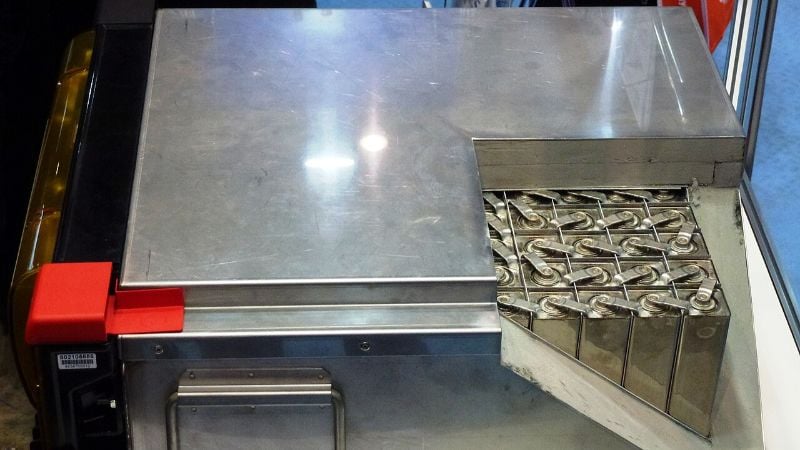
Molten salt battery. Image used courtesy of Wikimedia Commons
What Are Salt Batteries?
Salt batteries are a sodium metal chloride battery architecture that uses a nonflammable solid-state electrolyte made of a ceramic ion conductor material based on sodium aluminum oxide. Known as a β-ceramic, it acts as the separator and allows sodium ions to pass through.
The cathode is a metal-based cathode typically based on nickel, nickel salts, and common salt (sodium chloride). The anode is a molten sodium anode that only forms when the battery charges (and exists as salt and metal powder when not in operation). The cell is encased in a steel casing to prevent the molten material from escaping during operation and to keep the heat in. Like other batteries, the electrons move via an external circuit attached to the cell during discharging and charging.
Salt batteries work by melting the salt in the anode during charging so that it becomes molten. Salt batteries operate at around 250 °C (482 °F), where a reaction occurs that only causes the anode to become molten. The nickel metal and salt transform into nickel chloride and sodium metal. The reaction’s balanced chemical equation is:
2NaCl + Ni → NiCl2 + 2Na
High temperatures are characteristic of salt batteries. The sodium must be kept molten for the battery, requiring a constant temperature. However, the charging time for salt batteries can be long. Salt batteries can take up to 11 hours to reach the melting temperature to enable the battery to start functioning.
Salt Battery Advantages and Disadvantages
Like any battery architecture, salt batteries have distinctive advantages and disadvantages. Some are application-dependent.
A major advantage is safety. Even though salt batteries are heated to very high temperatures, the intrinsic components will not burn or explode, and the materials used are nontoxic and noncorrosive. This means no temperature control or specialist protection components are required to ensure safety. The battery's safety is so robust that it doesn’t require a discharge buffer and can be completely discharged without damaging the battery. This allows salt batteries to be shut down or completely discharged (put into hibernation) and powered up again months later without issue.
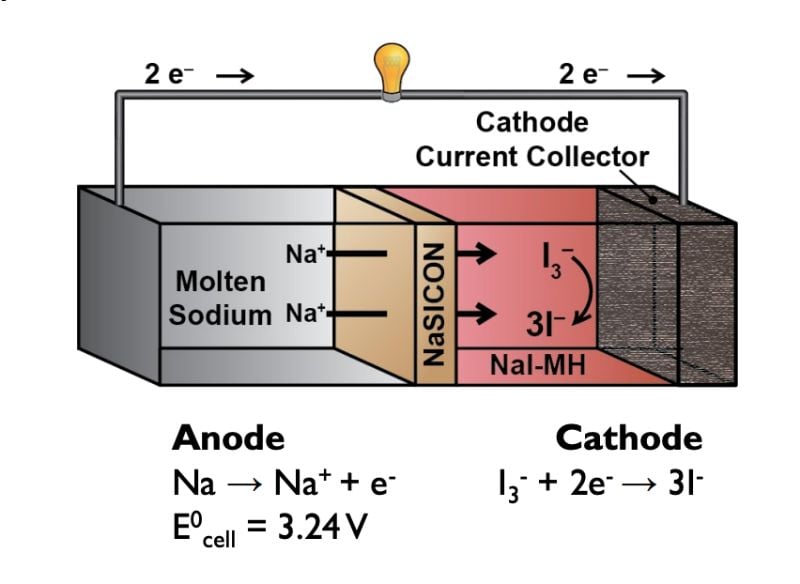
Molten salt battery operation. Image used courtesy of Sandia National Laboratories
Salt batteries also have long life cycles of above 4,500 charge and discharge cycles at 80% capacity retention. They are easy to dispose of and recycle because they are made of readily available natural materials. Salt batteries also have a high energy density, can be installed in any dry location, have long service lives above 15 years, and can operate in a range of temperature environments ranging from -20° to +60°C (-4° to 140°F).
Naturally, salt batteries do have their downsides as well. One disadvantage is the core operation mechanism, where the temperature must constantly be kept above 250°C to work. This requires a large and constant energy consumption to maintain the operation temperature. Additionally, salt batteries are not as efficient for high charge and discharge current. They are only suitable for short-term storage and cost more than Li-ion batteries.
Grid Applications Favored Over EVs
Despite their enhanced safety, salt batteries are limited to where they can be used. Since they take so long to heat up and function, they are unsuitable for vehicles. When used consistently, salt batteries will also use up to 30% of their energy to keep themselves operational. If left on continuously, a salt battery will completely discharge (from a 100% state of charge) in 80 hours by just trying to keep itself at the required operating temperature. Once discharged, it will cool down and no longer be operational. These factors render salt batteries unsuitable for automotive and industrial vehicle applications, which require batteries with faster recharging and higher discharge power.
Ideally, salt batteries can be used over a discharge period of two to ten hours while using a heating aid to help keep the cell temperature up (so that the battery doesn’t need to use as much of its own energy to self-sustain its internal temperature). A salt battery can be used in an application where the battery can be connected at all times. This is why on-grid applications are the most feasible, as they can meet these requirements. In on-grid applications, salt batteries can be used in emergency power storage systems in critical infrastructure, in remote locations, and in difficult environments where Li-ion batteries are not allowed, such as in mining and tunnel construction applications.
EU Project Looks Beyond Nickel
While nickel has been the metallic focus for the anode, a European Union project involving HORIEN and Empa is investigating reducing the nickel content in the molten anodes because it is classified as a critical material. The HiPerSoNick project, in conjunction with these companies, has been making progress, and they are considering the possibility of completely replacing the nickel in the anode with zinc.