Facebook
 Google
 GitHub
 Linkedin
Battery Research Reaches for Common Materials, Creative Methods
Studies focusing on concrete, soy, microwaves, and iron could lead to increased energy storage and better-performing batteries.
Researchers worldwide are continually exploring materials to improve battery performance and finding innovative ways to store energy. Recent advances include a supercapacitor concrete that could power an entire building, an affordable solid-state battery electrolyte using soy protein, microwave heating to speed up fuel cell manufacturing, and iron-based cathodes that could replace cobalt.
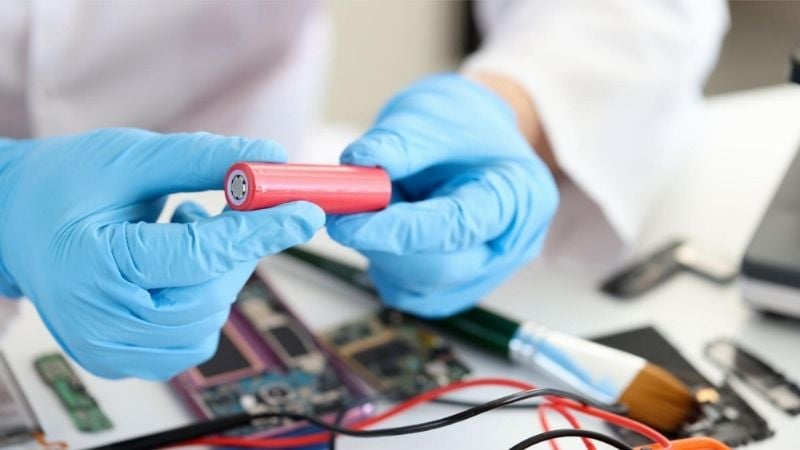
Battery research. Image used courtesy of Adobe Stock
MIT Develops Conductive Carbon-Concrete Supercapacitor
Electron-conducting carbon concrete (ecˆ3) is a conductive cement composite with a high mechanical robustness and the ability to store electrochemical energy. MIT researchers made these composites into functional supercapacitors for use in everyday infrastructure, such as walls, sidewalks, bridges, slabs, columns, and arches, to store and release electrical energy alongside their conventional structural functions.
To make the ecˆ3 conducting composite, the researchers combined cement, water, carbon black nanoparticles, and electrolytes. This created a cementitious composite matrix with dispersed carbon black nanoparticles that formed a fractal-like conductive network throughout the matrix.
They also fabricated centimeter-thick electrodes. The performance scaled linearly with electrode thickness and cell count―creating energy storage capabilities that are independent of scale.
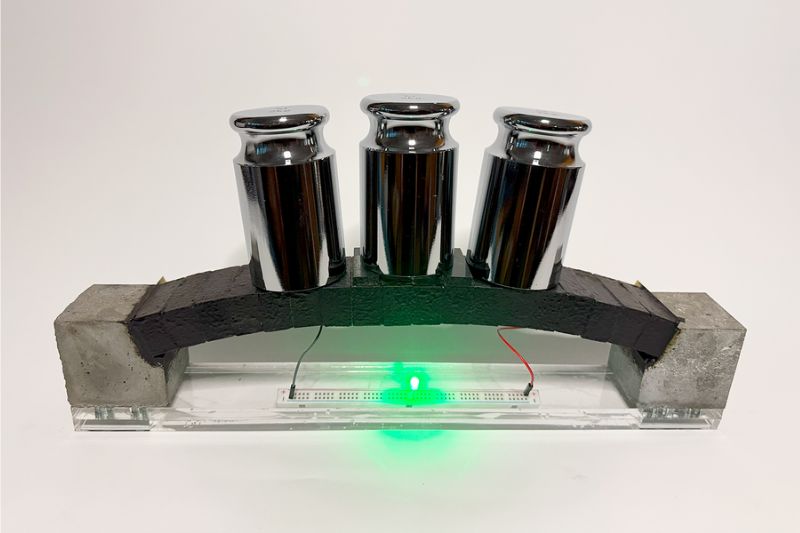
The prototype. Image used courtesy of MIT
The researchers also investigated using both organic and ionic electrolytes to optimize electrochemical behavior. They found that organic electrolytes using quaternary ammonium salts performed best. The final designs possessed a 10-fold increase in supercapacitor energy density compared to previous designs.
Using the composite, the researchers fabricated a 12 V, 50 F supercapacitor module and a 9 V arch prototype that integrates energy storage into load-bearing architectural elements. About five cubic meters of the concrete composite―roughly the volume of the average basement wall―could store enough energy to meet the daily energy needs of the average home.
Using Soy Protein To Power Solid-State Batteries
Tsinghua University researchers have developed an electrolyte material made from soy protein with the potential to power solid-state batteries with high efficiency and longevity. Soy protein could make batteries safer and more affordable using abundant natural materials.
To make the soy protein suitable for batteries, the researchers had to increase the conductivity to help lithium ions move more freely. They achieved this by creating a soy protein-based cross-link polymer material.
These crosslinked polymers contained the soy protein alongside polyvinylidene difluoride (PVDF), vinyl ethylene carbonate (VEC), and bis(trifluoromethane)sulfonimide lithium (LiTFSI). The material comprised a 3D network of hard and soft layers, giving the electrolyte both toughness and flexible properties. The solid-state electrolyte had a high ionic conductivity of 7.95 × 10⁻⁴ S cm−1 and Li+ transference number of 0.78 at 60°C.
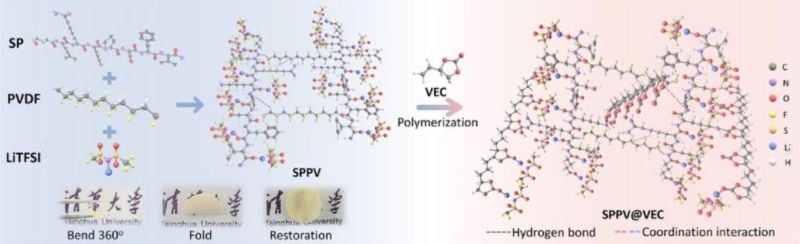
The cross-linked soy protein formation with PVDF, VEC, and LiTFSI. Image used courtesy of Li et al.
The researchers built a solid-state lithium battery using the electrolyte and put the battery through multiple stable charge-discharge cycles for over 2,000 hours at 60°C. They also raised the operating condition to 120°C, a more extreme operating environment, and the batteries still retained 75% of their original capacity after 800 charging cycles at a 2C cycling rate.
The soy protein electrolytes also showed a lower release of toxic and flammable volatile compounds compared to other materials.
10-Minute Microwave Batteries
In Korea, researchers have developed a solid oxide electrolysis cell (SOEC)―a fuel cell that produces green hydrogen―with a much quicker processing and manufacturing time than its predecessors.
SOECs typically require a sintering process to solidify the ceramic powders used to build the cell. This process allows the powder to form strong bonds that prevent gas leaks where hydrogen and oxygen could mix and trigger an explosion. It usually takes around 6 hours at 1400 °C, but a research team at KAIST has shortened it to just 10 minutes at 1200 °C using a process called volumetric heating.
_and_microwave-assisted_heating_(right).jpg)
The sintering mechanism with conventional convection heating (left) and microwave-assisted heating (right). Image used courtesy of Yu et al.
Volumetric heating uses microwaves to uniformly heat materials from the inside. In a sintering process, ceria and zirconia materials mix at high temperatures, leading to material issues, such as defects. The volumetric heating approach, however, not only cuts down the time but also prevents the materials from mixing, creating a dense and gap-free electrolyte layer.
The process shortened the entire manufacturing time needed to create a single battery. The usual sintering-based approach for these fuel cells takes around 36.5 hours. By contrast, this new approach only took 70 minutes, approximately 30 times faster.
The SOECs created using this approach produced 23.7 mL of hydrogen per minute at 750°C, operated stably for over 250 hours, and delivered a maximum power density of 2.43 W cm−2 at 700 °C in fuel cell mode and a current density of 3.16 A cm−2 at 750 °C in electrolysis mode.
Iron Shows Potential as a Cathode Material
Expensive materials and low-performing cathodes have limited the success of iron-based batteries. However, researchers from Stanford and SLAC have created an iron-based material that can store more energy than conventional chemistries.
Iron atoms usually only donate two or three electrons (Fe2+ and Fe3+, respectively). However, the research team managed to push iron’s electron-donating capabilities further by enabling iron to give up and receive five electrons.
By placing the iron atoms away from each other in a material crystal, the researchers built an iron-based cathode (made from LFSO―lithium, iron, antimony, and oxygen) that donated five electrons per iron atom during discharging and received 5 electrons back during charging. Side reactions usually prevent the attainment of higher oxygen states.
_vs._the_engineered_version_.jpg)
Conventional cathode material structure (top) vs. the engineered version. Image used courtesy of Stanford/Hari Ramachandran
Keeping the iron atoms away from each other and making the particles very small (300-400 nm) prevented them from undertaking side reactions with oxygen, allowing them to donate and receive more electrons. The nanoparticles in the cathode allowed management of any twisting and volumetric change in the cathode, which often occurs in high-voltage batteries. Instead, the cathode bent slightly to prevent any structural changes or cracking during cycling.
Iron is an abundant material that could help to replace expensive and vulnerable rare earth metals in batteries, such as cobalt. The next stage is to find a replacement for the antimony, another expensive material subject to supply chain challenges.