Facebook
 Google
 GitHub
 Linkedin
Air-Stable Batteries: The Future of Energy Storage?
Organic molecules make aqueous organic flow batteries more cost-effective and longer-lasting.
Redox flow batteries (RFB) have emerged as a promising energy storage technology thanks to their unique combination of scalability and long-duration storage capabilities. However, traditional RFBs often rely on rare and expensive materials like vanadium, limiting their widespread adoption. This has spurred research into more sustainable alternatives, particularly aqueous organic flow batteries (AOFB). Yet, AOFBs also face challenges, primarily in the instability of organic redox-active molecules (ORAM) when exposed to air.
Researchers at the Dalian Institute of Chemical Physics have developed naphthalene-based ORAMs for aqueous flow batteries that demonstrate stable cycling under normal air conditions. The innovation addresses the barriers to large-scale manufacturing of AOFBs and could lead to a solution.
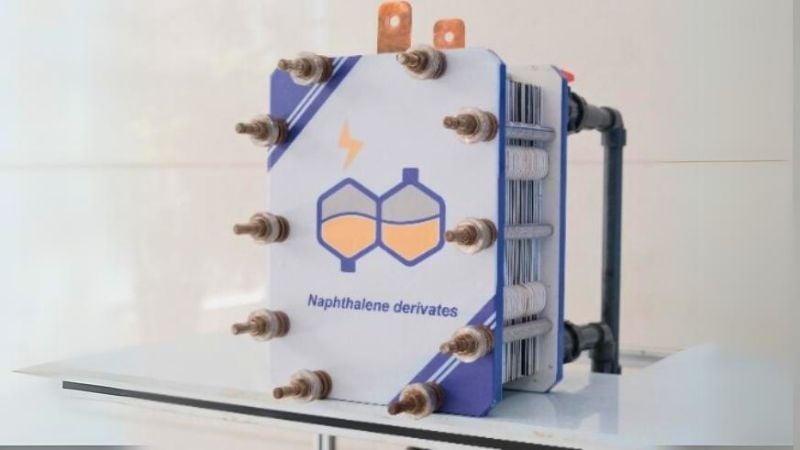
A pilot-scale naphthalene-based flow stack. Image used courtesy of Dalian Institute of Chemical Physics/Zhao Ziming and Zhang Changkun
Redox Flow Batteries
RFBs are advanced energy storage systems that directly convert chemical energy into electrical energy using reversible reactions.
These devices contain two electrolyte solutions containing dissolved redox-active materials stored in separate tanks. The electrolytes are pushed through an electrochemical cell where reactions occur on inert, porous electrodes. An ion-exchange membrane separates the electrodes, allowing ion transfer while preventing electrolyte mixing.
Traditional RFBs typically use inorganic redox species like zinc, lead acid, bromine, or polysulfides. Amongst these, vanadium is the most promising due to its multiple oxidation states, strong redox properties, and high stability. However, its scarcity and rising costs have led many to search for alternative, sustainable solutions, such as organic-based systems.
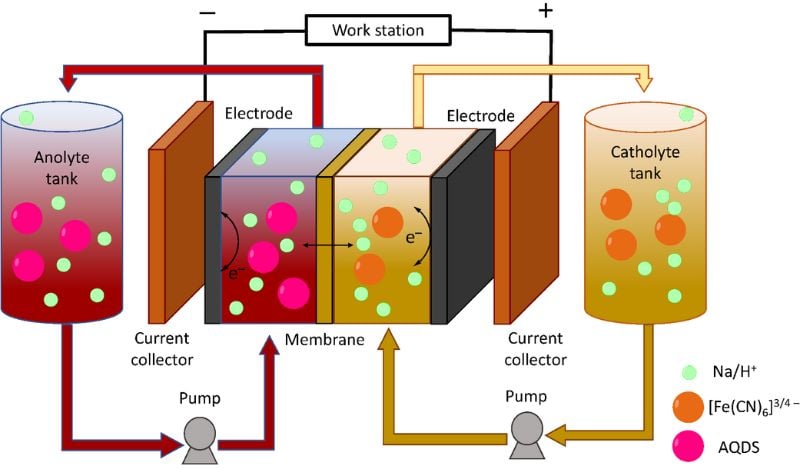
Schematic of an RFB battery. Image courtesy of Asenjo-Pascual et al.
AOFBs utilize organic materials dissolved in water-based electrolytes, making them more cost-effective and environmentally friendly. However, the challenge is the stability of the ORAMs used in these batteries. Specifically, ORAMs are prone to deactivation due to undesired side reactions, particularly when exposed to air. This deactivation process leads to irreversible capacity loss.
Moreover, the need for an inert gas environment to prevent ORAM deactivation adds complexity and cost to battery maintenance.
Naphthalene Battery Breakthrough
Researchers have developed an AOFB using naphthalene-based ORAMs to address the instability of inorganic ORAMs in air. The team synthesized naphthalene derivatives with active hydroxyls and dimethylamine scaffolds, combining chemical and in situ electrochemical methods. This approach simplified ORAM purification while being scalable and cost-effective.
The electrochemical step allowed the introduction of hydrophilic alkylamine scaffolds, which served to protect against side reactions. Spectral analyses and theoretical calculations show that dimethylamine scaffolds enhance water solubility and safeguard the active center, maintaining molecular stability during charge and discharge cycles.
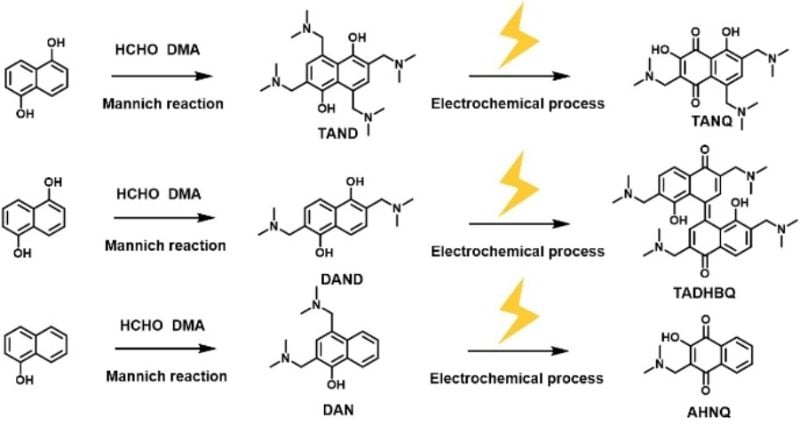
Naphthalene derivatives in chemical and electrochemical reactions. Image used courtesy of Dalian Institute of Chemical Physics/Zhao Ziming and Zhang Changkun
Using a 1.5 mol/L electrolyte, the resulting naphthalene flow battery demonstrated remarkable stability, achieving 850 cycles (approximately 40 days) without capacity loss. It also maintained a high capacity of 50 Ah per liter. Notably, the battery performed exceptionally well under continuous air exposure, completing 600 cycles (about 22 days) without performance degradation.
The researchers also addressed scalability, achieving naphthalene derivative production of 5 kg per pot. In pilot-scale tests, battery packs with a 330 Ah capacity exhibited cycling stability for 270 cycles (27 days) and an impressive retention capacity of 99.95% per cycle.
Next-Generation Energy Storage
This breakthrough in AOFB technology opens new avenues for sustainable energy storage. As researchers continue to refine these air-stable organic molecules, we may see a shift in the energy storage landscape. The potential for cost-effective, environmentally friendly, and scalable batteries could accelerate the adoption of renewable energy sources. Future developments could focus on improving energy density and exploring novel organic compounds.