Facebook
 Google
 GitHub
 Linkedin
0 to 80: Li-Ion Research Accelerates EV Fast Charging
The improved lithium-ion batteries could go from 0 to 80% in just 15 minutes.
Electric vehicle adoption continues to face technological hurdles that limit mainstream acceptance. Battery performance remains the primary constraint, with charging infrastructure, range limitations, and long charging times deterring potential buyers. Current lithium-ion battery technologies struggle to balance rapid charging capabilities with long-term durability, creating a complex engineering challenge.
As a result, the automotive and energy storage industries have invested billions in research to overcome these fundamental limitations. Researchers at the University of Waterloo, Ontario, have developed a novel approach to lithium-ion design that unlocks unprecedented charging times.
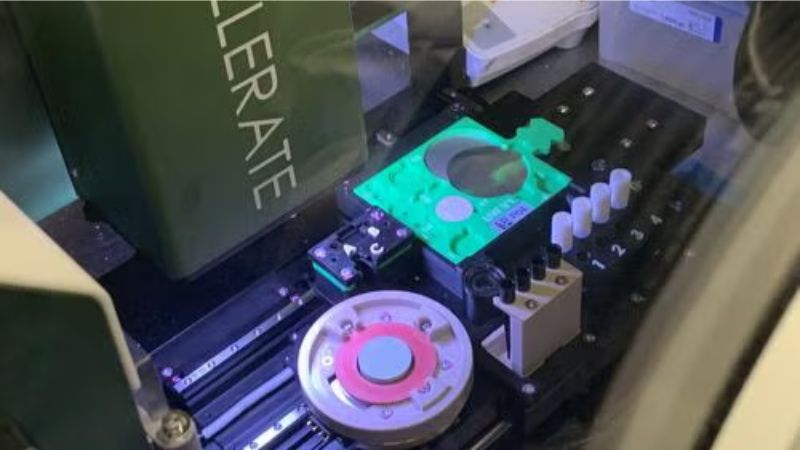
Automated assembly technology for batteries. Image used courtesy of University of Waterloo
Charging Bottlenecks
Range anxiety has always been the most important barrier to EV adoption. The limited availability of charging stations and lengthy charging times make consumers hesitant about long-distance travel in EVs.
Lithium-ion (Li-ion) batteries are the most expensive component in EVs. Li-ions enable lithium ions to move between an anode and cathode through an electrolyte to produce electrical energy. Their high energy density makes them suitable for EVs, but they pose certain challenges. For instance, traditional Li-ions degrade significantly during repeated charging cycles, reducing battery life and performance.
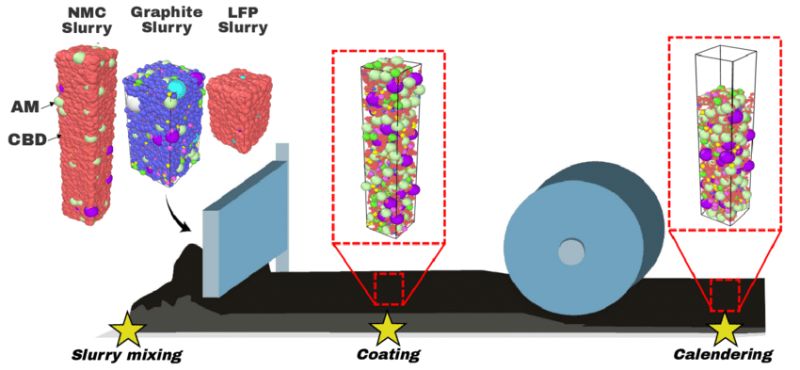
Electrode manufacturing process. Image used courtesy of Duquesnoy et al.
EV owners have been demanding an improvement in the current standard EV charging time of 1 hour. However, fast charging in Li-ions accelerates wear on the electrodes and can lead to safety hazards like overheating. Moreover, traditional graphite anodes, while effective, are limited in conductivity and structural stability during fast charging. This is because conventional electrode manufacturing relies on a slurry-based approach, incorporating polymeric binders and carbon additives to facilitate electron transport. Despite its cost-effectiveness and scalability, this architecture suffers from critical limitations such as low electrical conductivity and unstable electron pathways.
EV batteries must strike a delicate balance between high capacity and fast-charging capabilities, but improving one often compromises the other. Moreover, the current state of used EV batteries poses challenges for second-hand markets due to uncertainties about their remaining life and reliability.
Waterloo’s Electrode Breakthrough
Researchers from the University of Waterloo have developed a Li-ion design with anode architectural improvements they claim enable rapid charging and enhanced durability.
In a paper in Advanced Science, the scientists presented a novel method to improve anodes by incorporating titanium carbide (TiC) interconnects into graphite electrodes. Researchers used carbothermal conversion of titanium hydride at temperatures up to 1,000°C to form covalent TiC bonds at particle interfaces. This approach enhanced electrical conductivity and mechanical stability, allowing the electrodes to endure extreme fast-charging conditions.
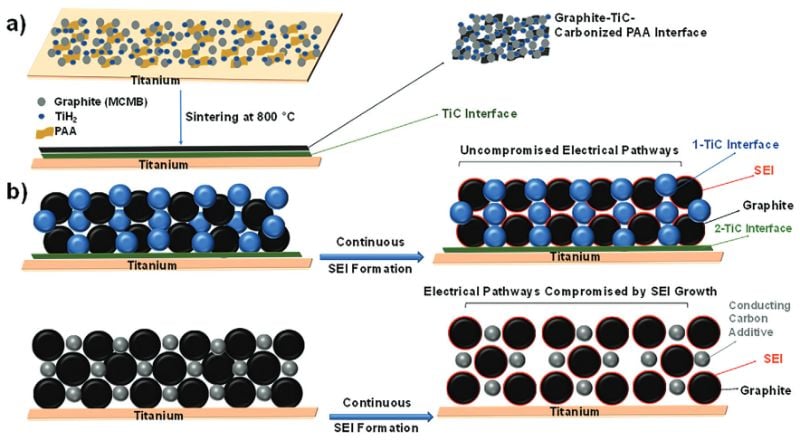
Novel approach for electrode manufacturing. Image used courtesy of Rangom et al.
The optimized anodes demonstrated remarkable durability, retaining 80% capacity after 800 cycles at 4C charging rates, with a specific areal capacity of 3 mAh/cm². The team used transmission electron microscopy and X-ray photoelectron spectroscopy to confirm the formation of thinner and more conductive solid electrolyte interphase, reducing impedance growth and mitigating lithium plating.
The architecture also increased in-plane conductivity to 14.5 S/cm, approximately 3.24 times higher than conventional electrodes. Most notably, the battery could charge from 0 to 80 percent in just 15 minutes.
Future Prospects
By optimizing particle arrangement and binder characteristics, the researchers created a battery technology that addresses a major challenge in EV adoption. Importantly, the approach maintains compatibility with existing battery manufacturing processes while delivering improved performance metrics, including the ability to withstand up to 800 charging cycles.
Moving forward, the research team will refine manufacturing protocols and validate the technology's industrial scalability. Their current focus involves prototype assessments and engaging potential partners to evaluate commercial viability and market readiness.