Facebook
 Google
 GitHub
 Linkedin
Run by Rust: Massive Iron Air Energy Storage System
Form Energy uses an unconventional battery in New England's largest capacity storage expansion.
Massachusetts-based energy storage developer Form Energy will build an 85 MW/8.5 GWh iron-air battery system at a former paper and tissue mill in rural Maine. The company’s multi-day storage solution delivers electricity for 100 hours, significantly longer than short-duration lithium-ion batteries.
Learn more about iron-air batteries and large-scale energy storage. Video used courtesy of Form Energy
At completion, Form Energy’s Maine project would be the world’s largest long-duration battery storage plant by capacity. Several factors make it unique from other major projects in the U.S., many of which only offer four hours of storage. That includes newly operational solar-plus-storage sites like California’s Edwards & Sanborn, with 875 MW of solar and 3.2 GWh of battery storage capacity, and Nevada’s Gemini project, with 690 MW of solar combined with a 380 MW, 1.4 GWh battery system.
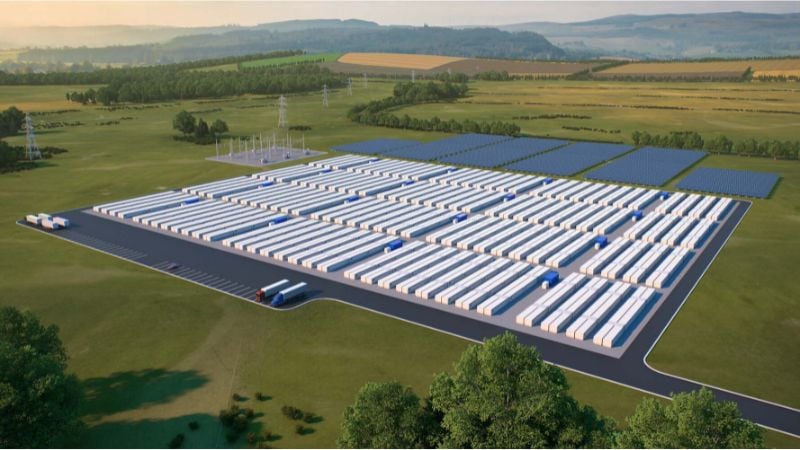
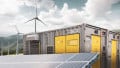
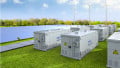
Rendering of a grid-connected energy storage system. Image used courtesy of Form Energy
Form Energy’s Long-Duration Energy Storage Solution
Form Energy’s long-duration iron-air battery can store electricity for 100 hours, unlike conventional four-hour lithium-ion batteries. The product also uses iron, one of Earth’s most abundant metals, rather than rare lithium or cobalt.
The battery runs on a reversible rusting process. When charging, an electric current converts rust into metallic iron, and the battery then releases oxygen. While discharging, the battery receives oxygen from the air and reverts iron metal into rust.
Each module includes a stack of 50 three-foot-tall cells filled with a water-based liquid electrolyte and iron and air electrodes. Units are grouped in protected enclosures, forming modular MW-scale power blocks.
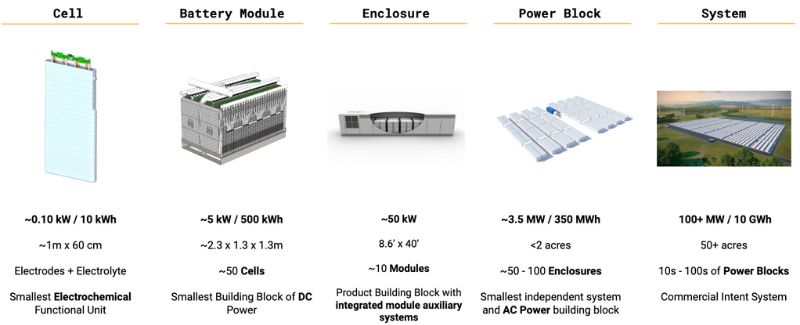
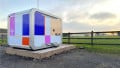
Form Energy’s storage system specs. Image used courtesy of Form Energy
Form Energy broke ground on its first commercial project, a 1.5 MW/150 MWh system in Minnesota. The company is also working with utility Xcel Energy on a Department of Energy-funded demonstration to deploy two 10 MW storage systems at retiring coal plants in Minnesota and Colorado.
Facing high demand for its modules, Form Energy is building a high-volume manufacturing facility in West Virginia with 500 MW of annual production capacity.
New England Energy Storage Needs
Form Energy’s multi-day storage project in Maine is part of a broader effort to increase electric reliability in New England’s six-state network. The Massachusetts-led Power Up New England partnership convenes regional transmission authorities, public utilities, and tech providers like Form Energy, National Grid, and Eversource. In August, it was one of eight projects selected to receive $2.2 billion in funding from the Bipartisan Infrastructure Law.
For decades, two large-scale pumped-hydro storage plants supplied around 2 GW of on-demand storage capacity for New England. As the region phases out fossil fuels, grid operators now require additional dispatchable resources to balance volatility from variable renewables like wind and solar farms. Energy storage projects represent nearly half the interconnection requests in ISO New England’s queue.
ISO New England’s cumulative solar PV capacity tops 7 GW today and is projected to reach 13.4 GW by 2033. The transmission system operator also anticipates more offshore wind development as states pursue clean energy goals. Massachusetts, which hosts one of the nation’s first commercial-scale offshore wind farms, aims to procure 5.6 GW by 2027. Connecticut plans to secure 2 GW by 2030, while Maine targets 3 GW by 2040.
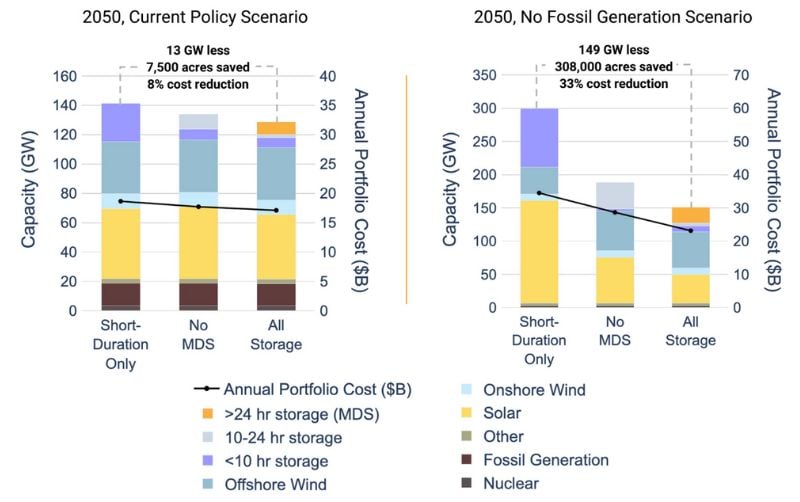
Cost-effective New England resource portfolios in 2050. Image used courtesy of Form Energy (Page 4)
Form Energy’s modeling shows that 23 GW of multi-day storage would avoid over-building 149 GW of new solar and short-duration resources across New England by 2050. Still, the region needs 4.5 GW/300 GWh of energy storage reserves by 2030 to prevent winter outages.
In a 2023 whitepaper, Form Energy estimated that combining 2.9 GW of multi-day storage and 1.6 GW of short-duration storage would be the lowest-cost option to maintain winter reliability.
The Maine installation is partially funded by a $389 million Department of Energy grant awarded to Power Up New England, a regional plan to add new transmission and storage capacity in Massachusetts, Maine, New Hampshire, Connecticut, Rhode Island, and Vermont.