Facebook
 Google
 GitHub
 Linkedin
Humans Not Required: Robotic Arms Charge EVs While Parked
The electric vehicle charging system can fully charge over two-thirds of the building's garage capacity within 24 hours.
The electric vehicle charging system can fully charge over two-thirds of the building's garage capacity within 24 hours.
The widespread adoption of electric vehicles faces significant challenges, particularly in urban areas. In densely populated city centers, parking comes at a premium for all cars, and for EV owners, finding a convenient and accessible spot with a charging station is even tougher.
A luxury condo tower in downtown Seattle aimed to solve these challenges by introducing an automated parking garage with robotic arms to assist in charging EVs. This infrastructure could provide a solution to the limited availability of EV chargers.
Automated parking. Video used courtesy of Sotefin
The EV Charging Infrastructure Challenge
The modern EV charging infrastructure comprises a network of charging stations ranging from Level 1 chargers (120 VAC, ~1.4 kW) to DC fast chargers (up to 350 kW), with charging speeds varying accordingly. While other options exist, the standard EV charging process involves locating a charging station and connecting the vehicle to the charging point via a physical connector.
However, charging infrastructure is limited, particularly in urban areas. The growing disparity between the number of EVs and available charging points is becoming increasingly problematic. For example, as of February 2024, the U.K. had 57,290 EV charging points across 32,575 locations. However, more is needed, with over 1 million EVs and 620,000 plug-in hybrids on U.K. roads.
In densely populated urban areas, the scarcity of available space for charging stations conflicts directly with the high demand for parking. Each charging point typically requires a dedicated parking space to accommodate EVs, but this reduces overall parking capacity. This problem is particularly acute in multi-unit dwellings, where residents often need access to personal charging options. Additionally, EVs’ long charging times, even with fast chargers, create logistical challenges in high-turnover parking areas, leading to charging station congestion and inefficient use of limited charging resources.
Automated Parking Meets Automated EV Charging
The Spire condominium in downtown Seattle has implemented a new solution to EV charging challenges. The building is augmented with an automated parking system integrated with robotic EV charging capabilities.
Designed by Parkworks, this system can fully charge up to 192 vehicles—over two-thirds of the garage's capacity—within 24 hours. The architecture combines computer-controlled elevators and a network of dollies to transport vehicles to available parking spaces underground.
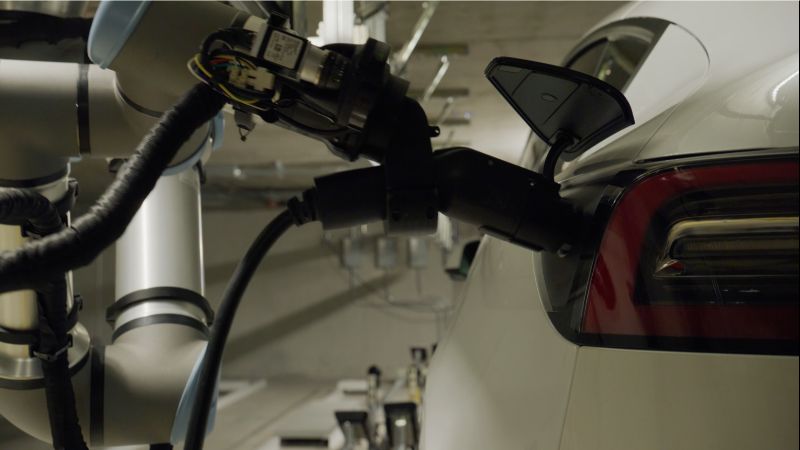
Robotic arm for EV charging. Image used courtesy of Reese Films
The system automatically moves EVs to assigned charging stations. A robotic arm then retrieves the appropriate charger and inserts it into the vehicle without human intervention. According to the team, this setup is designed to accommodate all types of EVs and can scale to 100% EV charging capacity if future demand requires.
A major benefit of this system is its flexibility, which allows it to maximize space efficiency in a confined urban environment. The system's automated nature also addresses security concerns associated with public charging stations, as the entire process occurs within the secure, automated garage environment. This integrated approach effectively tackles the charging infrastructure deficit and parking scarcity simultaneously, offering a scalable solution for multi-unit dwellings in urban areas.
Charged and Ready
Cities continue to wrestle with electrification challenges and sustainable transportation, and integrated approaches like Spire’s may become necessary. While the initial implementation is in a luxury setting, the concept holds promise for broader applications in various urban contexts. The technology also has the potential to evolve to include features like predictive charging based on user habits or integration with smart grid systems for optimal energy management.