Facebook
 Google
 GitHub
 Linkedin
Flying High With Solar+Storage: Airship Flies for 24 Hours
How could the blimp-like craft fly in darkness using only solar power?
New Mexico-based aerospace company Sceye has developed a high-altitude platform station (HAPS) that completed a full diurnal flight in the stratosphere using renewable energy.
Watch the Sceye Infinity launch. Video used courtesy of Sceye
The achievement marks the first time Sceye's airship has maintained flight over a designated area in the stratosphere for more than 24 hours, utilizing solar power during the day and battery storage for nighttime operation.
According to Sceye, the HAPS was launched at 7:36 a.m. MST on August 15 from the company's test facility in New Mexico and landed at 12:21 p.m. MST the next day after completing all its test objectives.
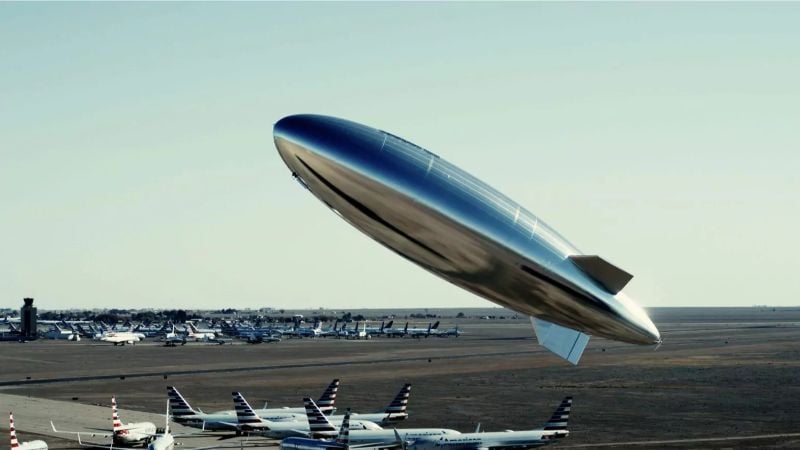
The HAPS is powered by solar energy. Image used courtesy of Sceye
Day and Night Solar Operation
A full diurnal flight spans the entire 24-hour cycle, covering both day and night. In its diurnal flight, Sceye’s airship maintained its position in the stratosphere over a designated area for more than 24 hours. This was achieved using solar power during daylight hours and battery energy at night.
The solar-battery combination is critical for long-duration flights because it allows a HAPS to remain airborne for extended periods, potentially for months or even years, without refueling. The successful completion of the diurnal flight demonstrates the airship's ability to operate continuously by harnessing renewable energy sources, a significant milestone for Sceye's stratospheric objectives and commercial applications.
How the HAPS Works
Sceye strategically used an airship design, eschewing traditional balloons and fixed-wing aircraft. This choice enables the platform to maintain geostationary capability while carrying and powering a payload far greater than any other available platform.
- Design: The Sceye HAPS is a helium-filled, blimp-like aircraft measuring 65 meters long. It is designed to launch vertically and ascend to altitudes between 60,000 and 65,000 feet. The airship has gallium-selenide and gallium-arsenide solar cells integrated into its structure, allowing it to harness solar energy efficiently.
- Renewable energy: During daylight hours, the solar cells charge onboard batteries, powering the airship overnight. This sustainable energy model enables the HAPS to remain airborne for extended periods, potentially months, without refueling.
- Stability and control: The combination of its buoyant design and renewable energy systems allows the HAPS to maintain a stable position in the stratosphere for extended periods. This capability is essential for its applications, such as providing internet access, environmental monitoring, and disaster detection.
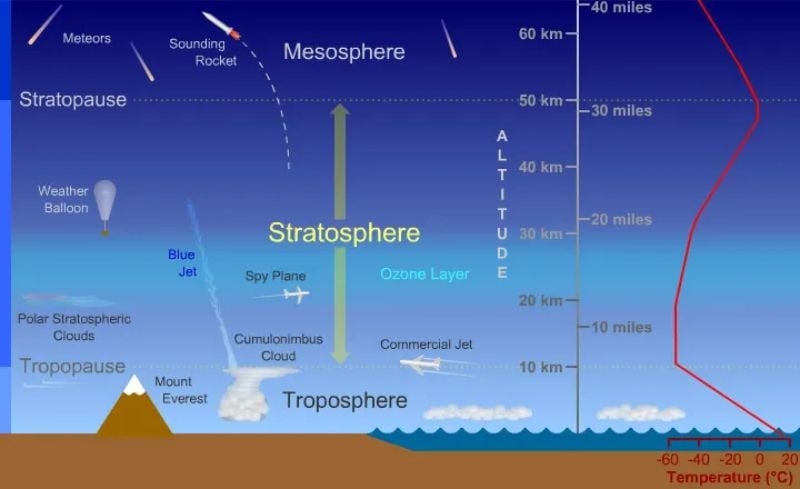
Atmospheric levels. Image used courtesy of Center for Science Education
- Automated systems: The Sceye HAPS uses automated flight software to enhance its reliability during critical flight phases, such as launch and ascent. This software aids in maintaining its geostationary position in the stratosphere.
- Instrumentation: An advanced payload suite includes stereo-optical cameras for creating precise elevation models and infrared cameras to predict and detect wildfires and methane leaks in real time. Synthetic aperture radar was also included in the payload to allow the platform to see through clouds, providing a view of the Earth in any weather and at any time.
- Applications: The Sceye HAPS is designed for various applications, including providing high-speed internet to remote regions, environmental monitoring, and disaster response. It plays a crucial role in initiatives like providing broadband access to the Navajo Nation and participating in a five-year study by the U.S. Environmental Protection Agency to monitor methane emissions.
- Performance: The recent flight demonstrated the airship's ability to hover in place and relocate as needed, showcasing its stability and resilience. This capability is essential for its intended applications, such as real-time climate disaster detection and connectivity solutions.
New Materials
The engineering prowess behind Sceye’s success comprises a team with a broad spectrum of expertise. Engineers combine knowledge from the worlds of the America’s Cup, aerospace, and cutting-edge academic research. This diverse background has been instrumental in pushing the boundaries of what is possible in high-altitude platforms.
The Sceye HAPS incorporates several advancements in material science to enhance its performance and durability in the stratosphere. The hull fabric of the Sceye HAPS, known as Sceye Skin, is a significant advancement in material science. It is five times stronger relative to its weight than traditional materials and is 1,500 times more gas-tight. This fabric is also resistant to UV and ozone, making it well-suited for the harsh conditions of the stratosphere. The airship's hull incorporates advanced lamination techniques for weathering layers, reducing weight without compromising strength. This is important for maintaining buoyancy and structural integrity at high altitudes.
The Sceye HAPS solar panels are made from copper-indium-gallium-selenide and gallium-arsenide cells. These materials are chosen for their high efficiency in capturing solar energy, which is crucial for powering the airship during daylight hours. The solar energy is stored in lithium-sulfur batteries, which have an energy density of about 400 Wh/kg. This high energy density is essential for maintaining power during nighttime operations. The airship’s diurnal capability is critical for long-duration flights, allowing the HAPS to remain airborne for extended periods, potentially for months or even years, without refueling.
Diurnal Flight Impact on Renewable Energy
Successfully completing a full diurnal flight demonstrates the airship's ability to operate continuously by harnessing renewable energy sources, which is a significant milestone for Sceye's stratospheric objectives and commercial applications.
Sceye's advancements in diurnal flight with renewable energy highlight the potential of high-altitude platforms to create a new infrastructure layer to provide a stable platform between drones and satellites. It offers unique solutions for connectivity and environmental monitoring.