Facebook
 Google
 GitHub
 Linkedin
400 or 800 V Electric Vehicle? No Worries; Eaton Can Charge Both
A battery configuration switch from Eaton wowed us at The Battery Show.
Among the products, technologies, and developments on display from the more than 1,150 suppliers and manufacturers last week at The Battery Show in Detroit, one of our favorite innovations was Eaton's battery configuration switch (BCS), designed to provide electric vehicle charging flexibility.
Eaton partnered with Munich Electrification to develop and market the bistable device, an advanced solution for 400-volt/800-volt dual-string battery packs in electrified vehicles. This means that 800-volt vehicles can be charged via a 400-volt charger. The technology was displayed and demonstrated at Eaton’s booth on The Battery Show’s expo show floor.
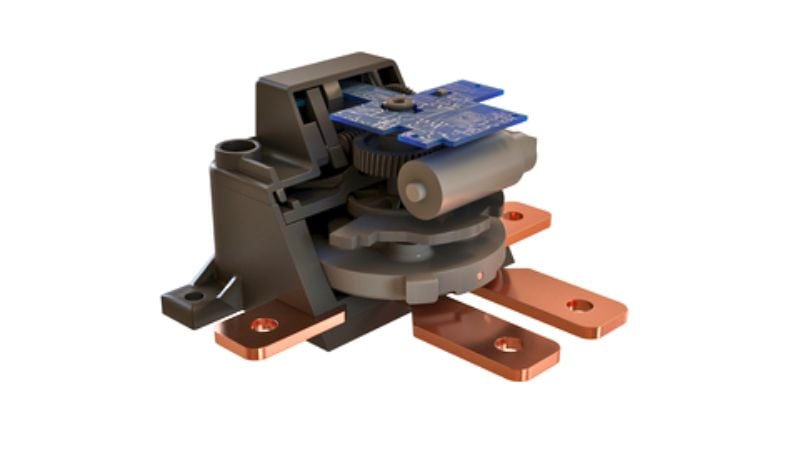
Battery configuration switch. Image used courtesy of Eaton
A Game Changer
While the number of 800-volt EVs grows, many charging stations are limited to 400-volts. Eaton’s BCS enables charging these higher-performance 800-volt vehicles within the existing 400-volt infrastructure by allowing for parallel series reconfiguration of the battery pack. It can also maintain stable battery conditions if or when the electronic control unit loses power. The switch’s bistable nature allows it to maintain its position (open or closed) without requiring continuous power. This improves efficiency during normal charging by eliminating the need for a constant hold current of traditional contactors.
The BCS includes a mechanical interlock to prevent pack short circuits during a vehicle crash or due to software bugs, contactor malfunctions, or other devices within the EV. In addition, the BCS can simplify the EV system and streamline packaging by reducing up to 12 components compared to conventional contactor switch systems. This includes three contactors and their associated wiring harnesses and busbars. Overall system efficiency is also enhanced by reduced contact resistance and a reduction in the number of contact points.
Bistable Switches
Primarily used in electric vehicles, bistable switches have applications in various fields, including automotive and light commercial vehicles, utility terrain vehicles, marine applications (such as boat battery management), and industrial electrical systems. Bistable switches require power pulses for both opening and closing operations. To close the switch, a pulse is sent in one direction, and to open the switch, a pulse is sent in the reverse direction. This differs from traditional contactors, which typically only require power to close and use a spring mechanism to open.
By providing enhanced flexibility, efficiency, and battery management safety, bistable battery configuration switches represent an important advancement in electrification technology across multiple industries.
Eaton and Munich Electrification
Founded in 1911, Eaton has a well-established history in the automotive and electrification segments.
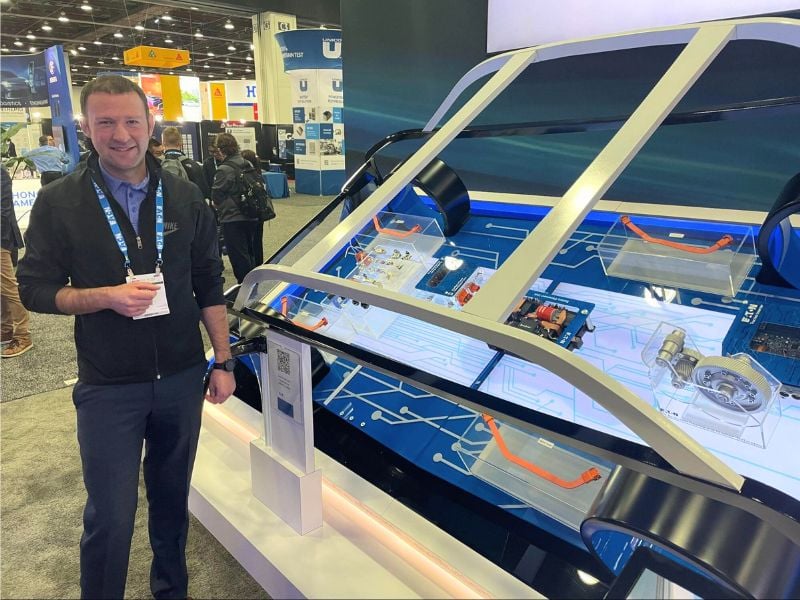
Eaton’s booth at The Battery Show. Image used courtesy of EETech
Munich Electrification GmbH has a much shorter, 10-year history. The Germany-based company has become a leading provider of innovative battery management solutions, including switching devices, automotive and stationary BMS designs, and sensor solutions. It has a strong interest in automotive electrification solutions, making it an excellent Eaton partner.