Facebook
 Google
 GitHub
 Linkedin
Uptime-Centric EV Charger Design Boosts Reliability, Convenience
Lynkwell’s Level 2 electric vehicle charger enhances performance and serviceability for commercial applications.
A major hurdle facing electric vehicle adoption is developing reliable and widespread charging infrastructure capable of meeting the needs of both consumers and commercial operators. Unlike traditional refueling stations for internal combustion vehicles, EV charging stations require more than just strategic placement—they must ensure consistent availability, performance, and easy use to build user confidence.
Unfortunately, many current EV chargers suffer from reliability issues such as software malfunctions, hardware failures, and inadequate maintenance, which lead to frequent downtime. The result? Inconsistencies that inconvenience drivers and discourage broader adoption of electric vehicles.
To address this issue, Lynkwell, a U.S.-based energy infrastructure development company, recently launched its XLynk Level 2 EV Charger. EEPower interviewed Schuyler Poukish, CEO and Co-founder of Lynkwell, to learn more about the release firsthand.
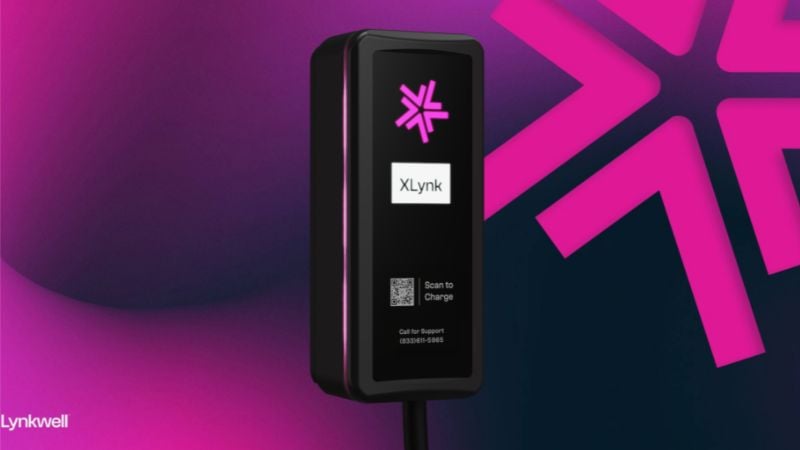
The XLynk Charger. Image used courtesy of Lynkwell
XLynk’s Uptime-Centric Architecture
According to Lynkwell, the XLynk Level 2 EV Charger is engineered to address the increasing demand for reliable, high-performance EV charging solutions. To this end, the charging station focuses heavily on ensuring operational reliability through an "uptime-centric" design, offering features that minimize downtime while maximizing performance.
Poukish explained, “True uptime requires the network software and hardware to be concurrently functional. At Lynkwell, we know that for our customers—whether they’re businesses, fleets, municipalities, utilities, or individual EV drivers—uptime isn’t just convenient; it’s an imperative."
This is achieved through the company’s EZ-Swap Faceplate: a modular, removable, and customizable element housing the electronic components necessary for the charger's operation. Importantly, using basic tools, the EZ-Swap Faceplate allows site operators to replace the faceplate in under five minutes. This quick-swap feature eliminates the need for full unit replacements or prolonged downtime when servicing is required. For instance, if a charger experiences a fault or needs an upgrade, the faceplate can be swapped out without needing a technician to dismantle the entire unit, which Lynkwell claims can decrease maintenance times by up to 90% compared to traditional charging units.
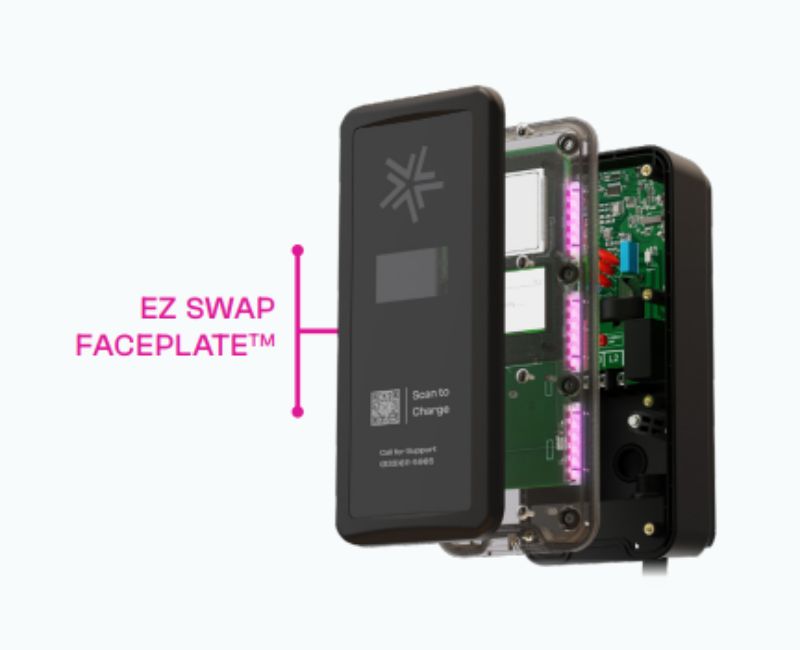
XLynk’s EZ-Swap Faceplate. Image used courtesy of Lynkwell
In addition, the charger supports automatic remote monitoring and diagnostics to ensure issues can be detected and resolved in real-time. With over-the-air updates, software-related problems are addressed without on-site intervention, reducing the potential for service interruptions.
Technical Specifications and Performance Metrics
From an electrical performance perspective, the XLynk is engineered for flexibility.
“We’ve engineered XLynk to simplify the charging experience, ensuring reliable infrastructure that supports the success of EV adoption and customer satisfaction,” Poukish said.
With this in mind, the charger operates with a configurable current limit, ranging from 12 amps to 48 amps, allowing it to cater to a broad spectrum of vehicle types and charging needs. The charger is rated for a voltage input of 208-240 VAC at 60Hz, delivering up to 11.5 kW of power at its maximum 48-amp configuration.
For safety, the XLynk includes integrated ground fault detection and auto-reset capabilities and offers open ground detection to enhance safety during charging sessions. The power measurement system boasts an accuracy of +/- 1.0%.
Networking and communication capabilities are also integral to XLynk’s performance. The charger is available in two configurations: gateway-enabled units (with Wi-Fi and LTE) and non-gateway units (Wi-Fi only). Up to nine non-gateway units can be connected to one gateway unit to facilitate scalable deployments across sites. Cellular connectivity is handled by an LTE CAT-M1 SIM card, designed to connect to the strongest available signal and switch towers automatically if the connection is disrupted.
Industry-First Lifetime Warranty
Finally, what really sets the XLynk apart from other commercial EV chargers on the market is its lifetime warranty. The warranty is structured on a pay-as-you-go basis, allowing site operators to manage costs while ensuring long-term coverage for their infrastructure. According to Lynkwell, this is the first time such a warranty has been offered for a commercial EV charger.
The charger is also Buy America-compliant, meaning it meets federal requirements for domestically sourced materials and components. This makes it eligible for various procurement programs, including the GSA Blanket Purchase Agreement and other state-level contracts, positioning Lynkwell as a key player in federal and commercial EV infrastructure initiatives.
Addressing EV Infrastructure Challenges
With its focus on reliability, serviceability, and environmental resilience, the XLynk is poised to play a significant role in expanding the availability and dependability of EV charging infrastructure across the U.S. and beyond.
Reflecting on the release, Poukish explained, "We believe that by tackling these reliability challenges head-on, we can contribute to a more dependable and widespread EV charging network, supporting both the immediate needs and long-term goals of our customers and the broader EV community."