Facebook
 Google
 GitHub
 Linkedin
Toshiba Launches Photovoltaic Photocoupler for High Voltage SSR
Toshiba's TLX9920 eliminates the secondary power supply in MOSFET gate drive circuits, delivering 5000 VRMS isolation in a compact SO6L package.
Most gate drive circuits need a separate isolated power supply on the output side. Toshiba's TLX9920 skips that requirement entirely. It's a photovoltaic-output photocoupler, which means it converts light from its internal LED into a DC voltage and uses that voltage to directly drive the MOSFET gate. This is particularly useful for high-side and back-to-back MOSFET configurations, where the gate sits above the load voltage and is difficult to bias with a standard supply.
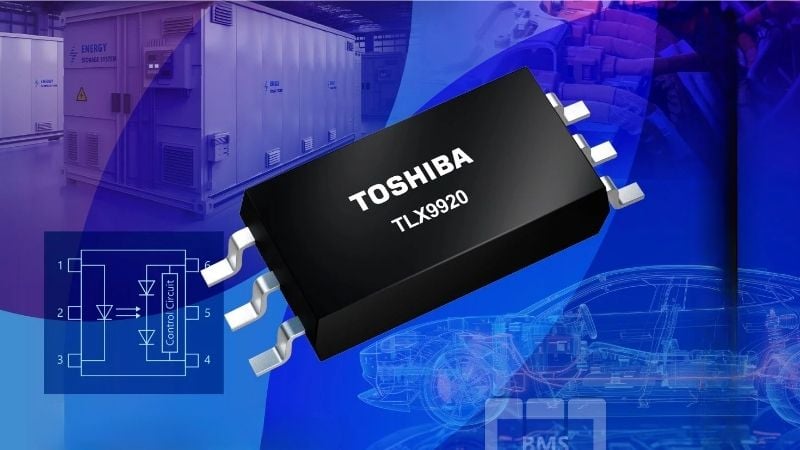
The TLX9920, with its internal circuit diagram, targets automotive and energy storage applications. Image used courtesy of Toshiba
The Problem With Standard Photocouplers
Solid-state relays are the cleaner, more reliable alternative to mechanical relays—no moving parts, no contact wear, no arcing. But they still need a way to switch power MOSFETs on and off, which means safely getting a control signal across a high-voltage isolation barrier.
Photocouplers do that job. An LED on the control side flashes a signal; photodetectors on the power side pick it up. No electrical connection crosses the barrier, only light. That part works well.
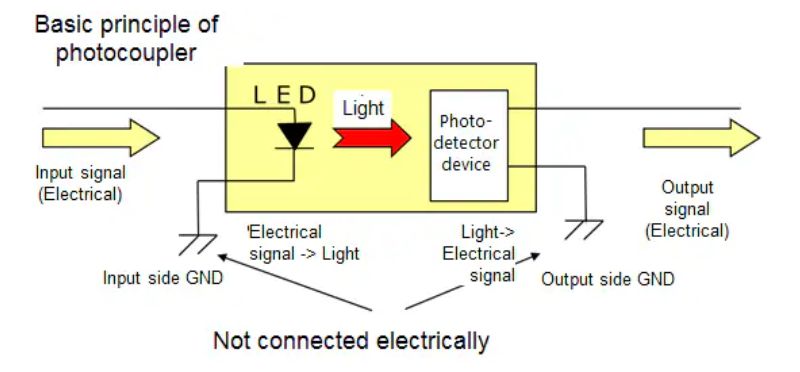
Basic working principle of photocouplers. Image used courtesy of Toshiba
Once the signal is across, the power side still needs its own voltage source to actually drive the MOSFET gate. That typically means adding a separate isolated DC-DC converter—extra components, extra board space, and one more thing to design around. In complex systems like electric vehicle battery management or industrial energy storage, where isolation barriers multiply, that overhead adds up fast.
The TLX9920 goes one step further. Its photodiode array doesn't just detect the LED's light; it also converts that light into an actual DC voltage that directly drives the MOSFET gate.
Specifications and Ratings
The TLX9920 is driven by an LED forward current of 10 mA, at which point it produces a minimum open-circuit output voltage (Voc) of 13.5 V and a minimum short-circuit current of 8 µA, sufficient to drive the gates of the power MOSFETs used in most SSR designs.
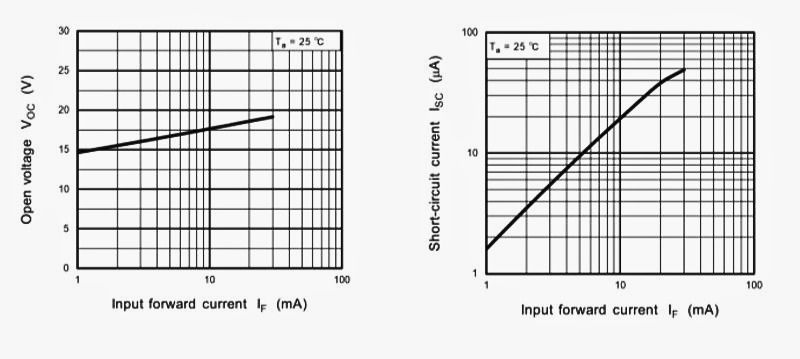
Characteristics curve of short-circuit current (ISC, µA) vs. LED forward current (IF, mA) (left) and open-circuit voltage (VOC, V) vs. LED forward current (IF, mA) (right). Image used courtesy of Toshiba Electronics
The TLX9920 is qualified to the AEC-Q101 standard, making it eligible for use in safety-relevant subsystems. Toshiba targets it primarily for EVs and hybrid-electric applications, including battery management systems, onboard chargers, and traction inverters, where the control-to-power boundary must withstand both sustained and transient high voltages.
The isolation specs reflect this. The device is rated at 5,000 VRMS minimum isolation voltage rating. Creepage distance, which is the shortest surface path between the input and output pins, is 8 mm, meeting the requirement set by IEC 60664-1 for equipment operating at 400 V or above in pollution degree 2 environments. A built-in discharge circuit also ensures the gate is reliably pulled low at turn-off, eliminating the need for an external pull-down component and further simplifying the design.
It operates across a temperature range of -40°C to +125°C and comes in a compact 6-pin SO6L surface-mount package measuring 3.84 mm × 10.0 mm × 2.1 mm.
The datasheet and selection guide are available on the Toshiba product page.
The Push Toward Supply-Less Isolation
As EV architectures add more isolated domains, such as cell-balancing circuits, gate drivers for multi-level inverters, and bidirectional DC-DC converters, each requiring its own isolated supply, the overhead compounds quickly. Photovoltaic-output photocouplers offer a way to trim that overhead at the component level.
Toshiba's expanding automotive photocoupler lineup suggests that the company is seeing demand beyond SSR designers, from anyone architecting a high-voltage isolated control path who would rather spend BOM budget on current-sensing accuracy or EMI filtering than on another isolated DC-DC module.