Facebook
 Google
 GitHub
 Linkedin
MITRAMAX and PV Power Tech Release 400Vdc HVPV Modules
MITRAMAX Energy and PV Power Tech announced the availability of their range of high voltage PV modules that continuously deliver automatically tracked peak output at high voltage of 400Vdc.
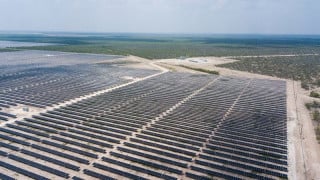
P. S. Deodhar, the Chairman of Mitramax Energy, the Indo-German joint venture company, and the former Electronics Advisor to Rajiv Gandhi, said that these HVPV modules reduce the installed cost and improve the efficiency of solar power arrays helping to increase the energy yield from such array by as much as 10 to 30%. According to the company, parallel arrays built with HVPV modules would effectively cost lower that the conventional "series-parallel" arrays in terms of its total energy yield.
According to the company, parallel architecture reduces the amount of hardware needed for a solar array, simplifies array wiring, and removes many design and installation constraints. While modules and inverters are the most visible and expensive components of a solar power installation, the string inverters in every string, the complex wiring, junction boxes, racks and other "balance-of-system" gear drive significant cost as well. The Mitramax technology will remove the need for most of this equipment and can thus cut total system costs by 5 to10%, even for large commercial installations. Further savings can be realized through simplified design and installation.
Each HVPV module has an integrated output high voltage cable with shock-safe snaptogether connector which connected to a bus bar on which each HVPV module delivers its peak power. This eliminates a large amount of custom on-site wiring. HVPV modules also provide distributed maximum power point tracking. This ensures that the inverter constantly operates within its optimal range, with each panel contributing to its full potential at all times, regardless of shading, installation angle, soiling, and other design and operational issues. This simplifies the task of designing an array, gives designers more flexibility, extends the life of system components, and increases power harvest by 10 to 30%.
By applying advanced dc power management technology to solar energy, the HVPV modules also allow what the company describes as an unprecedented number of such modules to be connected on a bus bar. According to Deodhar, unlike micro-inverter-based wiring technology, the Parallel Solar approach creates a dc bus that operates at a constant high voltage, allowing an installation’s dc-ac conversion to be handled by a single central inverter operating in its most efficient range. This approach means there is only one inverter connection to the outside power grid, rather than hundreds or thousands – greatly reducing the need for connection monitoring and management.