Facebook
 Google
 GitHub
 Linkedin
Microchip Launches 3.3 kV Power Modules for Solid-State Transformers
New HV-D3 mSiC silicon carbide phase leg modules enhance grid-to-rack efficiency and thermal robustness for hyperscale data centers.
Microchip Technology has announced the release of its 3.3 kV HV-D3 mSiC power modules, aiming to optimize power delivery architectures for AI data centers and high-voltage grid interfaces. These modules integrate silicon carbide MOSFETs and Schottky barrier diodes (SBDs) within an industry-standard 62 mm package footprint.
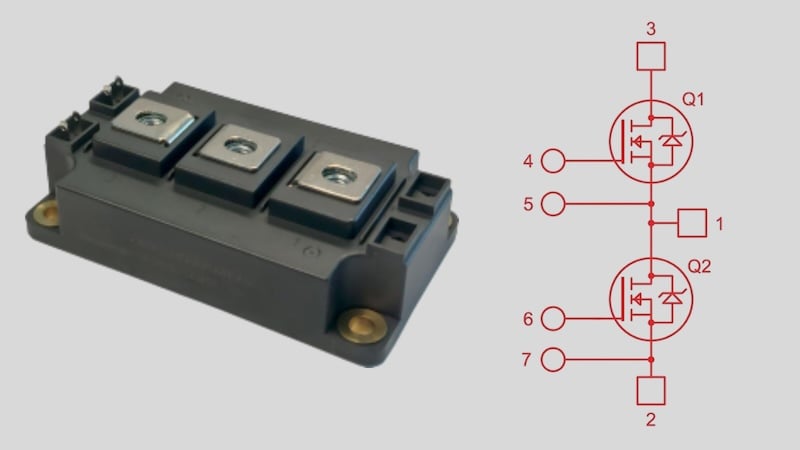
SiC MOSFETS are paired with anti-parallel Schottky barrier diodes. Images used courtesy of Microchip
Reducing Grid-to-Rack Conversion Stages
Traditional power delivery frameworks depend heavily on large, line-frequency transformers that require a sequence of descending voltage transformation steps. Each stage introduces additional thermal dissipation and structural footprint demands inside a facility.
Solid-state transformers use high-frequency semiconductor topologies that can deliver regulated DC power directly from the primary utility lines. Leveraging a 3.3 kV block enables engineers to cut down the total number of series-connected devices by approximately half compared to standard 1.2 kV or 1.7 kV options.
Package Reliability and Thermal Dynamics
High-voltage switching circuits impose severe thermal and electrical stresses that require specific material mitigation measures. The highest-current HV-D3 modules utilize a silicon nitride substrate to handle continuous power-cycling strains while maintaining superior thermal conductivity. This ceramic layer allows operators to implement higher power densities without requiring overly complex active cooling systems.

HV-D3 mSiC power modules enhance efficiency and thermal robustness for AI data center applications. Image used courtesy of Microchip
Externally, the module is housed in a plastic enclosure with a comparative tracking index rating of CTI 600. Combined with extended creepage and clearance distances, the enclosure satisfies the 6 kV electrical isolation requirements needed to sustain safe series operation in medium-voltage environments.
A copper baseplate and M6 power connectors ensure stable electrical contacts and reliable mounting directly to a system heatsink.
Scalable Topologies for High-Voltage Systems
Microchip has announced three products in the HV-D3 mSiC family:
- MSCSM330AM07CD3NG is a 3.3 kV SiC MOSFET phase leg power module. It is optimized for high currents up to 234 A due to its low 6.8 mΩ RDS(on).
- MSCSM330AM15D3NG is also a 3.3 kV SiC MOSFET phase leg power module. This lower-current design operates up to 120 A with a 13.5 mω RDS(on).
- MSCSM330DUM07CD3NG is a 3.3 kV, dual, common‑source SiC MOSFET power module supporting currents up to 234 at an RDS(on) of 6.8 mΩ.
To assist developers, Microchip has released an application note, a design guide, and device and simulation models.
Phase Leg Modules
The phase leg variants feature a high‑side and low‑side SiC MOSFET pair. They also include integrated anti-parallel mSiC Schottky barrier diodes alongside the primary MOSFET pairs.
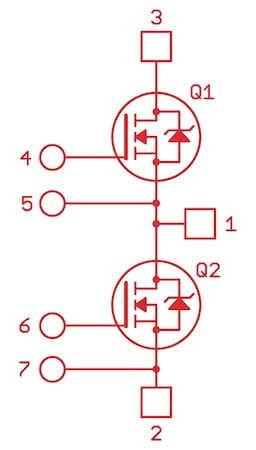
Schematic of the phase leg versions of the HV-D3 mSiC power modules. Image used courtesy of Microchip
The addition of these dedicated diodes minimizes both forward and reverse recovery losses while providing a positive temperature coefficient on forward voltage. This internal configuration reduces overall commutation ringing and drastically reduces losses compared with conventional body-diode conduction paths.
These phase leg module variants are designed as scalable building blocks. They can be integrated into motor drives, traction systems, and three‑phase inverters.
Dual Common Source Modules
The dual common source HV‑D3 mSiC modules also include integrated anti‑parallel mSiC SBDs. This configuration separates power and gate return paths, significantly reducing common‑source inductance.
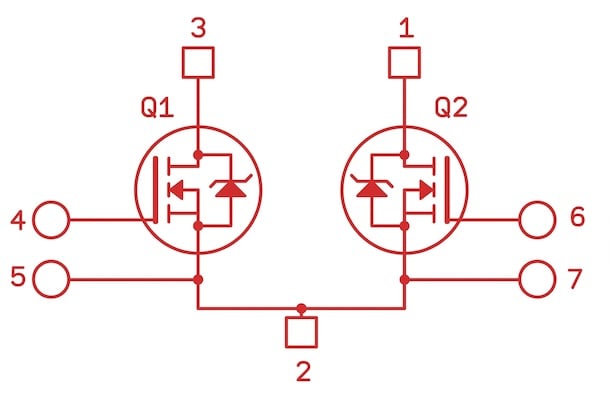
Schematic of the dual common source version of the HV-D3 mSiC power modules. Image used courtesy of Microchip
The dual common source variant is well-suited for advanced inverter topologies, high‑frequency DC‑DC converters, and PFC stages.