Facebook
 Google
 GitHub
 Linkedin
Mean Well Debuts Slim 200 W – 400 W Power Supplies for LED Displays
Three low-profile models rated at 40 A, 60 A, and 80 A swap the potentiometer for DIP-switch voltage selection, with redundant variants available for parallel setups.
Mean Well has introduced the UDP-200, UDP-300, and UDP-400, a trio of single-output power supplies built for LED display applications. They succeed the company’s HSP and UHP series, and the manufacturer points to a more compact size, higher power density, improved conversion efficiency, and better cost performance as the main gains. Gone, too, is the adjustable potentiometer; onboard DIP switches now handle output-voltage selection.
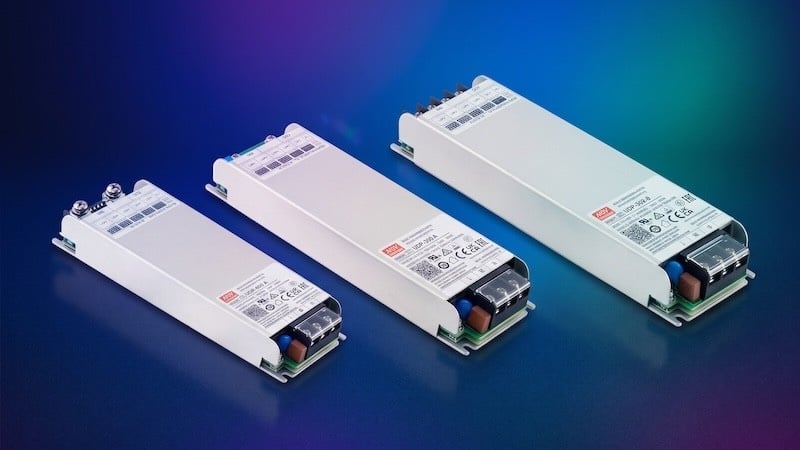
Mean Well’s new UDP-200/300/400 series
Every series offers three rated output voltages (4.2 V, 4.6 V, and 5 V) at a fixed rated current: 40 A for the UDP-200, 60 A for the UDP-300, and 80 A for the UDP-400. Because current stays constant within each series, rated power climbs in step with voltage.
Three Models, Side by Side
The data sheets break the lineup down as follows, with efficiency figures typical at 230 VAC input, rated load, and 25°C ambient:
- UDP-200: 40 A output; 168 W, 184 W, and 200 W at 4.2 V, 4.6 V, and 5 V; typical efficiency of 91.5%, 91.5%, and 92%; 150 × 50 × 19 mm (L × W × H); 0.24 kg.
- UDP-300: 60 A output; 252 W, 276 W, and 300 W; typical efficiency of 91%, 91.5%, and 92%; 165 × 50 × 26 mm; 0.39 kg.
- UDP-400: 80 A output; 336 W, 368 W, and 400 W; typical efficiency of 90.5%, 91%, and 92%; 200 × 50 × 26 mm; 0.46 kg.
Efficiency peaks at 92% on all three 5 V variants, while the lower-voltage versions surrender between half a point and a point and a half, with the UDP-400 showing the widest spread. Typical AC input current scales alongside output power: 2.4 A (115 VAC) and 1.2 A (230 VAC) for the UDP-200, 3.6 A and 1.8 A for the UDP-300, and 4.8 A and 2.4 A for the UDP-400. More information is available in the spec sheets for the UDP-200, UDP-300, and UDP-400.
Voltage Trim, Redundancy, and Protection
On each model, the DIP switch shifts the output across a 0.4 V window in 0.1 V increments: 3.8–4.2 V on the 4.2 V units, 4.2–4.6 V on the 4.6 V units, and 4.6–5.0 V on the 5 V units. The data sheets recommend making adjustments with the power off.
An R-suffix variant of each model adds built-in redundancy. Wire two units in parallel and, should one drop out, its partner takes over automatically, sparing the display a full shutdown. Combined load must not exceed the rated power of a single supply, and R-type efficiency runs slightly below that of the standard versions. Both versions are listed as in stock.
Protection covers short circuit, overload, overvoltage, and overtemperature, each handled in hiccup mode with automatic recovery once the fault clears. The overload threshold ranges from 105% to 180% of rated output power. Conformal-coated PCBs and a three-year warranty round out the package.
Input, Thermal, and Mounting Details
Input is universal: 90–264 VAC (or 127–370 VDC) at 47–63 Hz, with built-in active PFC delivering a power factor of at least 0.97 at 115 VAC and 0.95 at 230 VAC under full load. It tolerates a 300 VAC surge for five seconds, operating ambient temperature runs from –40°C to +70°C, and the series is rated for altitudes up to 5,000 m, though a 3.5°C-per-1,000 m derating applies above 2,000 m.

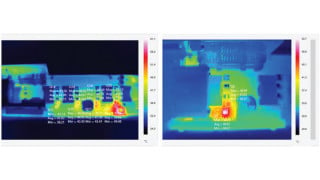
Application example for the UDP-200/300/400 series
Cooling is fanless, by free-air convection, but there is a catch worth flagging. To meet the published derating curve and static characteristics, mount each supply at the center of an aluminum plate (or a cabinet of equivalent dimensions): 380 × 380 × 4 mm for the UDP-200 and UDP-300, and 450 × 450 × 3 mm for the UDP-400. The surface should be flat and smooth, or treated with thermal grease. Derating may also be needed at low input voltages.
All told, the UDP family spans 200 W to 400 W in enclosures just 19 mm or 26 mm tall, a handy trait for slim sign modules. LED signage displays, moving signs, channel letters, and LED TV walls are the named targets, and the DIP-switch voltage selection plus the optional redundant versions should make life easier for integrators. Just be sure to budget room for that aluminum plate.
All images used courtesy of Mean Well.