Facebook
 Google
 GitHub
 Linkedin
Insulation Monitor Debuts Capable of 1000 V DC for EV Charging Stations
Carlo Gavazzi’s new insulation monitoring device targets unearthed DC systems to enhance safety and simplify integration in high-voltage Mode 4 DC electric vehicle charging stations.
Carlo Gavazzi Automation has introduced the DRC61 Series, a new insulation monitoring device specifically developed for unearthed DC (IT) systems operating up to 1000 V. Marking a strategic expansion of the company’s portfolio for electric vehicle (EV) charging infrastructure, the device is designed to continuously monitor the insulation resistance between DC lines and the ground.
In high-voltage DC environments—particularly Mode 4 DC fast charging stations—guaranteeing user safety requires early detection of both gradual insulation degradation and sudden system faults. Traditional insulation monitors designed for these elevated voltage levels often rely on external adapters, increasing the complexity and physical footprint of the charging platform.
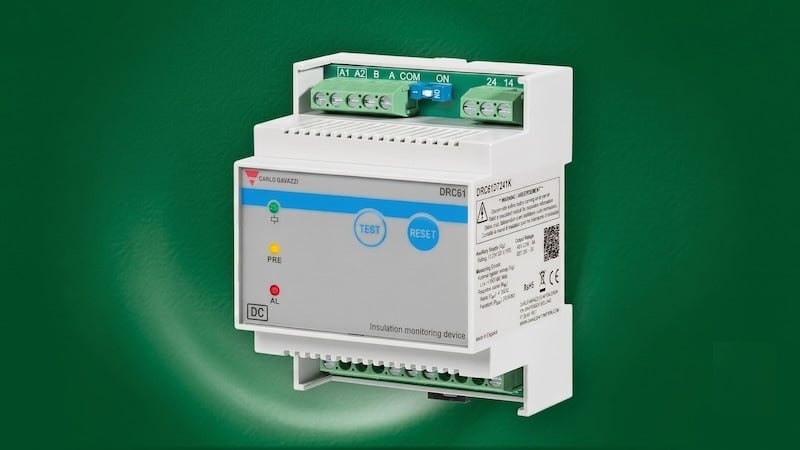
The DRC61 is an insulation monitoring device developed for unearthed DC systems up to 1000 V DC, targeting EV charging infrastructure.
By operating directly at up to 1000 V DC without supplementary components, the DRC61 aims to streamline system architecture, making integration easier for original equipment manufacturers (OEMs).
Single-Module High-Voltage Architecture
A primary engineering benefit of the DRC61 is its single-module configuration. It supports an operating range of up to 1000 V DC (with a maximum permanently admissible voltage of 1100 V DC), thereby eliminating the need for additional voltage adapters typically required by competing solutions. This results in a more compact and efficient architecture, which is critical in EV charging stations where space limitations and integration ease dictate design choices.
The DRC61 operates by superimposing a voltage measuring signal across the L+/L- and protective earth (PE) terminals. In the event of a breakdown, such as a fault between a live conductor and the ground, a measurable current flows. The device continuously monitors this signal and compares it against configurable threshold parameters, triggering respective pre-alarms or alarms if resistance falls below safe limits.
Digital Integration and Charging Compatibility
Beyond its high-voltage capability, the module introduces comprehensive configuration flexibility via Modbus RTU communication over a built-in RS485 port. The device features two configurable SPST relay outputs that default to a 500 kΩ pre-alarm and a 100 kΩ alarm setpoint. Providing distinct thresholds allows system operators to perform preventative interventions before sudden failures force unexpected equipment shutdowns.
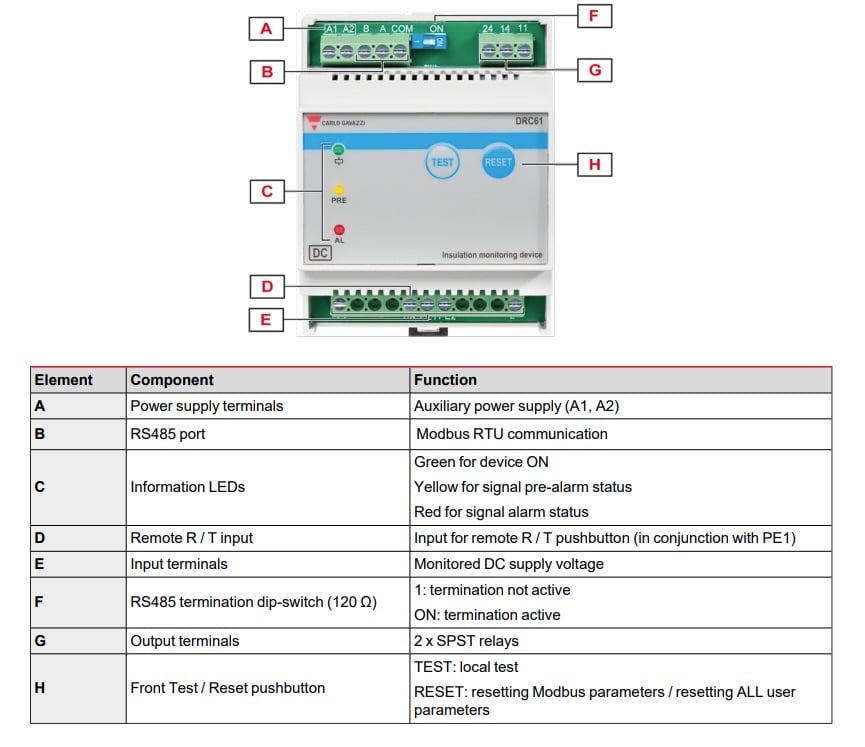
DRC61 structure diagram and component list. (Click on diagram to enlarge)
To simplify standardizing next-generation platforms, the DRC61 is compatible with both CCS and CHAdeMO charging architectures. It accommodates a maximum system leakage capacitance of 25 µF (and 1.6 µF per conductor in CHAdeMO mode). Furthermore, standard local and remote Test and Reset functions, combined with clear LED diagnostic indicators, assist engineers with rapid on-site troubleshooting.
Fail-Safe Operations and Reliability
Addressing the stringent safety constraints of the e-mobility sector, the DRC61 is UL listed in accordance with UL 2231-1 and UL 2231-2 standards. It incorporates a default de-energize-on-fault logic, establishing a fail-safe operational behavior in the event of critical conditions or a loss of auxiliary power. The unit also goes beyond basic insulation monitoring by including continuous system voltage monitoring for both undervoltage and overvoltage anomalies.
Moving forward, the hardware represents a compelling step for engineers designing high-power EV traction chargers, battery storage networks, and microgrids looking to maximize reliability without complicating the electrical footprint.
More information can be found in the DRC61 Series data sheet.
All images used courtesy of Carlo Gavazzi.