Facebook
 Google
 GitHub
 Linkedin
Infineon Unwraps High-Density TLVR Modules for Data Centers
The dual-phase trans-inductance voltage regulator modules aim to bring compact, high-efficiency power to AI and HPC workloads
Infineon has introduced a dual-phase power module featuring a trans-inductance voltage regulator (TLVR) architecture. The TDM22545T module features a proprietary inductor topology that Infineon claims is the industry’s first high-density TLVR solution intended specifically for AI data centers.
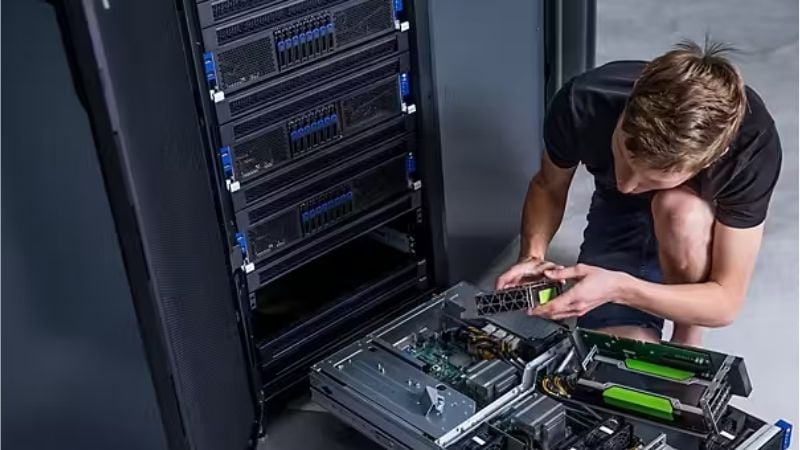
The TDM22545T is designed for high-voltage data centers. Image used courtesy of Infineon
TDM22545T Technical Details
The TDM22545T comprises two fully integrated synchronous buck converters, each with a smart power stage and a TLVR inductor. Packaged within a 10 mm x 9 mm x 4.8 mm land-grid array, the module delivers 80 A continuous and up to 120 A peak current per phase, for a combined 140 A capability.
The device’s power stages are based on Infineon’s OptiMOS-6 trench MOSFETs, which may be optimized for low conduction losses and fast switching at frequencies up to 2 MHz. Input voltage spans 4.25 V to 16 V, and regulated outputs range from 0.225 V to 2 V at 12 V input. The device integrates unique gate-driver circuitry that helps minimize propagation delay and switch-node ringing to improve overall system efficiency at sub-1 V output levels.
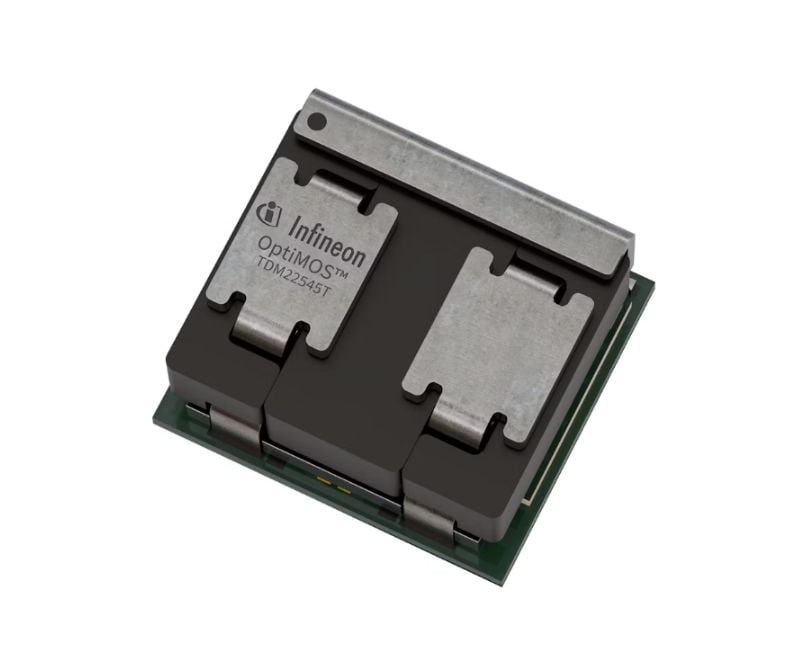
The TLVR device. Image used courtesy of Infineon
One unique feature of the device is its TLVR inductor structure. Embedding the inductors within the package reduces the need for discrete decoupling capacitors traditionally used to stabilize the load. In that way, the architecture simultaneously decreases power-delivery network (PDN) impedance, shrinks the total regulator footprint, and improves transient response during current surges. According to Infineon, in vertical power-delivery (VPD) configurations, the same TLVR topology can cut PDN losses by as much as 50% relative to lateral top-side designs.
Other features include thermal and electrical monitoring implemented through on-chip current and temperature sensing, where the module outputs a 5 µA/A current-sense signal and an 8 mV/°C temperature coefficient for analog telemetry. A bootstrap “auto-refresh” circuit maintains capacitor charge integrity to ensure stability during fast load transitions, and a dedicated DEEP SLEEP mode reduces quiescent current to approximately 32 µA per phase.
Trans-Inductor Voltage Regulation
Trans-inductor voltage regulation offers a unique approach for power modules to handle energy storage and load dynamics. Where traditional multiphase converters employ separate inductors and large capacitor banks to maintain voltage stability across each switching cycle, TLVR designs integrate inductive elements within the regulator’s main circuit. The effect is to create a mutual inductance between phases that unlocks faster current redistribution and reduces effective output inductance.
_versus_TLVR_(right).jpg)
Multiphase buck regulation (left) versus TLVR (right). Image used courtesy of Texas Instruments
In high-performance compute environments, processors draw current that can fluctuate from a few amperes to hundreds within microseconds. This challenge is confounded when operating from sub-1 V rails. The TLVR approach shortens the current-loop path and improves control bandwidth so that the regulator can recover from transient events more rapidly and with less voltage droop.
Because the integrated inductors reduce both the physical footprint and the required decoupling capacitance, TLVR designs simplify board layouts and mitigate parasitic effects that degrade signal integrity.
Finally, thermally, the co-packaged inductors distribute heat more evenly across the module surface, improving conduction to the PCB and system heatsink. Thermal uniformity supports higher continuous current densities without exceeding component temperature limits.
Compact Power, Expanding Compute
Infineon’s OptiMOS TDM22545T is exciting because it brings TLVR architecture into production-grade power modules. For system designers confronting ever-higher current densities and space constraints, the module offers a means to deliver stable, low-voltage power with fewer external components and improved transient behavior.