Facebook
 Google
 GitHub
 Linkedin
Allient Releases GaN-Based Controller for Drone Propulsion Systems
This new electronic speed controller pushes efficiency boundaries to enhance professional drone propulsion systems and streamline mission-specific configurations.
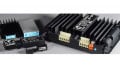
Allient has introduced the Vyxalon Apex Drone Drive, an electronic speed controller (ESC) designed for professional drone propulsion systems. The primary advancement of this drive is its utilization of advanced Gallium Nitride (GaN) power technology to deliver high propulsion efficiency and reliability for mission-critical unmanned aerial applications.
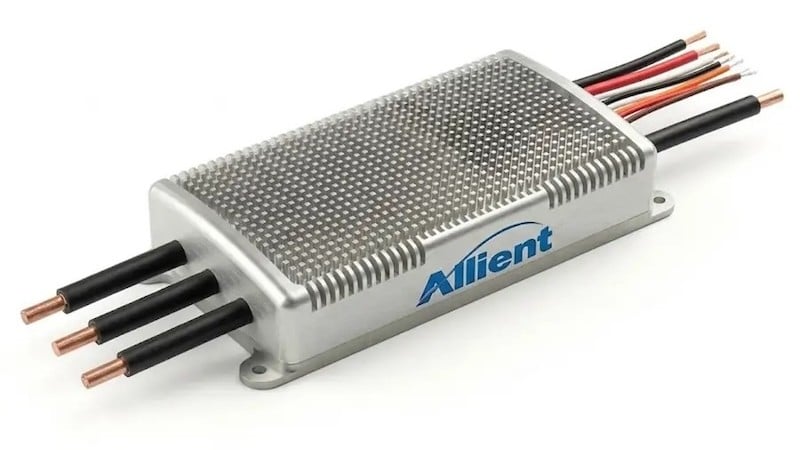
The Vyxalon Apex Drone Drive is an GaN-based electronic speed controller (ESC) crafted for professional drone propulsion systems.
Traditional drone electronic speed controllers often face limitations regarding power density and thermal management in demanding environments. Pushing past these thresholds with GaN technology allows aerospace manufacturers and tier-one defense suppliers to extract greater performance and reliability from existing unmanned flight platforms.
Gallium Nitride Architecture and Field-Oriented Control
Integrating GaN technology directly impacts the power efficiency and switching capabilities of the speed controller. By pairing this power architecture with high-speed sensorless and encoder-based Field-Oriented Control (FOC), the drive enhances overall flight performance and minimizes energy losses compared to conventional silicon-based designs.
This efficiency translates directly into higher power density within the drive assembly. It gives aerospace engineers the flexibility to achieve greater propulsion performance and optimize heavy-lift or long-endurance platforms without increasing the overall physical footprint of the electronic control unit.
Streamlining Flight Range and Mission Configurability
The drive’s thermal and energy efficiency fundamentally alters the design trade-offs associated with drone flight times. Because the speed controller inherently manages thermal losses more effectively, operators can maximize flight range and overall uptime. Engineers can optimize the system for longer endurance, which directly boosts flight efficiency in demanding operational environments.
In addition to its power capabilities, the Vyxalon Apex is engineered for low-noise and low-vibration operation. It features field-programmable tuning, empowering operators to adjust performance parameters in the field to maximize mission-specific configurability.
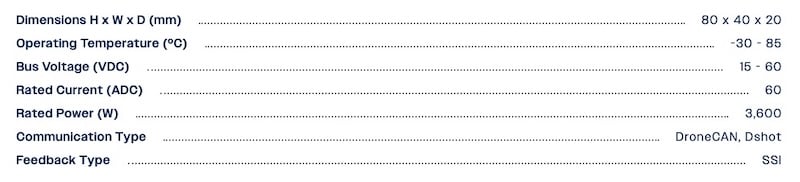
Specification overview of the Vyxalon Apex Drone Drive
Reducing the dependency on inefficient or bulky legacy speed controllers has a cascading positive effect on the entire unmanned architecture. By migrating to a more compact electronics package, designers can shave critical weight off the vehicle. The resulting reduction in mass directly enhances the overall energy efficiency of the platform, lowering battery consumption and maximizing the practical flight range.
The data sheet for the Vyxalon Apex is gated and requires registration.
New Integration Options and Defense Compliance
This architectural flexibility also opens up new possibilities for system integration. The drive includes advanced protection and diagnostic features, alongside support for multiple communication interfaces, ensuring it can seamlessly integrate into modern, complex drone control networks.
A critical engineering benefit of the new module is its adherence to strict defense industry standards. The Vyxalon Apex Drone Drive is engineered to satisfy National Defense Authorization Act (NDAA) supply chain requirements and will be cataloged within the Defense Contract Management Agency (DCMA) Blue UAS Framework.
This hardware appears well suited for defense, industrial, robotics, and agriculture drone platforms looking to maximize power density, increase flight endurance, and meet rigorous military supply chain standards.
All images used courtesy of Allient.