Facebook
 Google
 GitHub
 Linkedin
4 Companies Address Energy Needs With High-Performance Power FETs
STMicroelectronics, Magnachip, Diodes Incorporated, and Toshiba have released upgraded MOSFETs to meet growing challenges in server and automotive power systems.
Automotive and data center architectures have embraced a move to 48 V bus architectures. While this higher voltage, up from 12 V, helps decrease current and cabling demands, it also creates new challenges for the underlying power circuitry. Helping to support this transition, STMicroelectronics, Magnachip, Diodes Incorporated, and Toshiba each announced a series of N-channel power MOSFETs.
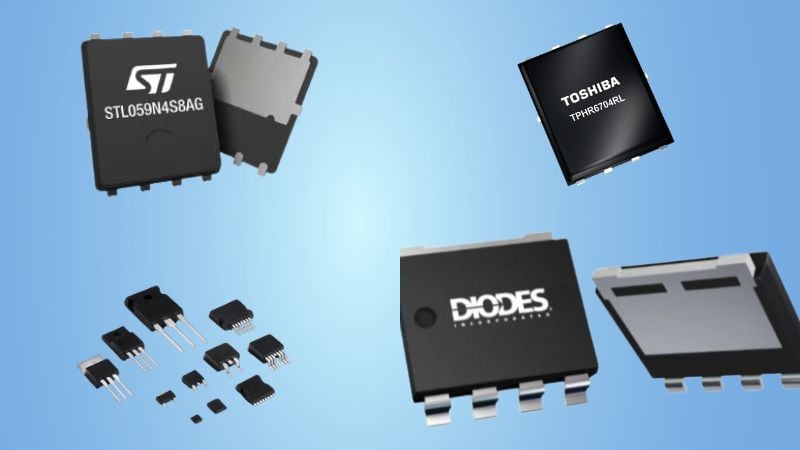
Power MOSFETs.
STMicroelectronics Smart STripFET F8 Technology
STMicroelectronics has launched its Smart STripFET F8 series of 40- and 100-V N-channel FETs for automotive. With reduced internal capacitances and gate charge, the new series is meant to achieve lower switching losses and higher conversion efficiency.
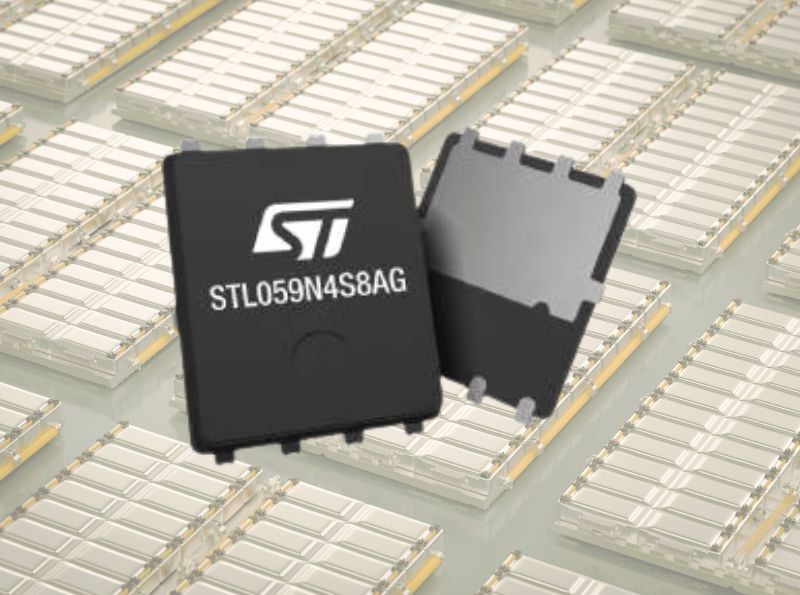
STMicroelectronics’ flagship STL059N4S8AG. Image used courtesy of STMicroelectronics
The flagship device based on the architecture, STL059N4S8AG, is a 40 V N-channel enhancement-mode MOSFET with an RDS(on) of 0.59 mOhm, packed in a PowerFLAT 5x6 with wettable flanks. It also supports a continuous current rating of 420 A and offers stable operation up to 175°C.
Engineers can also look forward to the upcoming STK035N4S8AG, which will further lower resistance to 0.35 mOhm to support 780 A current ratings in advanced battery management systems.
Diodes Incorporated PowerDI8080-5 Portfolio
48 V automotive designers may also benefit from Diodes’s expanded PowerDI8080-5 portfolio, led by the 100 V-rated DMTH10H1M7SPGWQ. This MOSFET offers a maximum RDS(on) of 1.5 mOhm and employs copper-clad die bonding to achieve a junction-to-case thermal resistance (RthjC) of 0.3°C/W.
With high thermal performance, the device could handle drain currents up to 847 A for power steering and braking systems.
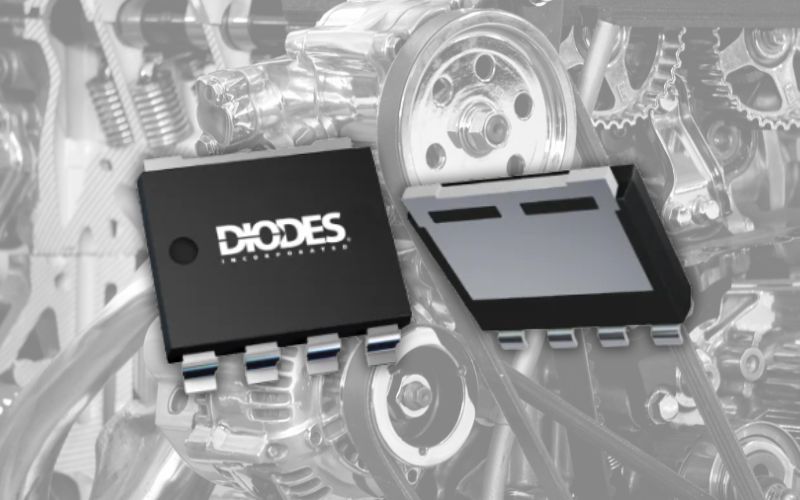
Reference package for Diodes Incorporated’s PowerDI8080-5 portfolio. Image used courtesy of Diodes Incorporated
For lower-voltage 12 V applications, Diodes offers the 40 V DMTH4M40SPGWQ with a maximum RDS(on) of 0.4 mOhm. Because the PowerDI8080-5 package occupies 64 mm^2, it requires approximately 40% less board space than traditional TO-263 packages, thereby enabling much higher power density in motor drive stages.
Magnachip 8th-Generation MV MOSFETs
Magnachip has released its 8th-generation Medium-Voltage (MV) MOSFET family. According to the company, these products use Shielded-Gate Trench (SGT) technology to deliver a 40% increase in current density over previous generations.
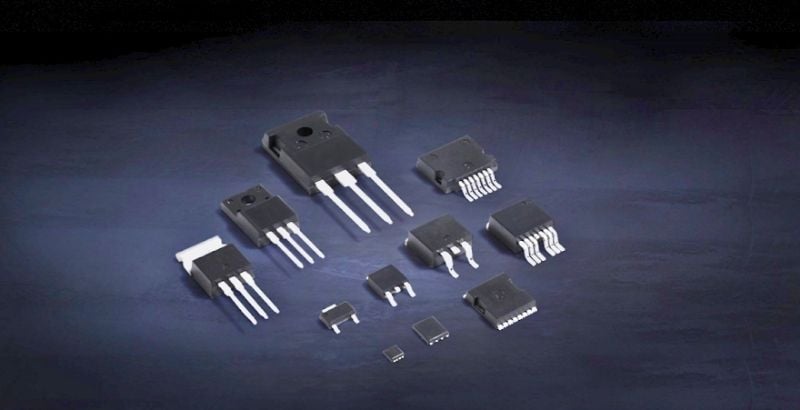
Magnachip’s 8th-generation MV MOSFET family. Image used courtesy of Magnachip
The 60V MDU060N010PSVRH offers a 1.05 mOhm RDS(on) and switches 60% faster than its 7th-generation predecessors for improved efficiency in the synchronous rectification stage of server power supplies.
Beyond the MDU060N010PSVRH, Magnachip offers many other options, including the MDU040N007PSLVRH, which features a 0.7 mOhm RDS(on) and a 1.8 V threshold voltage.
The whole family meets JEDEC standards and supports operating temperatures up to 175°C.
Toshiba U-MOS11-H Process Technology
Finally, Toshiba provides another path to increased efficiency with the TPHR6704RL, a 40 V MOSFET fabricated on its latest-generation U-MOS11-H process. This technology enables the device to achieve a maximum RDS(on) of 0.67 mOhm at a gate-source voltage (VGS) of 10 V for a 21% reduction in resistance compared to earlier generations.
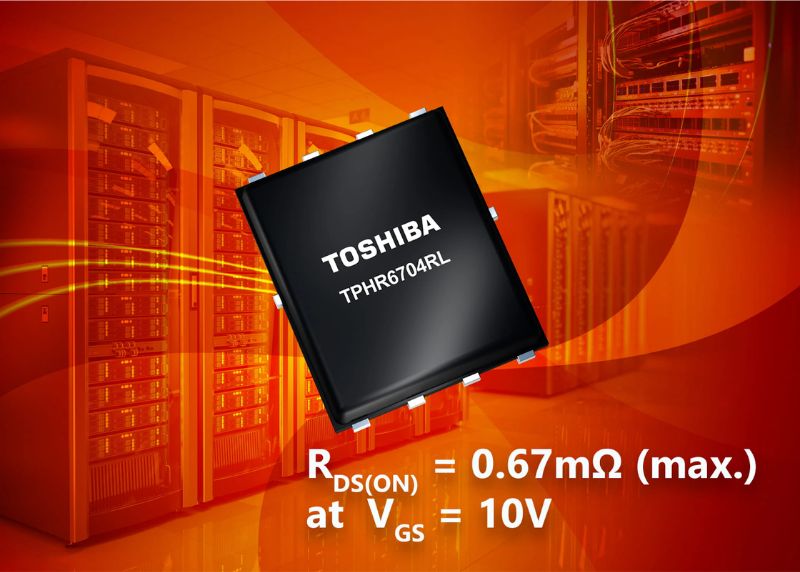
Toshiba’s TPHR6704RL. Image used courtesy of Toshiba
Beyond low resistance, Toshiba optimized the total gate charge (Qg) to 88 nC to improve switching efficiency, resulting in a 37% improvement in the RDS(on) x Qg figure of merit. Designers can integrate this device using the SOP Advance (N) package for high-footprint compatibility.
Improving Power Density in Tomorrow’s Systems
As 48 V adoption continues to grow in automotive and data center applications, higher-rated and higher-performance N-channel FETs will be needed to lower conduction losses and boost thermal performance and power density. While each manufacturer takes a distinct approach, all converge on the same goal of delivering more efficient power conversion in space-constrained designs.