Facebook
 Google
 GitHub
 Linkedin
‘Radioactive Batteries’ Could Last Years
Researchers have developed an advanced battery powered by beta rays from radioactive carbon isotopes. The semi-permanent device could operate for years without recharging.
Nuclear batteries represent the latest frontiers in energy conversion technology. They harness the decay of radioactive isotopes to unlock superior longevity and efficiency, operating for years or even decades without recharging. Betavoltaic cells, which pull energy directly from radioactive beta particles, are particularly promising due to their durability and long service life. As non-thermal conversion devices, they’re also resistant to temperature degradation.
Researchers from South Korea’s Daegu Gyeongbuk Institute of Science and Technology (DGIST) have developed an advanced betavoltaic cell to build on these benefits using carbon 14 (14C) as the radioactive source. 14C isotopes offer high energy density and a long half-life of 5,730 years.
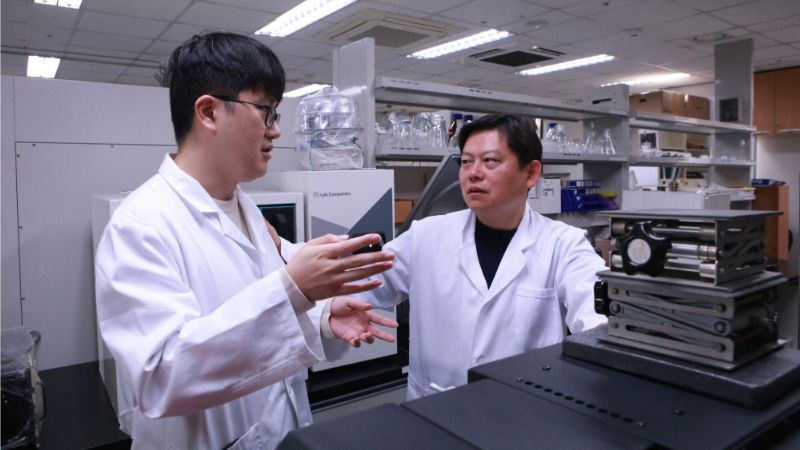
Su-il In and Hong-soo Kim of DGIST’s Department of Energy Engineering. Image used courtesy of DGIST
The dual-site design improves beta-ray electron absorption by treating both the anode and cathode with a beta-radiation source. The researchers also coated the anode in ruthenium (Ru)-based dye, which acts as a charge-generating layer, while the radioactive isotope, citric acid, minimizes energy losses. On the cathode, they synthesized citric acid into carbon isotope nanoparticles to boost beta-radiation energy density.
The research results, published in the Journal of Power Sources, show the Radioactive Isotope Dye-sensitized Betavoltaic Cell (d-DSBC) exhibited high power density and energy conversion efficiency.
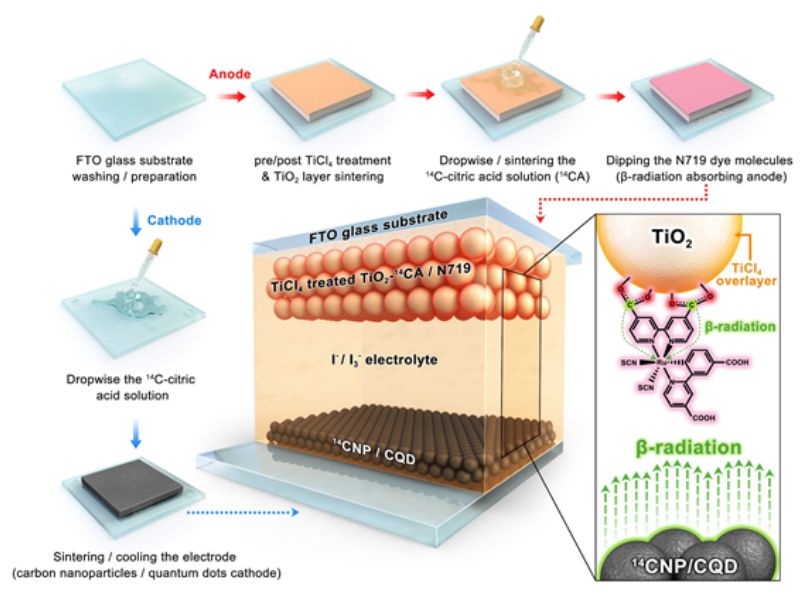
Schematic showing the manufacturing method for the beta cell. Image used courtesy of DGIST (Figure 1)
What Are Betavoltaic Cells?
Betavoltaic cells, first developed in the 1950s, generate electricity with high-energy electrons emitted from the decay of radioisotope sources like carbon. Though they ultimately provide less power than conventional electrochemical batteries, betavoltaic devices are gaining traction for their superior durability and long-term stability.
Betavoltaic batteries are primarily used for small-scale applications requiring continuous power, like medical implants and space satellites. However, ongoing improvements to energy density could make the technology suitable for electric vehicles, deep-sea equipment, drones, and other higher-power markets.
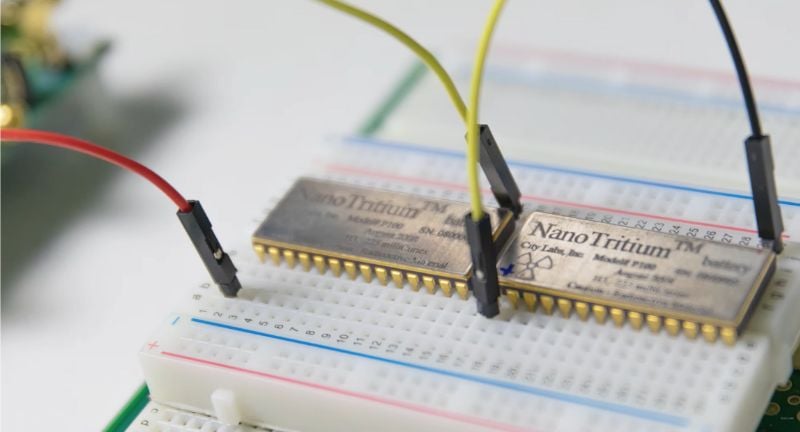
City Labs’ Nano Tritium battery. Image used courtesy of City Labs
Several companies are commercializing betavoltaic cells with some impressive features. China-based BetaVolt, for example, claims its cells last 50 years, sourcing energy from radioactive nickel-63. Florida-based City Labs uses the hydrogen isotope tritium to unlock a 20-plus-year lifespan.
Engineering a Next-Gen Betavoltaic Cell
Many betavoltaic cells use semiconductors as radiation absorbers, but raw materials can be expensive and difficult to source. The DGIST researchers wanted to explore a combination of cheaper cell components with comparable or superior performance.
The team opted for carbon isotope treatment rather than semiconductors for the anode. The anode was treated with citric acid and a Ru-based, series N719 dye on a titanium dioxide (TiO2) electrode, as dye-sensitized cells offer a high power conversion efficiency.
_alongside_a_radioactivity_meter_(right).jpg)
The d-DSBC cell electrode and battery (left) alongside a radioactivity meter (right). Image used courtesy of DGIST (Figure 2)
First, the researchers coated the anode’s TiO2 layer with a citric acid radioactive isotope, followed by the Ru dye. This approach is based on the team’s previous research demonstrating high performance due to the dye absorbing beta radiation rather than TiO. Citric acid between the N719 dye and titanium dioxide forms a bond with high stability and energy conversion.
The cathode comprises a radioactive isotope of carbon nanoparticles, which have a high surface-to-volume ratio and thus are used to adapt the electrode surface. Carbon nanoparticles also enable high electrical conductivity and heat resistance.
In developing the cathode, the researchers synthesized radioisotope carbon nanoparticles and quantum dots (nano-scale semiconductors) by drying and firing citric acid on a fluorine-doped tin oxide electrode, a conductive material with good electrochemical stability. The cell operates by treating liquid electrolytes between the two electrodes.
Results Support Dual-Site, Dye-Sensitized Design
The test results were promising, as d-DSBC demonstrated a high power density per radioactive source and a 2.86% energy conversion efficiency, generating power for more than 100 hours.
The cell generated 65,850 times (6.585 x 104) more electrons than it emitted. It also exhibited a high short-circuit current density (31.00 nA cm−2) and open-circuit voltage (86.4 mV).
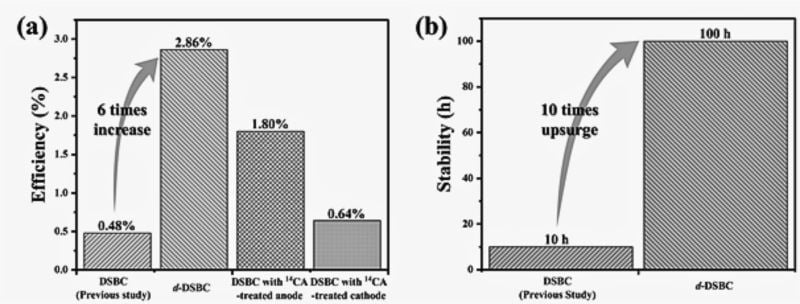
Performance charts for the d-DSBC battery cell. Image used courtesy of DGIST (Figure 3)
The results build on the team’s previous cell iteration in 2020. The dual-site approach—applying the radioactive isotope (citric acid) source to the anode and cathode—improved the power conversion efficiency by six times and stability tenfold. By treating both with radioactive isotopes, the researchers aimed to minimize the drop in beta radiation energy with distance and improve charge collection and efficiency in the anode, anchored by the N719 dye and TiO2 particles.
The team plans to improve the cell’s performance, stability, and mass production design in future research.