Facebook
 Google
 GitHub
 Linkedin
Powering Lunar Life With Moon Dust Solar Panels
Scientists say it’s possible for lunar astronauts to make solar panels using dust from the lunar surface. The panels could power a future moon base.
The coming years will see an unprecedented diversity of lunar missions, including government-led and commercial efforts, with a strong focus on the lunar south pole, resource utilization, and eventual human settlement.
Watch a simulation of the next moon landing. Video used courtesy of NASA
One key to building a sustainable presence on the moon will be managing available resources, including solar energy. However, transporting solar panels to the moon is expensive and can take up valuable space for other supplies. Instead, what if astronauts could create solar panels by using materials on the lunar surface—in essence, moon dust? Researchers are exploring a way to make it possible.
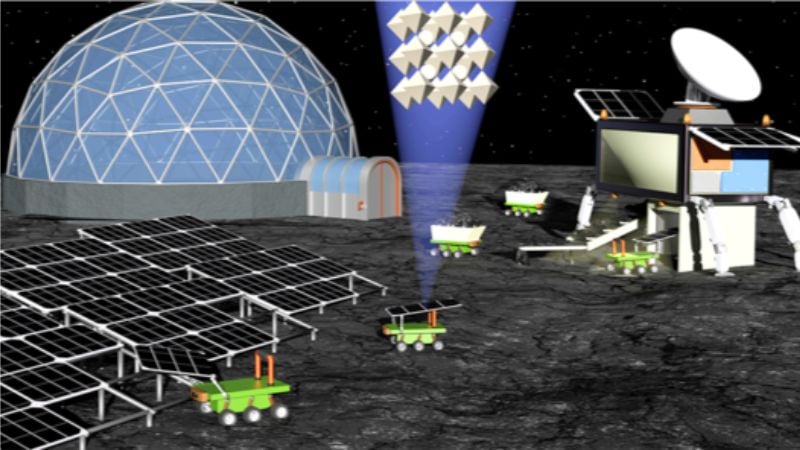
Concept of building solar panels on the moon. Image used courtesy of the University of Potsdam/Sercan Özen
Planned Moon Missions
NASA’s Artemis program aims to return humans to the Moon by the decade’s end. The Artemis II (crewed lunar flyby) is planned for 2026, and the Artemis III (crewed lunar landing) is targeting 2027. Other countries, including China, India, Russia, Japan, South Korea, and Israel, all have active programs to land on the moon.
NASA’s Artemis program also aims to establish a sustainable human presence at the lunar south pole, with the Artemis Base Camp as the first permanent outpost, planned for the 2030s. China and Russia are jointly developing the International Lunar Research Station (ILRS), with plans for a nuclear-powered base at the lunar south pole, targeted for completion by 2035, with expansion planned by 2045.
Making Solar Panels From Regolith
The moon’s surface material, Regolith, is rich in oxygen (45% by weight), silicon (20%), aluminum (10-18%), iron (~14-17%), and titanium (up to 8%). This makes it a viable construction material for habitats, landing pads, and radiation shielding.
The University of Potsdam, in collaboration with other German institutions, has pioneered a project to create solar panels directly on the Moon using lunar regolith as the primary raw material. This concept eliminates the need to transport heavy, costly solar panels from Earth.
The Potsdam team has developed a process where simulated lunar regolith is melted to form "moonglass." This glass is then combined with an ultra-thin layer of perovskite crystal (a highly efficient solar cell material) to create a functioning solar cell.
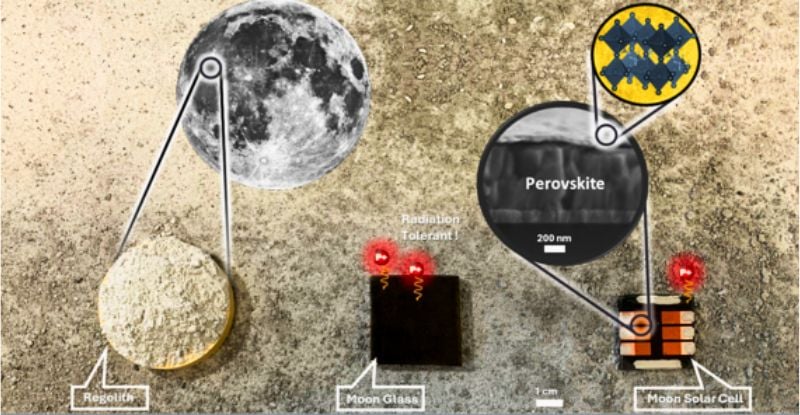
Making solar panels from regolith. Image used courtesy of the University of Potsdam/Felix Lang
The process involves heating lunar regolith to around 1,550°C, a temperature achievable on the Moon using concentrated sunlight via mirrors or Fresnel lenses. The resulting moonglass can be produced without complex pre-processing, making the approach highly scalable and practical for lunar conditions. Current prototypes have achieved efficiencies between 8.5 and 12%. Simulations suggest that efficiencies could reach 17.5 to 23% through further optimization and impurity removal.
The moonglass produced through this process is naturally resistant to radiation, a crucial property for the lunar environment, thanks to iron impurities in the regolith. This resistance helps maintain performance over time, unlike conventional glass, which darkens under space radiation. Significantly, by manufacturing the glass substrate of the solar panel on the moon and only transporting a small amount of perovskite from Earth, the team estimates a 99 percent reduction in launch mass.
A 1 kg of perovskite brought from the Earth could yield up to 400 square meters of solar panels produced on the lunar surface. The Potsdam team is working on increasing efficiency further by refining glass thickness and removing some of the impurities. They are also seeking funding for a demonstration mission to test the technology on the moon.