Facebook
 Google
 GitHub
 Linkedin
ORNL Test Bed: Grid Hardening With Transmission Line Coating
Oak Ridge National Laboratory is testing coating material that could bolster transmission lines.
Transmission lines face increasing strain as they must carry higher loads over longer distances, often through challenging environmental conditions. Aging infrastructure compounds these challenges, with many lines operating well beyond their original design capacities, leading to inefficiencies, safety risks, and reliability concerns.
Oak Ridge National Laboratory (ORNL) is testing a coating material that can improve transmission line longevity. The material could increase the grid’s capacity without a complete overhaul.
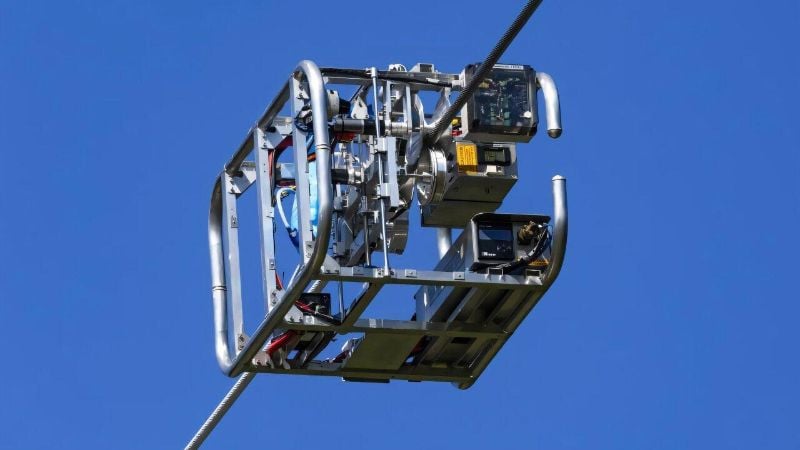
Prysmian robot coating a transmission line. Image used courtesy of ONRL
Grid Capacity Bottleneck
Transmission lines transmit electricity from power stations to buildings, but they can often be a bottleneck for grid capacity.
One notable challenge is that transmission lines must function reliably under diverse environmental conditions, including extreme temperatures, wind, and high loads. At the same time, the rise of renewable energy resources requires higher transmission line capacity beyond what currently exists in the grid. In fact, the U.S. Department of Energy estimates that transmission capacity must increase by 60% by 2030 and triple by 2050 to support renewable energy goals.
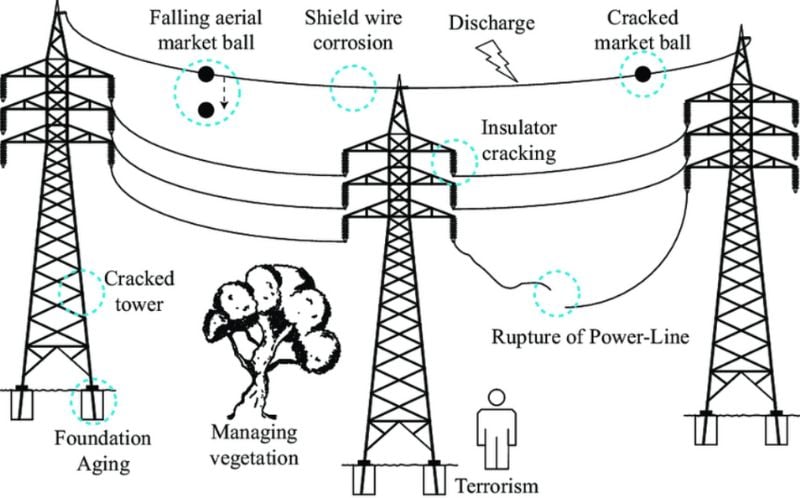
Threats to transmission lines. Image used courtesy of Menendez et al.
When capacity increases, thermals become a prominent factor in transmission line performance and reliability. As lines carry higher currents to meet growing demand, they heat up, leading to sagging, reduced efficiency, and potential safety hazards. Sagging lines could come into contact with vegetation, which is a significant cause of wildfires and power outages. Increased resistance of transmission lines at higher temperatures leads to power losses and reduced efficiency.
Ultimately, these variables are largely influenced by transmission lines’ material composition. Ideally, the materials should have low electrical resistance, high thermal conductivity, and robust mechanical properties to handle expansion, contraction, and environmental wear.
ORNL Initiative to Enhance Grid Capacity
Oak Ridge National Laboratory has developed new coating materials to improve the performance of transmission lines under harsh weather conditions.
At ORNL’s Powerline Conductor Accelerated Testing Facility (PCAT), companies can test transmission line technologies over extended periods under extreme wind, weather, temperature, and electrical load conditions. Prysmian tested a robot-applied coating technology called E3X, designed to enhance power transmission lines' performance. This coating is engineered to reduce thermal buildup on power lines by minimizing heat retention, allowing conductors to operate at lower temperatures under identical loads.
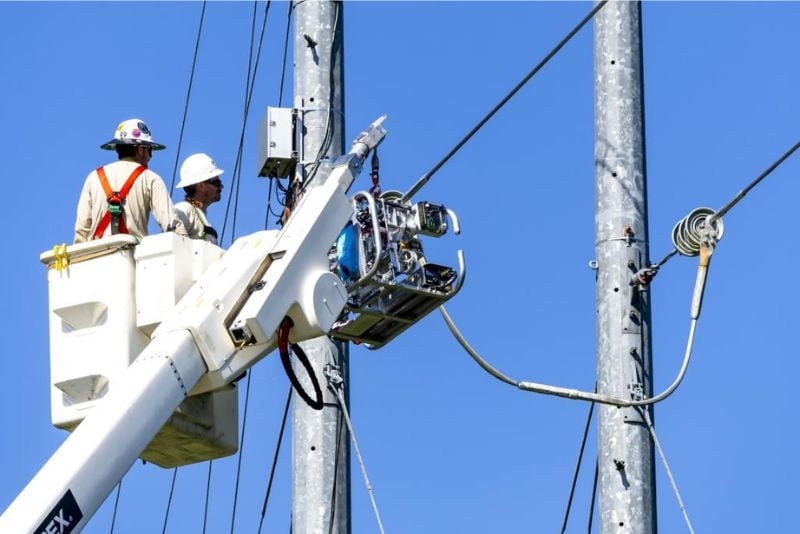
Installing the Prysmian robot. Image used courtesy of ORNL
A specialized robot applies the coating for uniform and accessible material deployment in challenging locations. The invention’s unique features include its capacity to be retrofitted onto in-service lines, making it a cost-effective solution for grid upgrades.
Testing at PCAT included prolonged mechanical cycling and high current loads to simulate extreme environmental and operational conditions. Quantitatively, tests demonstrated that the E3X-coated power lines could remain up to 57°C cooler than uncoated lines during high-load conditions. This significant thermal reduction increases the line’s current-carrying capacity without requiring replacement or structural modifications.
Advancing Grid Capacity
The challenges facing modern electrical grids require adopting technologies to optimize performance under increasing demand and environmental stress. Advancements such as ORNL’s coating material could help support a more sustainable and reliable grid in the future.