Facebook
 Google
 GitHub
 Linkedin
NREL Offers ‘Swiss Army Knife’ Tool for Wave Energy Development
The open-source multi-tool platform can help designers build better wave energy converters.
Wave energy converters (WECs) have long promised a steady, predictable renewable energy source, but translating that promise into reliable performance at sea remains a major engineering challenge. Unlike solar or wind systems, WECs must operate within some of the most complex, dynamic, and unforgiving environments on Earth.
A quick look at NREL’s SEA-Stack in action. Video used courtesy of NREL/Project Chrono
In planning WEC projects, traditional modeling approaches have struggled to effectively model these intense conditions. To address the difficulties, the National Laboratory of the Rockies (NREL) has developed SEA-Stack, a free, open-source modeling platform (available on GitHub) that integrates multiple wave-energy simulation tools into one streamlined workflow.
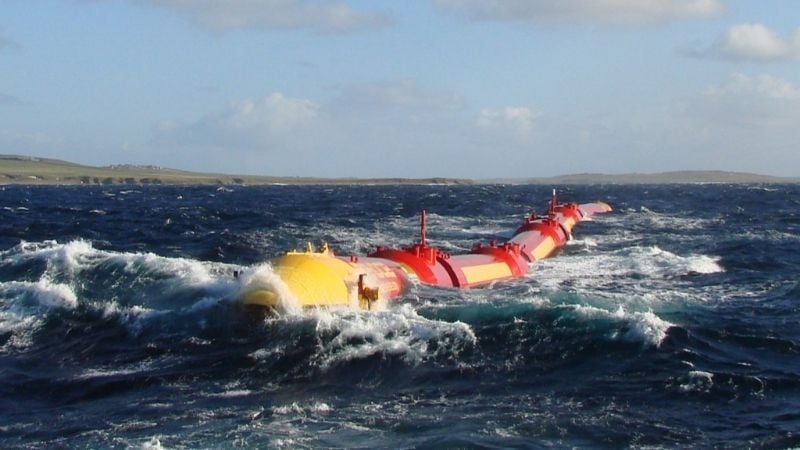
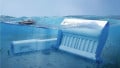
Attenuator type of wave energy converter. Image used courtesy of Department of Energy/Tethys
Why Accurate Modeling Is Crucial
Every WEC device must withstand highly variable wave conditions, corrosive saltwater, extreme storms, marine life buildup, and the cumulative mechanical fatigue that comes from nonstop motion. At the same time, designers must optimize energy capture across a wide range of sea states, pushing for efficiency without compromising survivability.
Without confident modeling, developers risk losing time, money, and investor confidence if an unproven WEC prototype fails in harsh ocean conditions. To avoid this, companies need a virtual testing platform that accurately replicates the marine environment, allowing them to evaluate designs with far less risk, cost, and delay.
Conventional Marine Environment Modeling
When designing a wave energy project, developers typically use several separate computer or simulation models to evaluate the site conditions and the device design.
According to NREL, these modeling tools can be fast, but when used individually, they cannot give developers a full picture. For example, if developers have used one tool to develop an effective device, they cannot use the same tool to assess how variabilities in wave size and speed may affect the device.
Many existing tools cannot model critical features such as flexible device shells, collisions, or autonomous control systems that allow devices to adapt to changing ocean conditions. Developers are also constrained by rigid software systems and modeling silos, which prevent combining different codes to expand design possibilities.
NREL’s SEA-Stack combines four tools into a single platform, allowing developers to explore device concepts and fine-tune the design while also modeling the wave action and its impacts.
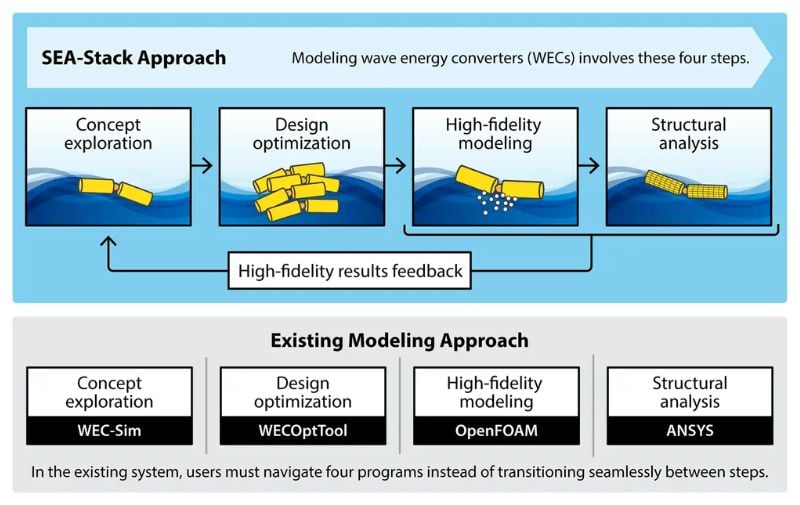
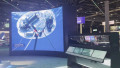
SEA-Stack combines four traditionally separate modeling steps into one platform. Image used courtesy of NREL/Christopher Schwing
SEA-Stack’s Advantages
NREL calls SEA-Stack a “Swiss Army knife” for wave energy developers. Powered by high-performance computing, it runs tens to hundreds of times faster than previous modeling tools. Its flexible framework supports everything from simple, rapid simulations to advanced analyses that capture complex physical interactions.
Much of SEA-Stack’s success builds on its predecessor and partner, WEC-Sim, which was used by NASA and Lockheed Martin researchers to advise a spaceflight crew on landing their module safely in the ocean.
While WEC-Sim offers powerful tools, developers face limitations once they move beyond its ecosystem, and its mostly two-dimensional models cannot fully capture real-world wave behavior. SEA-Stack expands WEC-Sim rather than replacing it, layering in three additional codes—Python, C++, and Chrono—to add realism, flexibility, and advanced physics.
SEA-Stack also uses HydroChrono, a time-domain hydrodynamics simulation tool that can model ocean systems.
Ultimately, SEA-Stack enables developers to conduct extensive “dry” testing and gather robust data before deploying WEC technology. The platform allows rapid exploration of early design ideas, followed by seamless transitions to higher-fidelity simulations that validate and refine earlier results. Machine learning further strengthens SEA-Stack by incorporating insights from across ocean-based industries.
Beyond wave energy, SEA-Stack’s modeling capabilities extend to a wide range of marine systems, including floating platforms, ships, marine robots, and autonomous underwater vehicles.