Facebook
 Google
 GitHub
 Linkedin
Green Hydrogen-Powered Crypto Mining: A Catalyst for Renewable Energy?
Researchers have identified a potential solution to the environmental concerns surrounding cryptocurrency mining, which has been criticized for its high energy consumption and fossil fuel reliance.
Cryptocurrency mining (crypto mining) often draws criticism because its energy-intensive processes could negatively affect the environment. Carbon-based fuel is frequently used to mine different crypto coins. The digital currency has gained much interest over the last decade, with prices regularly fetching tens of thousands of dollars per bitcoin and lower (but profitable) amounts for other cryptocurrencies. The allure of the investment potential has increased crypto mining’s popularity, with little regard for its environmental impact.
What if there was a way to turn this energy-intensive process on its head and use it to boost the renewable and clean energy sectors? A study in Proceedings of the National Academy of Sciences has shown that pairing crypto mining with green hydrogen technology could help accelerate renewable energy adoption, creating a more sustainable energy landscape and reducing crypto mining's carbon impact.

Crypto mining and energy use. Image used courtesy of Adobe Stock
Powering Crypto Mining While Increasing Renewables
Crypto mining uses high computation processes known as “proof of work” to verify crypto assets. Currently, mining cryptocurrencies in the U.S. uses as much carbon-based energy as Argentina. The U.S. Energy Information Administration indicates crypto mining was responsible for about 0.6% to 2.3% of all U.S. electricity consumption in 2023.
However, renewable energy sources like green hydrogen could power crypto-mining operations. The associated tax credits generated from using renewable energy could be invested, leading to greater capacity in wind and solar energy harvesting technologies.
At Cornell University, researchers found that by using green hydrogen to power crypto mining operations, they can use the tax credits to invest in wind and solar development. Hydrogen is also more efficient than conventional sources and can reduce carbon emissions.
Growing Renewable Energy While Mitigating Carbon Emissions
The study used a conventional mitigation framework to examine how enhanced renewable energy penetration can mitigate fossil-based greenhouse gas emissions. The profits earned by combining bitcoin mining with green hydrogen (produced through renewable energy sources) can increase capital investment in conventional mitigation frameworks.
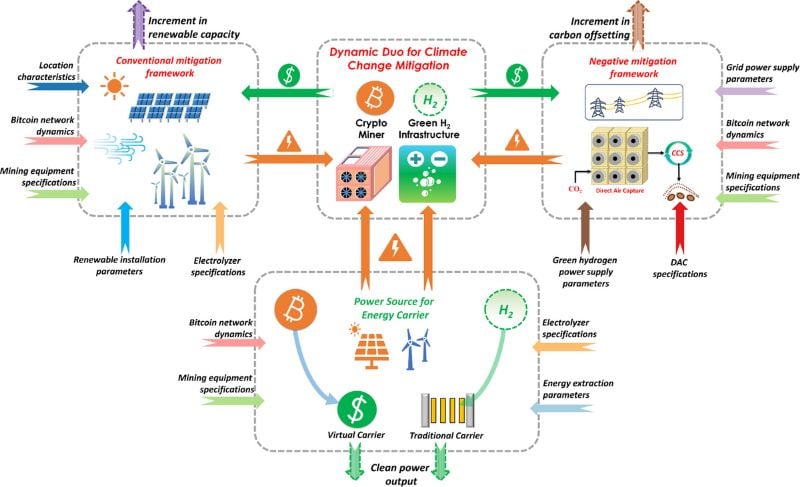
Pairing crypto mining with green hydrogen to invest in renewable energy. Image used courtesy of the authors
The study found pairing green hydrogen production with crypto operations could help accelerate the deployment of solar and wind systems. Leveraging green hydrogen production’s financial potential and Bitcoin toward renewable energy investment could increase solar power installations by up to 25.5% and wind power installations by 73.2%. For example, the study detailed the potential to generate 78.4 MWh of solar power for each Bitcoin mined in New Mexico and up to 265.8 MWh of wind power for each Bitcoin mined in Wyoming.
The study also showed that continued technological advancements could allow the pairing of green hydrogen and bitcoin to increase solar power capacity by 149% and wind power capacity by 140% by 2050. Using green hydrogen to power bitcoin mining could produce a minimum negative mitigation capacity of 7.4 tCO2-eq per bitcoin mined, and some states, such as Idaho, could support a 22.6 tCO2-eq carbon capture capacity for every bitcoin mined.
Crypto Mining and Sustainability
While there’s potential, realizing a more sustainable crypto-mining future will rely on stronger federal policies around climate goals, the environment, and renewable energy sources. This includes policies for renewable energy and green hydrogen infrastructure to increase energy capacity through virtual energy carriers, minimize energy losses from equipment, and reduce transport carbon emissions. By providing policy support to green hydrogen power generation, states with low fossil fuel dependence could support crypto operations' decarbonization and the negative mitigation framework.
Given the environmental stigma surrounding cryptocurrencies, showing the potential to mine carbon-neutral bitcoins using green hydrogen could help remove the stigma. Tax credits can also be earned from using green hydrogen in different states. Investing this into renewable energy technologies could help make cryptocurrencies more sustainable and further improve the perception of crypto mining in the public eye.
Federal and state policies are needed to facilitate this transition. Still, the study provides interesting food for thought about how the most energy-intensive operations in society today could lead to sustainable solutions that ultimately benefit everyone on the planet.