Facebook
 Google
 GitHub
 Linkedin
Cold-Weather EV Battery Design Charges 500% Faster
U-M engineers developed an electric battery upgrade that charges significantly faster in cold weather and could extend driving range.
U-M engineers developed an electric battery upgrade that charges significantly faster in cold weather and could extend driving range.
For many drivers considering electric vehicles, winter temperatures are roadblocks, not just a chill in the air. Battery performance decreases as temperatures drop. This leads to long wait times at charging stations and reduced ranges. This flaw has discouraged many buyers in colder regions from purchasing EVs.
Engineers at the University of Michigan may have cracked the code. They've developed a lithium-ion battery structure that enables fast charging in freezing temperatures. This new design preserves energy density and also prevents the battery degradation that usually occurs while rapid charging in the cold, potentially making EVs a more reliable option year-round.
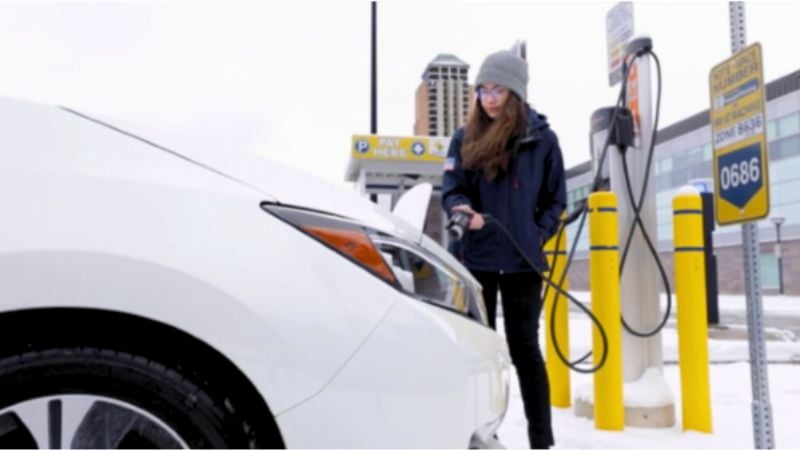
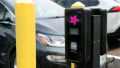
Charging an EV in cold temperatures. Image courtesy of University of Michigan
The Problem and Potential Solution with Cold-Weather EVs
The innovation combines two key advancements: a re-engineered internal battery structure and a protective nanocoating. Traditional EV batteries slow down in the cold because lithium ions, which shuttle energy between electrodes, become sluggish. Automakers have tried to counter this by thickening battery electrodes and extending the driving range but at a cost. Thicker electrodes make it harder for lithium ions to penetrate deeply and evenly, especially when it's cold, leading to slower charging and reduced power output.
Several years ago, Neil Dasgupta’s team at U-M began addressing that issue by using lasers to carve microscopic channels into the graphite anode. These tunnels gave lithium ions easier pathways, which improved room-temperature charging. However, that wasn’t enough in freezing weather. Something else was still clogging the system.
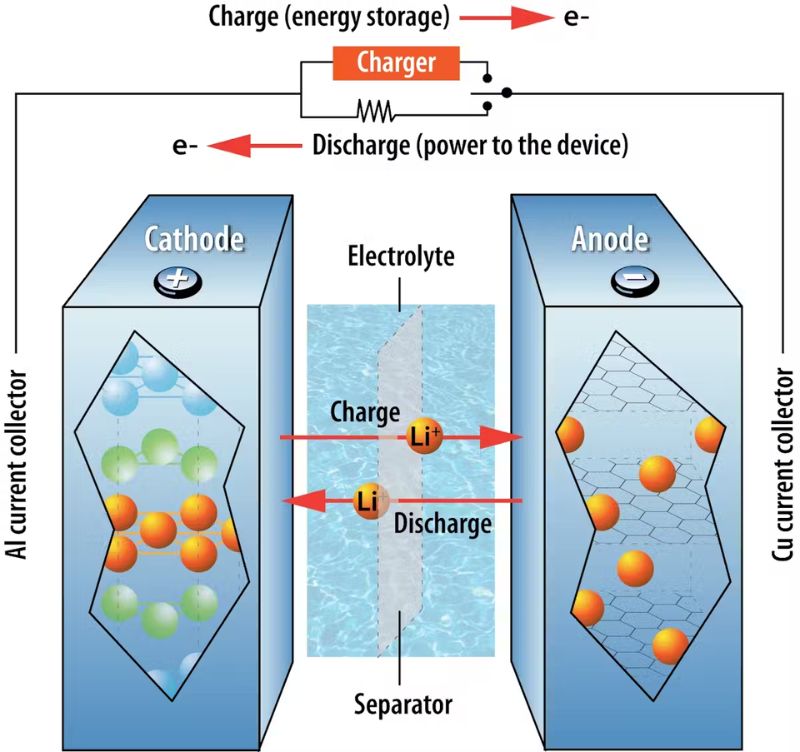
Lithium-ion activity when charging and discharging. Image used courtesy of Argonne National Laboratory
The culprit? A surface layer forms when the electrolyte inside the battery reacts with the electrode at low temperatures. Dasgupta, an associate professor of mechanical engineering, compared it to trying to spread cold butter—possible but painfully slow. When fast-charging is attempted under these conditions, the ions can’t move quickly enough, leading to a dangerous buildup of lithium metal (lithium plating). This slows charging further and also damages the battery over time.
To fix that, the team developed an ultra-thin coating, just 20 nanometers thick, made from lithium borate-carbonate, which acts like a protective shell. This glassy layer prevents the formation of that unwanted barrier, allowing the ions to move freely even when it’s well below freezing. When paired with the 3D channels, the results were dramatic. The test cells charged five times faster at 14°F than standard batteries while retaining 97% of their capacity after 100 cold fast-charging cycles.
From Lab to Road
According to Dasgupta, the approach doesn’t require a full redesign of battery manufacturing lines. It’s a tweak, not a teardown, making it more feasible for EV battery manufacturers to adopt.
While electric vehicle adoption has grown over the last decade, recent trends suggest the momentum may be stalling. A recent AAA survey noted a decline in the number of U.S. adults likely to purchase an EV, dropping from 23% in 2023 to 18% in 2024. One major reason cited was poor winter performance. In January 2024, when temperatures plunged across much of the country, many EV owners reported charging times ballooning to over an hour—double the typical charging time.
Cold Weather EV Progress
The U-M team’s work, carried out at the university’s Battery Lab and supported by the Michigan Economic Development Corporation, could be the missing piece in restoring consumer confidence. Arbor Battery Innovations, a startup licensing the technology, is already working to commercialize the laser-channel method, and the research team is applying for patents with help from U-M Innovation Partnerships.
Range loss and painfully slow charging in winter have long haunted the electric vehicle market, keeping hesitant buyers on the sidelines. U-M engineers may have finally offered a practical fix—one that makes cold-weather EV driving not just possible but efficient.