Facebook
 Google
 GitHub
 Linkedin
Air Apparent: Metal-Air Challenges Lithium-Ion’s EV Dominance
South Korean researchers have designed a sodium-air battery that could lead to safer, more efficient, and less expensive electric vehicles.
Lithium-ion batteries are increasingly popular for electric vehicles due to their long cycle lives, high energy density, and decreasing costs. Moreover, advancements in battery management systems have enhanced their safety and efficiency, making them a reliable choice for consumers and industries. However, metal-air batteries are gaining significant research interest due to their potential to surpass lithium-ion batteries’ energy density by a substantial margin.
How do sodium batteries work? Video used courtesy of Lyth Energy Technology
Interest is growing in sodium-air chemistry. Sodium, abundant and cheaper than lithium, offers a promising alternative. Pohang University of Science and Technology researchers reported a sodium-air (Na-air) battery based on Nasicon (Na Super Ionic Conductor). This solid electrolyte delivers a high discharge potential of 3.4 V and achieves more than 86% efficiency over 100 cycles. This development could lead to an affordable, powerful, and durable battery, which are three critical factors for EVs and large-scale energy storage systems.
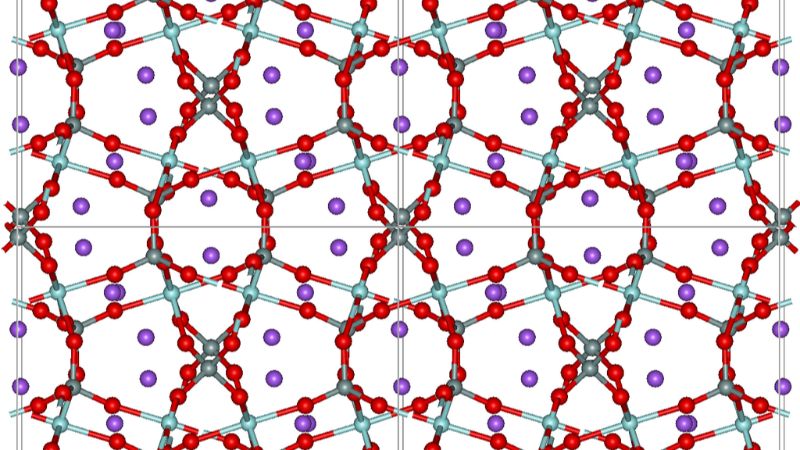
Nasicon’s crystal structure. Image used courtesy of Wikimedia Commons
Introduction to Metal-Air Batteries
Metal-air batteries use oxygen from the air as a reactant, allowing them to be much lighter and more energy-dense since they do not need to carry a bulky oxidizer within the cell. This inherent design advantage could lead to better-performing batteries. In addition, metal-air batteries also offer a lower fire risk compared to lithium-ion. Lithium-ion batteries are prone to thermal runaway, where their temperature rapidly increases, leading to fires or explosions. Metal-air batteries have a less volatile chemical composition, reducing the risk of hazardous incidents.
Despite these promising benefits, metal-air batteries face several challenges that have hindered their commercial viability. The chemical reactions involving air form unwanted by-products that degrade the battery over time. Also, practical applications expose batteries to varying temperatures, humidity levels, and other environmental factors affecting their performance. Additionally, metal-air batteries typically suffer from poor rechargeability, with current prototypes able to withstand only limited charge-discharge cycles before their performance deteriorates.
Overcoming Challenges in Solid-State Metal-Air Batteries
Researchers have been tackling the challenges of ambient air in batteries by developing all-solid-state lithium-air batteries based on chemically stable oxide-based solid electrolytes. However, even though lithium oxides and hydroxides form as discharge products in these cells, they can still react with CO2 and H2O in the air to create lithium hydroxides and carbonates. Thanks to the solid electrolyte’s wide electrochemical window, these by-products can be broken down during the charging process by applying a high over-potential, which boosts coulombic efficiency.
The downside of the process is that it leads to poor energy efficiency due to a large potential gap between charge and discharge reactions. Moreover, Pohang University researchers reported that they’ve progressed with quasi-solid-state Na-air cells, which use a Nasicon solid electrolyte with anolyte and an ionic liquid gel electrolyte. However, fully solid-state Na-O2-air batteries are still not feasible due to the complexities in their fabrication and the high interfacial resistance.
Sodium-Air Battery Based on Reversible Carbonate Reactions
In their study published in Nature Communications, Pohang University researchers reported using ambient air as a fuel in a Nasicon (Na3Zr2Si2PO12) solid electrolyte-based Na-air battery. It leverages reversible electrochemical reactions of carbonates during cycling to achieve an operating voltage as high as 3.4 V. The researchers found that the moisture in the air reacts with the discharge products like hydroxides to form an in-situ catholyte, which acts as an electrolyte and an active material to activate reversible carbonate reactions in a large active reaction area.
Moreover, the catholyte formation allows the cell to undergo the same electrochemical reactions during the charge and discharge phases, reducing the potential gap between both cycles and increasing the round-trip energy efficiency. As a result, the newly developed Na-air battery achieves high energy density for 100 cycles with high energy efficiencies.
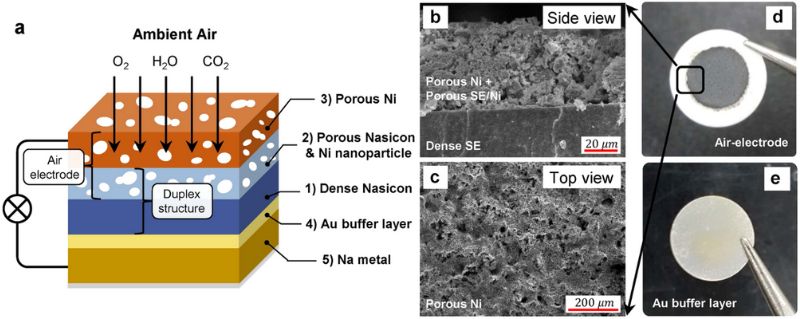
Na-air battery’s structure and configuration. Image used courtesy of Park et al.
The researchers synthesized a dense Nasicon solid electrolyte by a solid-state reaction at room temperature. Moreover, they prepared a duplex solid electrolyte with a dense and a porous solid electrolyte to reduce the interfacial resistance between the air electrode and the electrolyte. The porous Nasicon layer is fabricated on top of the dense electrolyte using a screen-printing process.
The advancement could mean more affordable and accessible electric cars. Lower costs associated with sodium compared to lithium could reduce the overall price of EVs, making them more attractive to consumers. Furthermore, the batteries’ high efficiency and stability could result in longer-lasting EVs with reduced maintenance costs.
On the energy storage front, the Na-air battery could provide a more sustainable and cost-effective solution for storing renewable energy. It could also help stabilize the grid even with intermittent energy sources.