Facebook
 Google
 GitHub
 Linkedin
Why the Next Era of Film Capacitors Will Be Won on Thermal Margin
Engineers who think of thermal stability as a first-class design variable will build systems that last.
The design constraints facing capacitor engineers have changed dramatically. The electrification of transport, densification of AI compute, and ruggedization of electronics across aerospace and industry have pushed capacitors into new environments they weren’t specified for: extreme heat, voltage fluctuations, and tighter space constraints.
For system engineers, thermal stability has become the primary design constraint. Two films have anchored the capacitor market for decades: biaxially oriented polypropylene (BOPP) and polyethylene naphthalate (PEN). But they weren’t designed for today’s punishing heating cycles, which shift dielectric behavior and erode predictability.
A new type of film technology is emerging that can close this gap and go even further, redefining what's achievable at the high end of thermal tolerance and power density.
Films Are Thermal Players
It’s tempting to treat capacitor film as just packaging, something you “set and forget.” In power-dense systems, capacitor film does much more… actively managing heat while filtering ripple and stabilizing voltage. In compact DC-link designs for automotive or aerospace electronics, capacitors sit near high-speed switching devices to minimize inductance. That proximity increases temperature exposure, collapsing efficiency.
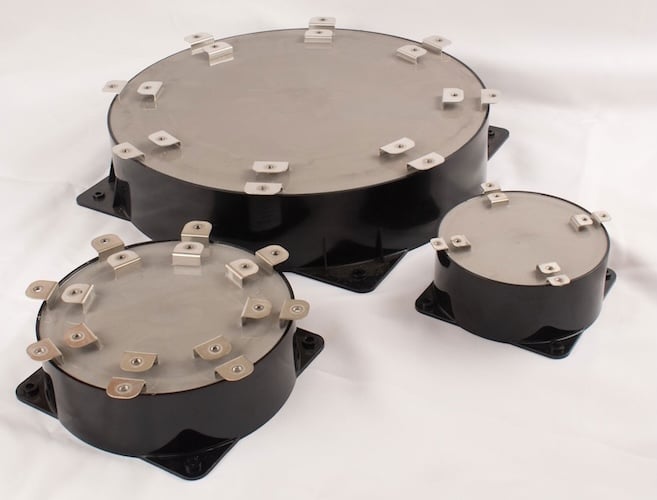
Large-format film capacitors anchor DC-link and pulse-power systems. Image used courtesy of Advanced Conversion Technology
BOPP and PEN were designed for the operating environments of an era that’s now ending.
BOPP: The Efficiency Benchmark With a Hard Ceiling
Biaxially oriented polypropylene (BOPP) has earned its place in capacitor engineering. Its ultra-low dissipation factor (~0.0002), high breakdown strength, and excellent self-healing behavior made it the default choice for large DC-link capacitors, energy storage, and pulse-power systems. For applications that stay below 100°C and don't demand tight packaging, BOPP remains a reasonable choice.
But BOPP's ~100°C temperature ceiling is incompatible with modern power electronics. EV inverter modules adjacent to SiC power devices routinely expose DC-link capacitors to ambients above 105°C. AI server rack power conditioning runs continuously at 70–90°C, with significant self-heating on top. In those environments, BOPP requires derating, or oversizing the capacitor bank altogether, adding weight, size, and cost to compensate.
PEN: The High-Temperature Workhorse With a Loss Penalty
Polyethylene naphthalate (PEN) extends the temperature envelope where BOPP falls short. Its improved thermal stability (withstanding > 150°C), high moisture resistance, dimensional stability at elevated temperatures, and suitability for SMD/reflow have made it the practical solution for automotive ECUs, UAV flight controllers, and night-vision sensor boards.
But its dissipation factor (0.003–0.005 vs. BOPP’s 0.0002) generates higher losses in high-power applications. In EV inverters, aerospace power modules, and advanced sensing systems, that shows up as heat the system has to remove, and it accelerates aging. The resulting thermal feedback loop constrains efficiency as power density climbs.
PEN is also facing discontinuation by major suppliers, making reliable sourcing difficult and pushing engineers to rethink their designs.
The Middle Path: Nanolayered Film
One emerging path through these constraints is architectural, rather than dependent on new polymer chemistry. Rather than searching for a single new polymer that outperforms both BOPP and PEN (a search that hasn’t produced a commercial answer in 30 years), a new class of dielectric film structures combines existing, well-characterized polymers in precisely controlled nanolayered architectures. These films are built through a multiplying coextrusion process, where each pass through a multiplier doubles the layer count to produce structures with thousands of nanoscale layers tuned for a specific thermal and dielectric profile.
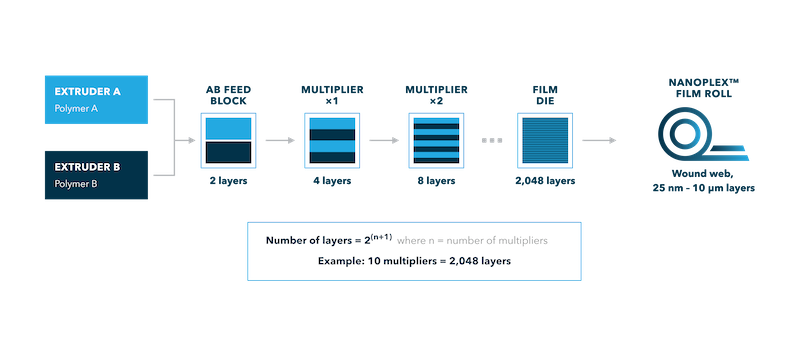
Nanolayered dielectric film architecture. Image used courtesy of Peak Nano
At this scale, layer thickness, sequence, material ratio and interfaces become additional design variables. This allows engineers to tune dielectric, thermal and mechanical behavior for the requirements of a particular capacitor application rather than accepting the inherent property limits of a single bulk polymer.
Recent advances in nanolayered dielectric films demonstrate what this approach can enable. Architectures have been developed that maintain very low dielectric losses at elevated temperatures while retaining high breakdown strength, creating opportunities for capacitors that operate in hotter environments without the size and weight penalties associated with simply moving to higher-temperature conventional films.
The same architectural approach can be tuned in another direction for applications where energy density is the priority, including pulsed power and other space-constrained systems. By controlling the materials and nanoscale structure, engineers can optimize for different combinations of energy density, temperature capability, dielectric loss and lifetime.
Importantly, these advances do not necessarily require capacitor manufacturers to reinvent their production infrastructure. Nanolayered dielectric films can be designed for compatibility with established metallizing, slitting and winding processes, creating a potential path to higher performance while leveraging existing manufacturing equipment.
What Film Selection Costs Over a System’s Life
Thermal tolerance determines system economics. In a continuous-duty industrial drive, the gap between a 0.0002 and a 0.004 dissipation factor generates kilowatts of additional heat per inverter module, which has direct consequences for cooling system size, enclosure temperature, and capacitor replacement intervals.
At the data center scale, those losses compound. Across a 100 MW facility operating continuously, the difference between BOPP-grade and PEN-grade dissipation factor translates into megawatts of cooling load that has to be built, powered, and maintained for the life of the facility.
Over time, engineering teams will see this difference in the operations budget.
Three Questions to Ask Your Film Supplier
As the dielectric film market transitions, conversations around specification must expand. These questions belong in every film supplier evaluation call:
- What’s the dissipation factor at your actual operating temperature? Most datasheets publish room-temperature figures. The numbers that matter will be between 105°C–135°C+, under your switching frequency and ripple current profile.
- Is the film qualified for your assembly process? Verifying drop-in compatibility before committing is essential. Get samples, run them on your line, and test a representative build.
- Where is the film manufactured, and what does the supply chain look like? Over 70% of conventional capacitor film is sourced from China. For programs with domestic content requirements, ITAR sensitivities, or supply continuity requirements, that’s a significant procurement risk.
The Bottom Line
BOPP remains unmatched in large, cool, high-energy systems. PEN remains the rugged choice for hot, compact, surface-mount designs… for as long as it remains available. But as electronics keep pushing into hotter, denser environments like 800V+ EVs and AI data centers, neither film can perform continuously. System engineers are being forced to make hard trade-offs.
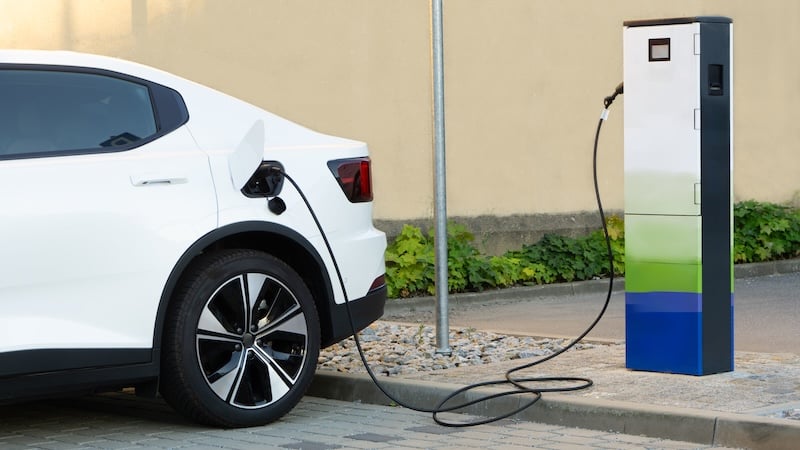
EV charging and power systems are moving to higher voltages and tighter enclosures. Image used courtesy of Adobe Stock
Nanolayered architectures combining the best of both films won’t displace the stalwarts overnight, but they provide an extra degree of freedom and possibility. That’s exactly what we need to meet the next decade’s performance and reliability demands.
Thermal stability is the variable that determines whether every other specification holds up over a system’s service life. The engineers who design around it from the start will be the ones whose systems last.