 Facebook
 Google
 GitHub
 Linkedin
Plug-In Microinverter Technology for Safe and Efficient PV Solar Installation
Plug-in solar is making residential power generation simpler. Here is a look at the built-in safety features that address UL 3700 requirements for standard outlet solar systems.
Plug-In PV Outpaced Its Safety Standards
Plug-in photovoltaics, the category known in Europe as "balcony solar," entered the United States as a consumer appliance. In jurisdictions where permitted, qualifying plug-in PV systems can connect to a properly installed household receptacle, offering a simpler alternative to conventional rooftop solar installations. Depending on local regulations and system requirements, installation may still require a licensed electrician, permits, or utility notification. Unlike a permitted rooftop array that requires some structural work, an interconnection application, and a commissioning visit, a plug-in PV system connects to the grid in under a minute once the panel is mounted. This opens residential solar to renters and homeowners whose roofs are shaded, aging, or governed by an association.
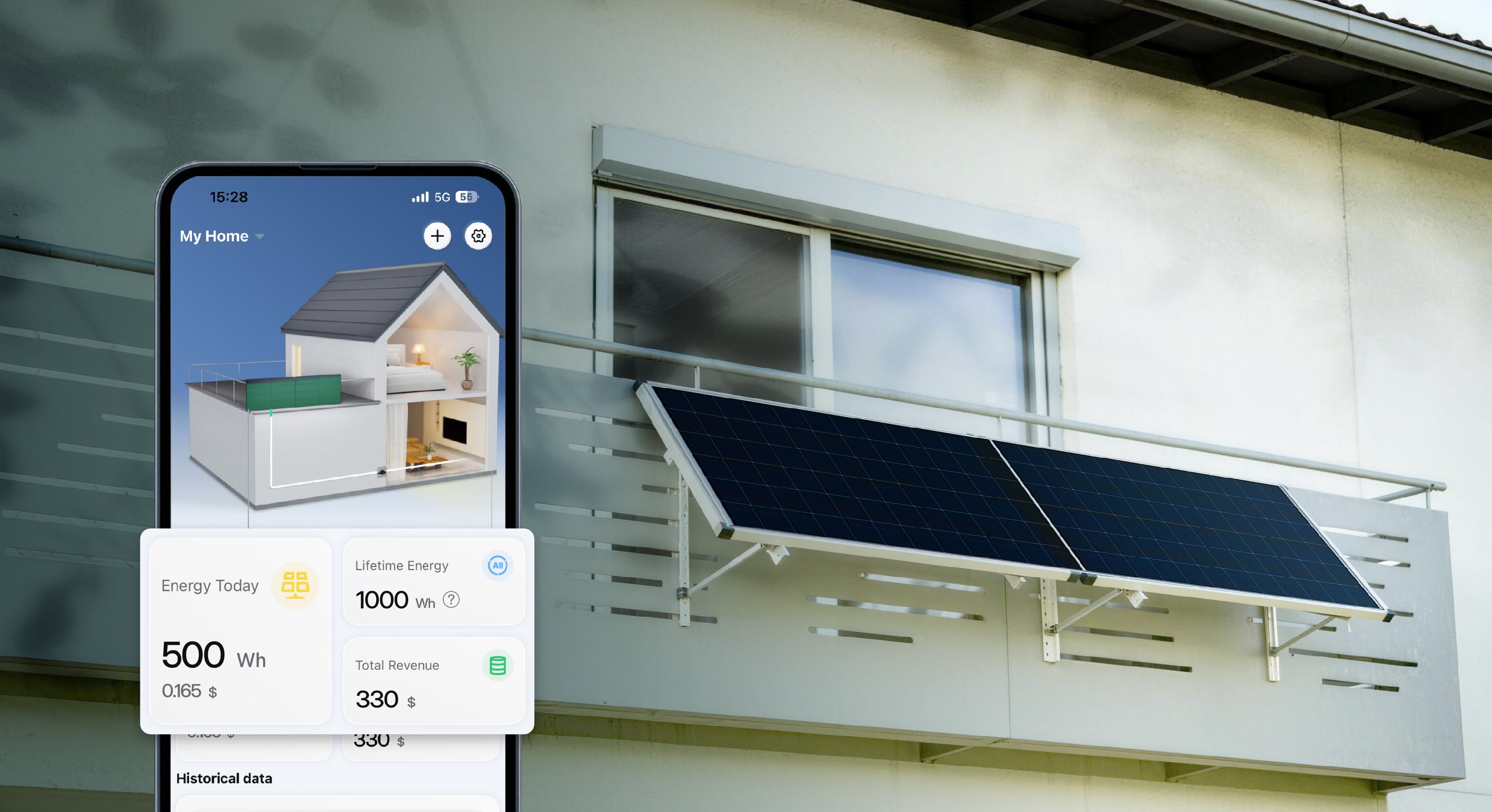
A balcony-mounted plug-in solar array with a companion app showing real-time energy production. Image used courtesy of Hoymiles.
Such a low barrier to entry allowed PV adoption to outrun its safety framework. The standards available when plug-in products reached the U.S. market were never designed for them. For example, NEC Article 690 only addresses permanently installed PV on dedicated wiring, UL 1741 covers grid-interactive inverter equipment broadly, and IEEE 1547 governs how a distributed resource behaves at its point of common coupling. All of these standards assume there was a qualified installer, a hard-wired termination, and a circuit that serves the array alone. None of them covers a generating device a consumer buys online and plugs into a receptacle already shared with a vacuum cleaner and a space heater.
Engineering Challenges of Plug-In Distributed Generation
Connecting a generating source to a shared household circuit through a consumer-handled plug introduces four engineering problems that existing standards fail to address.
Touch-safe disconnection is one of the most important considerations. When someone pulls the plug on an energized inverter, the exposed metal prongs can remain live if the source does not indicate that it has been disconnected from the grid. Another closely related issue is anti-islanding at low power levels. Detection schemes must remain dependable when the source contributes only a few hundred watts against a fluctuating household load, well below the operating range where rooftop-scale inverters were characterized.
Considering ground-fault protection, legacy ground fault circuit interrupters (GFCI) detect leakage current by sensing current imbalance through transformers designed and evaluated for unidirectional current flow. However, a generating device connected downstream of the GFCI can produce reverse power flow through the sensing circuitry in a direction for which those transformers were not evaluated. The fourth, and least intuitive problem, is breaker masking. Where a source sitting downstream of the branch breaker supplies part of the load current locally, the breaker reads less current than the conductors actually carry. The circuit can then be loaded past its rating while its protective device reports nothing unusual.
UL Solutions covers all four issues with UL 3700, published as an Outline of Investigation in December 2025 and backed by a dedicated testing and certification framework introduced in early 2026. The standard gave plug-in PV a safety baseline for the first time, but certification and permission are separate questions. Interconnection, permitting, and export rules vary by state, utility, and local authority. If you are specifying or advising on these systems, verify the requirements that apply at the installation address before committing to a design.
Designing Safety Into the Microinverter
UL 3700 reframes the problem by treating the microinverter as part of a complete system rather than as an isolated component. It evaluates the plug-in assembly as a whole, including the Microinverter, the connection method, relevant accessories and the overall system configuration. Since the consumer performs the installation, the safety case has to be contained within the product itself rather than delegated to field practice. So, the requirements that follow function primarily as design targets for the inverter, not instructions for an installer. That system-wide scope also separates two levels of certification. A component-level certification demonstrates that an individual product, such as a microinverter, complies with the requirements that apply to it, but it does not by itself establish that the complete system is compliant.
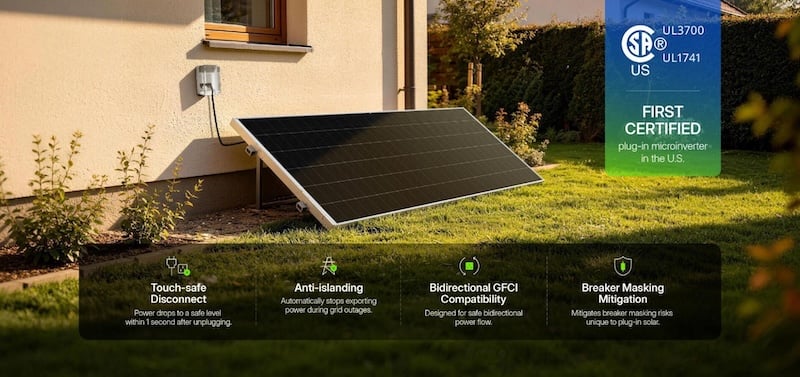
Touch-safe rapid shutdown carries the largest share of the burden of protection. As soon as mains voltage disappears, whether due to a utility outage or because the cord is unplugged, the inverter must immediately stop sourcing power before a worker can contact the exposed plug prongs. Hoymiles states a response time of 160 ms for its own implementation, with plug voltage falling to 30 V or below within a second of disconnection. Response time is critical here. The rapid shutdown that reduces the shock hazard at a disconnected plug also determines how quickly the inverter stops energizing a circuit that the utility or a worker may assume is de-energized.
Bidirectional GFCI compatibility mandates that the inverter produces a current signature that residual-current devices can interpret correctly when power flows back to the panel, rather than interfering with the protection upstream. On the other hand, breaker-masking mitigation limits how much current the device injects into a circuit whose overcurrent protection device cannot sense it. This is where circuit-level arithmetic begins to constrain the product itself. For example, a 120 V, 15 A residential branch circuit has limited headroom once the code’s continuous-load derating is applied. For this reason, designers work to a per-unit ceiling of about 360 VA (roughly 3 A at 120 V), and state statutes that define plug-in PV systems typically cap a complete installation around 1,200 W.
None of these measures is effective in isolation, which is the practical lesson embedded in the standard. For instance, rapid shutdown combined with unrestricted output can leave a breaker unable to account for current flowing through its own conductors. Conversely, a carefully limited output connected to an incompatible GFCI can compromise the ground-fault protection a household relies on. This implies that safe plug-in PV is a systems engineering outcome which depends on a standard and an inverter architecture working together, not a single protective feature.
Hoymiles’ HiFlow Pro: A UL 3700-Compliant Microinverter
Released in July 2026, Hoymiles HiFlow Pro, which TIME named one of the Best Inventions of 2026, is the first plug-in solar microinverter brought to the American market as compliant with UL 3700. Critically, it was designed around U.S. circuit parameters and NEC-aligned practice rather than adapted from a European balcony product. The HiFlow Pro offers four protections against the standard: touch-safe disconnect, anti-islanding, bidirectional GFCI compatibility, and breaker-masking mitigation. At this stage, that compliance applies to the microinverter itself, while Hoymiles is pursuing certification of the complete HiFlow Pro system.
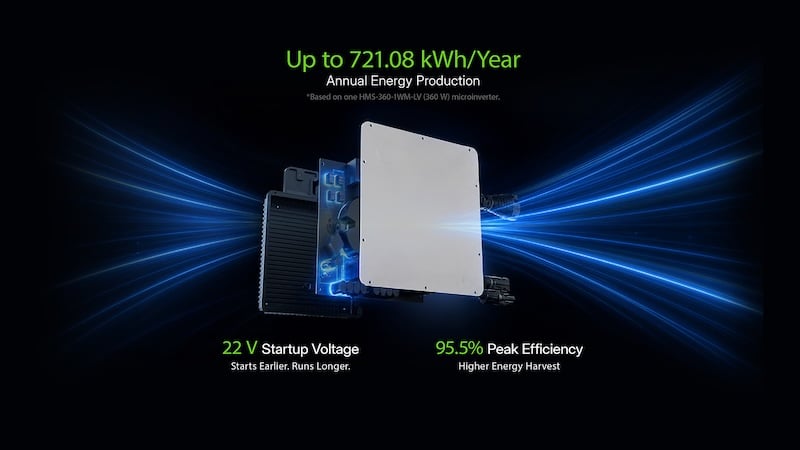
The HiFlow Pro microinverter has a 22 V startup voltage, 95.5% peak efficiency, and up to 721.08 kWh of annual production from a 360 W unit. Image used courtesy of Hoymiles.
On measured behavior, the microinverter stops producing electricity within 160 ms of a grid interruption, including the case where the plug is simply removed. Intelligent voltage reduction at the AC plug then brings the terminals to a safe level at or below 30 V within one second of disconnection. The product line covers 360 W to 500 W models, which gives distributors and integrators room to match wattage thresholds written into individual state rules. Up to four units can be combined into a single system for 1,200 W of total output. Hoymiles estimates annual production of up to 721.08 kWh from one 360 W unit and 2,403 kWh from a full four-unit system, based on PVGIS modeling at 5.6 peak sun hours per day.
Always verify applicable state and local codes, utility requirements, and installation conditions before installing a plug-in PV system. Image used courtesy of Hoymiles.
The HiFlow Pro’s production figures reflect a conversion architecture that was built around low-voltage operation. For example, a 22 V startup threshold brings the unit online early in the day, CEC-weighted peak efficiency reaches 95.5%, and MPPT tracking holds at 99.8% static and 99.5% dynamic.
Physically, the unit measures 182 × 164 × 30 mm at 1.8 kg in a NEMA Type 6/IP67 enclosure rated for continuous operation from -40°C to +65°C. Hoymiles reports 250,000+ hours of reliability testing. Built-in Bluetooth and Wi-Fi let you commission the microinverter in under 60 seconds, and the S-Miles Home app provides real-time production monitoring. Pairing the system with a compatible energy meter enables zero-export control, automatically trimming output to match the household’s consumption.
If you are sourcing the hardware, the HiFlow Pro is available as a standalone inverter or as part of a plug-in kit through four partners: Brightsaver, NAZ Solar Electric, Solwel, and US Solar Supplier
Note: Plug-in solar installation requirements vary across U.S. states and local jurisdictions. Direct plug-in installation without a licensed electrician is permitted only in certain locations and under specific conditions. Depending on local requirements, installation may involve electrical permits, utility notification, or professional installation. Always verify applicable state and local codes, utility requirements, and installation conditions before installing a plug-in PV system.
Implications for Installers and the Residential Solar Market
For distributors and integrators evaluating suppliers in this category, UL 3700 compliance can serve as a filter. It tells you the manufacturer has tested its hardware against the failure modes that make plug-in PV different from rooftop PV. It does not simply point at an inverter listing written for a hard-wired system and invite you to assume the rest. As state legislatures continue to reference the standard when defining what qualifies for a simplified pathway, that filter will increasingly do both regulatory and technical work.
For installations permitted under local regulations, a qualifying plug-in PV system can connect directly to a properly installed household receptacle, without intermediate power strips or extension cords. The installation method, outlet requirements, and any need for professional electrical work must follow applicable local codes and regulations.
From a system-design perspective, a plug-in array is sized primarily to offset daytime grid consumption, reducing the amount of electricity a household needs to purchase from the utility while the panels are generating power. Anti-islanding protection ensures the inverter synchronizes with the grid, shutting down within milliseconds of a utility interruption so line crews and connected equipment remain protected.
The practical step for engineers advising on these systems is to match array capacity to the site’s daytime load and confirm your local interconnection policy before finalizing a design. As additional U.S. states legislate simplified pathways for plug-in solar, plug-in systems certified to UL 3700 as a complete assembly are positioned to clear both the technical and the regulatory bar, and specifications written today are worth measuring against that benchmark.
For more information on Hoymiles’ HiFlow Pro plug-in solar microinverter and/or application-specific inquiries, please visit the website.