Facebook
 Google
 GitHub
 Linkedin
Leading from the Control Room: More Precise Ways to Manage Wildfire Risk
Wildfire risk is rising for utilities. A control room-based, data-forward strategy using ADMS integration and real-time data allows for precise, targeted mitigation instead of blanket power shutoffs.
Wildfires are now an almost year-round concern in the U.S., with fire season consistently lasting longer and fires becoming more frequent and catastrophic. From 2020-2024, wildfires burned more than 35 million acres, and NASA research shows the rate of mega-fires (those over 100,000 acres) has increased significantly over the last two decades and is expected to continue to grow as climate related weather events increase in severity.
What once felt like a problem relegated to specific regions like California and Australia, has made its way to the top of priority lists for utilities based around the world. Even more concerning than the significant service disruptions that wildfires can cause, is the possibility of environmental damage and loss of life. Utilities are under pressure to act quickly to deploy solutions in the field that lessen wildfire risk.
Gaps in Current Wildfire Mitigation Strategies
While utilities’ wildfire mitigation strategies vary greatly, a primary option is often centered around disabling reclosing on protective equipment. When an overhead transmission or distribution line falls to the ground, there is typically a protective device that will de-energize to protect that section of the line, then re-energize after a certain period to test if the fault were transient in nature, such as a tree branch falling through the lines but doing no damage.
If no fault condition remains, the reclosing attempt will be successful and restore power. If the fault is present, often reclosing equipment will attempt to reclose once or twice more before locking out. When wildfire risk is high, this reclosing action can be the cause of an ignition, and in certain conditions, a fire.
When there’s a high risk of fire, the common solution is to manually disable reclosing on protective equipment, so any downed power lines won’t be re-energized. If there’s an extremely high risk, utilities may even initiate a public safety power shutoff (PSPS), cutting power off completely in certain areas. This “blanket” approach could impact service for thousands of customers across the network.
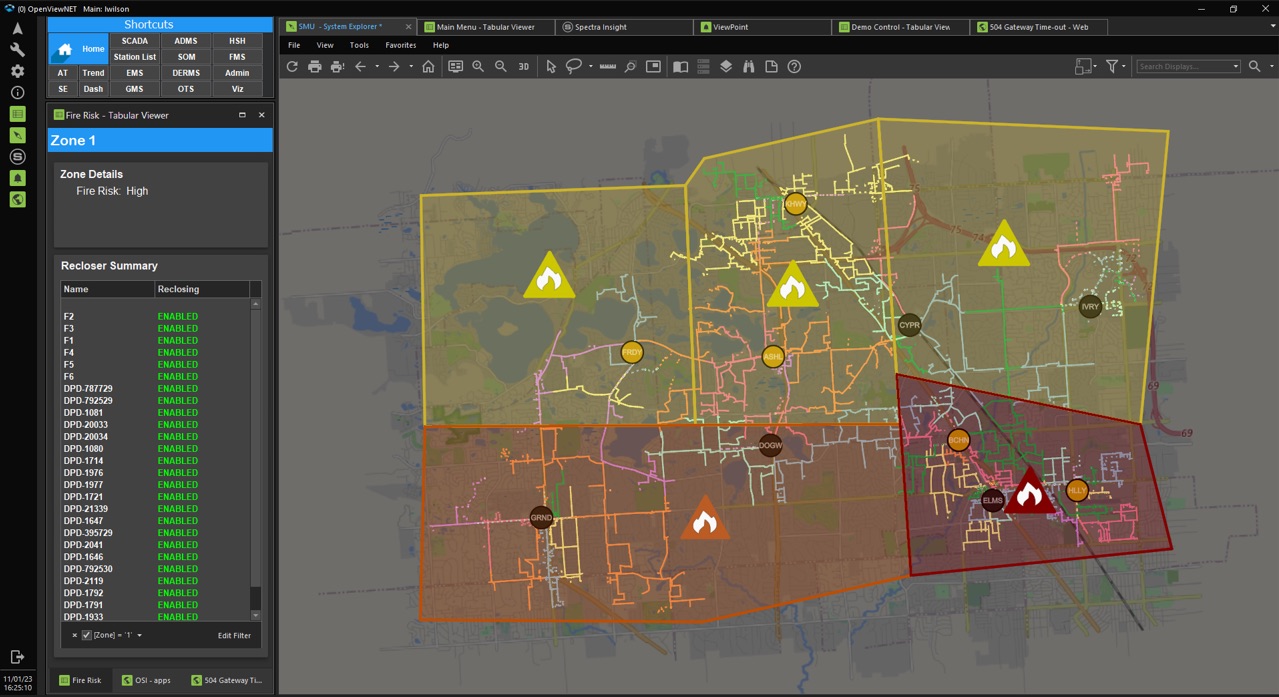
Figure 1. Shown here is the kind of SCADA (Supervisory Control and Data Acquisition) software interface used by a utilities company for monitoring and managing an electrical grid. Images used courtesy of Emerson / AspecTech. (Click on image to enlarge)
Some utilities have built their own tools that can source weather data inputs, then programmatically disable reclosing on a pre-engineered set of devices. Other tools pre-program SCADA control points and give operators a bulk control action that can be triggered with one click. While these strategies allow for slightly better targeting than blanket approaches, they come with their own set of challenges: custom-built solutions require manual maintenance that make them cumbersome and challenging to scale.
Mitigating wildfires during a time when risk continues to grow, calls for a more precise, actionable strategy based on a model-centric approach through the utility’s operational center – the control room.
A Data-Forward Approach from the Control Room
The control room is a utility’s beating heart. Mission-critical operational technology (OT) used to maintain grid performance for millions of customers is managed within a control room’s four walls. As wildfire mitigation is increasingly seen as a critical lever for operational excellence, utilities are relying on real-time, model-based solutions that can be integrated and managed in the control room with the trusted OT systems already in place.
Integrations with a utility’s ADMS already managing the distribution grid allow for a central location from which all relevant, real-time information is visible from one system. By layering new situational awareness data inputs, such as alarms, hotspot data, fire risk indices and other data from field equipment such as sensor and cameras, on top of the as-operated network model, operators are better equipped to act quickly in high-pressure settings. They can take targeted action on a specific area of the utility’s service territory.
Wildfire regions for a utility are often broken up into specific geographic zones with their own rules and triggers for when the wildfire threat level is high. When integrated into an advanced application in an ADMS, a fire mitigation application is able to send batched controls to all protective equipment that is in, or feeds into, a specific zone of the distribution system. This allows for targeted controls only to high-risk areas based on the as-operated state of the grid.
A Red Flag Day
The best example of this is a ‘Red Flag Day’ in which wildfire risk is high, so a utility would normally trigger an automatic elimination of reclose attempts. However, a ‘Red Flag Day’ warning may only pertain to a small sliver of a utility’s vast service territory. With a layered, data-driven approach reliant on weather, grid and situational awareness data, utilities can pinpoint exactly where ‘Red Flag’ areas are, monitor and quickly take action with precise controls to disable reclosing or change protection modes on devices, while leaving other service areas to operate nominally.
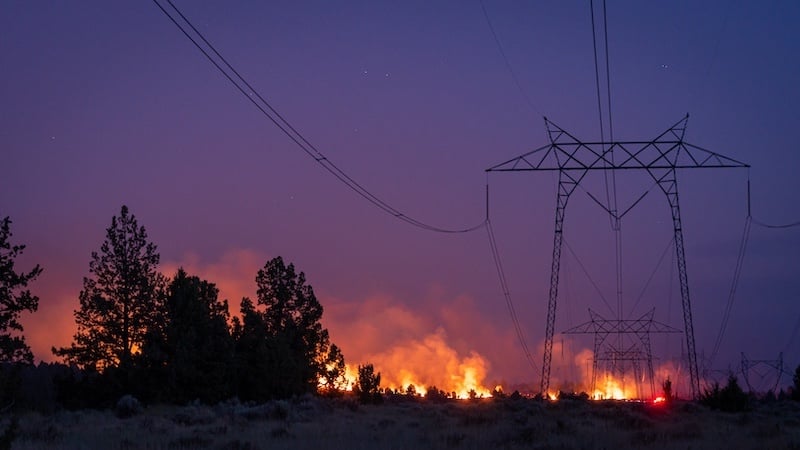
Figure 2. A California wildfire burns under power lines. Adobe Stock image (licensed)
Another approach might be to proactively re-route the power flow on the network to isolate a line that is in a high-risk area. This type of scenario is more common on transmission grids but is becoming more prominent for distribution grids as utilities increase their investments in remotely controlled equipment.
In addition to the distribution network, utilities have to consider wildfire management around their transmission lines, which often cross over multiple wildfire zones even if no actual end point of the line is in one of the zones. With a layered, data-driven strategy managed from the control room, utilities can analyze the geospatial relationship of a transmission line going through a defined region, then automatically communicate with the breakers at either end of the line to take the appropriate action.
Even for cases where there is not an ADMS for centralized automation, having more information at their fingertips means operators can explore options holistically, then take a specific action that only targets areas at elevated risk for a fire.
Tracking Customer Impact
Because all the data is contextualized within the utility’s centralized control system, there’s also an opportunity to track how many customers are impacted by a decision based on the current network status. Therefore, while the utility is responding to an actual event, it can simultaneously work to streamline communication with impacted customers.
And, as with any critical event, an after-action review will solidify improvements for the future. Because actions were taken based on a centralized repository of data in the control room, there’s an auditable trail of when controls were sent, when alerts or ‘Red Flag’ warnings were received and any other responses. The ability to capture data and audit an event allows for critical post-event analysis, learnings and regulatory reporting.
The Downstream Effect of Layered OT Data
While the control room is an important place to start, well-prepared utilities often have additional fire management measures deployed throughout their service territory to strengthen mitigation efforts. There are several things that, when used in combination, can help reduce the overall wildfire risk for any utility. These tools include:
- Vegetation management: proactively and routinely trimming tree canopies away from energized lines;
- Vibration sensors on poles: detect when there is a disturbance in order to deploy a truck faster to a specific location of damage. Some modern sensors now include cameras to send video feeds after an incident;
- Advanced protection curves in breaker and recloser relays: detect the presence of a falling wire and trip the breaker before the line hits the ground. This can be aggregated and centralized with a model-based solution in the control room;
- Advanced power line sensors: detect transient waveforms and use pattern recognition tools to associate waveforms with specific equipment operation or indicate equipment failure. This allows the utility to proactively find and repair equipment before catastrophic failure.
In layering these approaches together, utilities can strengthen their overall wildfire mitigation program, providing a way for them to produce clear reporting on what actions have been done proactively and in real-time.
Navigating a Challenging Environment
The challenges due to climate change and society’s growing reliance on energy is leading to an increasingly complex operating environment for utilities. Methods of generation and distribution are evolving, while utilities are challenged to meet growing demand and manage ever-growing environmental concerns.
Utilities can’t rely on the same manual approaches and reactive responses to address mission-critical risks such as wildfires. The auditability of actions is paramount for a utility to keep the community safe, avoid fines, retain good credit ratings, and decrease insurance premiums. The financial and societal risk of fires is so high that it is critically important for utilities to put in place a multi-faceted approach to do their part to avoid being the cause of a fire.
New approaches allow utilities to balance safety with service by mastering data and precision. As the threat of wildfire grows, utilities that advance efforts to mitigate their risk will best serve their customers and protect their community.