Facebook
 Google
 GitHub
 Linkedin
Interview: EPC Execs Discuss GaN Technology and Solutions at PCIM Asia
In this interview article, we learn about EPC’s Gen 8 GaN platform for AI power delivery and Trinity motor control—on display this week at PCIM Asia—to address rising power and space demands in AI and robotics.
As power demands rise across artificial intelligence, robotics, and autonomous machines, gallium nitride (GaN) is moving into applications that were once dominated by silicon. At PCIM Asia in Shenzhen, Efficient Power Conversion (EPC) is showcasing two technologies aimed at this transition: its next-generation Gen 8 GaN platform for AI power delivery and Trinity, an integrated three-phase GaN solution for motor control.
In two interviews ahead of the event, EPC CEO Alex Lidow and Nick Cataldo, Senior Vice President of Global Sales and Marketing, discussed how the company sees GaN evolving from a high-performance alternative to silicon into a key technology for emerging power architectures.
AI Pushes Power Electronics to New Limits
According to Cataldo, AI remains one of the strongest drivers of GaN adoption, while humanoid robotics is rapidly becoming another major opportunity.
“Everyone knows the market's buzz is AI, and we're certainly part of that,” Cataldo said. “And the humanoid robotic market has evolved into a major market, which everyone knows there's great opportunities ahead for solutions for robotics.”
The growing power density of AI systems is putting traditional silicon architectures under increasing pressure. As GPU voltage rails move below 1 V while current requirements continue to increase, efficiency, thermal management, and power density are becoming increasingly difficult challenges.
“The extremities of power required, especially in AI with the small footprint and thermal issues, really pushed silicon to its limits,” Cataldo explained. “AI has been one of the areas where it's really pressed the limits of technology.”
Lidow sees the evolution of AI power architecture extending from data center infrastructure all the way to the GPU. He predicts a future in which 800-V DC power is delivered to servers, with silicon carbide handling higher-voltage conversion and GaN taking over closer to the processor.
“The server rack itself will be the GaN world, the sidecar will be the silicon carbide world,” Lidow said.
Gen 8 Targets the Point of Load
A key part of EPC's strategy is Gen 8, which the company is previewing at PCIM Asia. The platform combines advanced GaN transistors with integrated control circuitry designed to extract more of the technology's performance at very high switching frequencies.
“For many years, I've been telling people that gallium nitride will get to a point where you can't extract the efficiency out of it as a discrete device,” Lidow said. “So, Gen 8 takes even more advanced GaN transistors, and we've put IC extraction tools inside, so it extracts the performance far more efficiently.”
The approach integrates drivers, level shifters, and logic alongside the power devices. EPC says the technology can enable conversion from a 6-V intermediate bus down to approximately 0.6 V at 10 MHz, potentially eliminating an intermediate voltage-regulation stage.
That could become increasingly important as AI systems move toward lower-voltage, higher-current architectures. Rather than distributing large amounts of power at 12 V and then adding another conversion stage close to the processor, EPC envisions distributing power at a lower intermediate voltage and converting directly at the GPU.
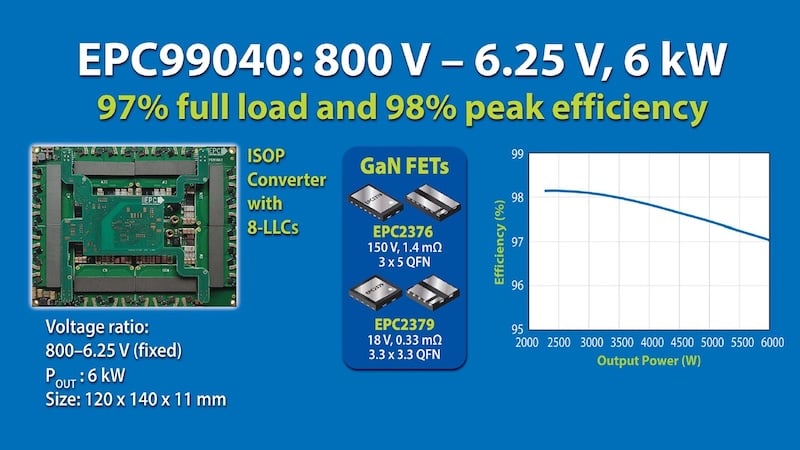
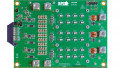
The EPC99040 800 V to 6 V board. Image used courtesy of EPC.
“The problem is if you go from 800 volts down to say 12 volts, you're distributing all this power at 12 volts. That's already pretty hard,” Lidow explained. “But if you can go from six volts directly down to point six, right at the back of the GPU, very efficiently, well, then you can locate 800-volt to 6-volt converters in a couple of strategic locations on the board and get a very efficient power distribution.”
Trinity Brings Integration to Motor Control
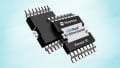
The second major technology story at the show is Trinity, EPC's highly integrated three-phase GaN motor-control platform. This technology targets applications where space, weight, thermal performance, and precision are critical, including humanoid robots, drones, and other intelligent machines.
Lidow said the concept addresses a longstanding challenge in brushless DC motor drives.
“In silicon, you have three phases. Well, you have six transistor devices: high side, low side, times three phases,” he said. “And the dream when I started EPC 18 or 19 years ago was let's put all those phases on one chip.”
Trinity goes beyond integrating the six power devices. It also incorporates drivers and level-shifting circuitry, reducing the number of external components required to build a complete motor-drive solution.
“All you need to do is glue on a controller, and you've got a motor drive,” Lidow said. “Now, if you're doing applications like fingers on a robot, that's the kind of thing you want.”
From GaN to Intelligent Machines
For EPC, the convergence of AI, robotics, and increasingly autonomous machines represents a broader shift in the power electronics market. Lidow also identified space applications as another important area for GaN, pointing to its radiation resistance and growing role in next-generation satellite systems.
At PCIM Asia, visitors will be able to discuss the technologies directly with EPC's engineers and applications specialists and examine reference designs and demonstrations.
With Gen 8 targeting the increasingly demanding power requirements of AI processors and Trinity addressing the compact, integrated motor drives required by next-generation robots, EPC's presence at PCIM Asia reflects a broader ambition: to move GaN beyond traditional power-conversion roles and deeper into the architectures shaping the next generation of intelligent machines and computing systems.