Facebook
 Google
 GitHub
 Linkedin
Thermal Management for Optical Modules in AI Data Centers: A Q&A With Dow’s Zou Lu
Next-gen thermal gels must balance 12 W/m·K conductivity with optical cleanliness and slump resistance to address severe power-density challenges in 800G and 1.6T interconnects.
As cloud computing and AI workloads accelerate the transition to 800G and 1.6T optical interconnects, rising heat density inside compact transceiver packages has become a critical design constraint. To explore how thermal interface materials are evolving to balance high conductivity, processability, and optical-grade cleanliness, EEPower spoke with Dr. Zou Lu, a Technical Service and Development Scientist at Dow. Dr. Lu has over 15 years of expertise developing advanced thermal management and PCB protection materials for the electronics industry.
Rising Heat Density in 800G and 1.6T Optical Modules
EEPower: As data centers move to 800G and 1.6T optical modules, what specifically is driving the jump in heat density inside the transceiver package, and how close are today’s designs to their thermal limits?
Zou Lu: The move to 800G and 1.6T is being driven by the bandwidth and low-latency requirements of AI and cloud computing. To deliver that performance, optical transceivers operate at higher speeds and consume more power within a compact package. The result is greater heat generation and more concentrated hotspots across components such as lasers, integrated circuits, and signal processors.
The practical challenge is not simply removing more heat. It is maintaining acceptable component temperatures across tightly packed, thermally uneven interfaces. As power density continues to rise, thermal headroom becomes increasingly constrained, making low interface resistance, reliable gap filling, and stable material performance more important to overall module design.
EEPower: Thermal interface materials for optical transceivers have to manage heat without contaminating photodiodes, fibers, or lenses. What makes “optical-grade cleanliness” so difficult to achieve in a thermal gel, and what happens when a material falls short?
Zou Lu: Optical transceivers combine heat-generating electronics with highly sensitive optical components, so a thermal material must deliver strong heat transfer while remaining clean and stable during dispensing and service. That balance is difficult because ultra-high-thermal-conductivity formulations can be challenging to dispense consistently, maintain control at the desired bond-line thickness, and formulate with minimal oil bleed.
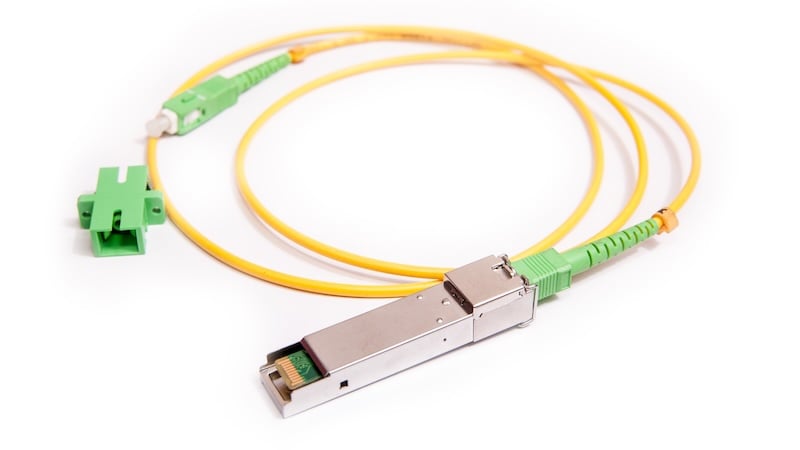
Small form-factor pluggable (SFP) optical transceivers combine heat-generating electronics with highly sensitive optical components. Image used courtesy of Adobe Stock
If a gel releases excessive oil or migrates beyond the intended interface, it can contaminate sensitive optical surfaces, interfere with adhesion, and contribute to optical performance failures. Even trace contamination on critical optical surfaces may affect optical coupling efficiency, increase optical loss, and impact long-term signal integrity. For this reason, optical-grade cleanliness is not a stand-alone specification. It must be engineered together with thermal conductivity, processability, and long-term material stability.
Engineering DOWSIL TC-3120 for Real-World Reliability
EEPower: Dow just launched DOWSIL™ TC-3120 Thermal Gel with roughly 12 W/m·K thermal conductivity. What engineering trade-offs typically stand between high thermal conductivity and dispensability, oil bleeding, and long-term reliability, and how was this balance achieved?
Zou Lu: Raising thermal conductivity generally requires a high loading of thermally conductive fillers. That can increase viscosity, reduce softness, complicate dispensing, and make it more difficult to maintain a consistent bond line. At the same time, the material must minimize oil bleed and remain compliant enough to relieve stress between components with different surfaces and tolerances.
In thermal design, higher conductivity alone does not automatically translate into better system performance. The ultimate objective is to reduce total thermal resistance while maintaining processability, reliability, and manufacturability. DOWSIL TC-3120 Thermal Gel was designed to balance these competing requirements. It combines approximately 12 W/m·K thermal conductivity with the application benefits of a silicone thermal gel, including dispensability, conformability, and stress relief. This balance helps manufacturers support efficient, high-volume assembly while addressing the thermal and mechanical demands of compact optical modules.
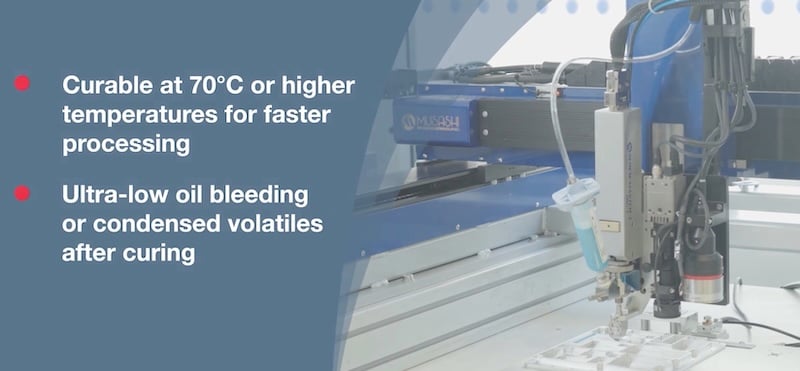
DOWSIL TC-3120 thermal gel supports automated dispensing. Image used courtesy of Dow
EEPower: Transceivers are often mounted vertically with uneven surfaces and tolerance stackups between the module and heatsink. How do material properties such as slump resistance and reworkability change the reliability calculus for these mechanical realities?
Zou Lu: In a vertically mounted transceiver, slump resistance keeps the thermal gel where it was dispensed. This matters because a material that creeps leaves a thinning, voided interface over the hottest components, and once intimate contact is lost, even a high-conductivity material cannot deliver its rated performance. After 1,000-hour vertical aging at 150°C, 85°C/85% RH, and −40 to 125°C cycling, DOWSIL TC-3120 showed no cracking or slumping, while non-curable putties do crack and slump.
A compliant silicone gel conforms to uneven surfaces and tolerance stackups, filling irregular gaps that would otherwise trap insulating air while exerting minimal pressure on fragile components. Reworkability protects yield: a failing module can be cleaned and re-dispensed rather than scrapped, preserving the thermal path from the TOSA box, tunable laser and signal processors to the heatsink or enclosure.
Thermal Interface Materials Beyond the Rack and Beyond 1.6T
EEPower: As liquid cooling and immersion cooling gain traction in hyperscale data centers, how does the role of thermal interface materials change, and where do they remain essential even in a liquid-cooled rack?
Zou Lu: Liquid cooling changes how heat is transported at the rack or system level, but it does not eliminate the need to move heat efficiently out of individual components and across solid-to-solid interfaces. Thermal interface materials remain essential wherever microscopic surface roughness, air gaps, or mechanical tolerances create resistance between a heat source and a heat spreader, cold plate, enclosure, or other cooling structure.

Optical modules are expected to face even higher heat flux and increasingly non-uniform hotspots as bandwidths continue to increase. Image used courtesy of Adobe Stock
The role of thermal interface materials varies based on the application. Different thermal interface materials address different needs, including thin bond lines, large-gap filling, reworkability, mechanical stability, and long-term reliability. This is consistent with the system-level philosophy behind the Dow Cooling Science framework: effective cooling is not a single technology, but an integrated solution built from multiple optimized layers.
EEPower: Looking ahead to next-generation optical modules beyond 1.6T, what thermal management challenges remain unsolved, and what would a breakthrough in materials or system design need to deliver?
Zou Lu: Beyond 1.6T, optical modules are expected to face even higher heat flux and increasingly non-uniform hotspots within tightly constrained package geometries. The remaining challenge is to remove more heat without adding excessive mechanical stress, process complexity, or reliability risk.
Emerging architectures such as co-packaged optics and more advanced photonic integration may further compress thermal budgets while increasing integration density. A meaningful breakthrough would need to improve more than bulk thermal conductivity alone. It would also need to reduce interface resistance, conform reliably to increasingly complex surfaces, remain stable over time, and integrate more tightly with the module and system cooling architecture. Progress will therefore depend on materials and system design advancing together, rather than treating the thermal interface as an isolated component.