Facebook
 Google
 GitHub
 Linkedin
Chemistry Tweak Could Improve Lithium-Sulfur EV Batteries
A hybrid polymer network cathode could lead to cheap, long-lasting, renewable batteries for electric vehicles.
With increasing demands for electric vehicles and renewable energy storage, the limitations of existing lithium-ion battery technology have become increasingly evident. Though widely used, lithium-ion batteries face energy density, sustainability, and cost-efficiency constraints.
Lithium-sulfur (Li-S) batteries are a promising lithium-ion alternative, boasting theoretical energy densities far superior to their lithium-ion counterparts. Sulfur, a key component of Li-S batteries, is abundant, cost-effective, and environmentally sustainable. However, Li-S batteries suffer from poor cycling stability and the detrimental effects of polysulfide dissolution, which significantly reduce battery lifespan and reliability.
A recent breakthrough in Li-S battery cathode design from Southern Methodist University has offered a pathway to unlocking the full potential of Li-S technology. This article explores the chemistry inside the Li-S batteries and how researchers have improved this chemistry for better utilization of Li-S batteries.
Lithium-sulfur batteries could be used in EVs or storage systems. Created from images used courtesy of Canva
The Chemistry Behind Li-S Batteries
Li-S batteries hold immense promise due to their theoretical high energy density and cost advantages over lithium-ion counterparts. Li-S batteries offer energy density reaching 2,567 Wh/kg and 2,199 Wh/L, far exceeding traditional lithium-cobalt-oxide/graphite cells (387 Wh/kg, 1,015 Wh/L). Moreover, sulfur is regarded as a sustainable resource due to its minimal environmental impact during extraction and the potential for recycling it from depleted batteries.
Despite these advantages, Li-S batteries face significant technical challenges that have hindered their practical application, particularly in EVs and renewable energy storage.
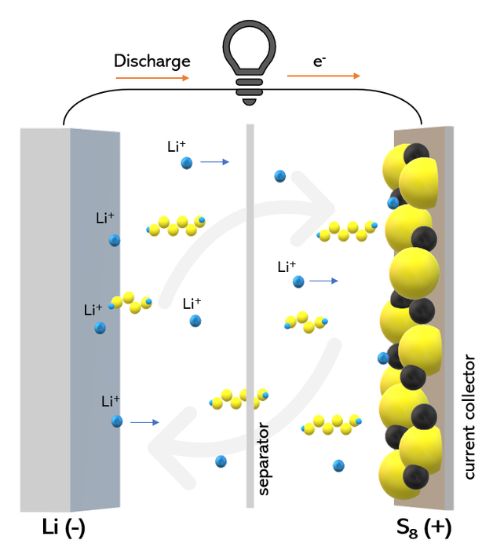
The chemistry of Li-S battery. Image used courtesy of Wikimedia Commons
Central to their operation is the interaction between a sulfur-based cathode and a lithium-metal anode, separated by an electrolyte. Lithium ions react with sulfur at the cathode during battery discharge, forming intermediate polysulfides. Unfortunately, these compounds are soluble in the electrolyte, leading to a phenomenon known as polysulfide dissolution.
This process results in losing active material from the cathode and accumulation on the anode (forming dendrites), progressively reducing the battery's capacity and lifespan. The instability contributes to poor cycling stability, meaning the battery cannot sustain repeated charge-discharge cycles without significant performance degradation.
Furthermore, the inherent instability of sulfur as an electrode material exacerbates the issue, as the chemical bonds within sulfur compounds degrade under repetitive cycling.
Hybrid Polymer Network Cathode
Researchers have developed a novel hybrid polymer network cathode for Li-S batteries to address poor cycling stability and polysulfide dissolution.
Specifically, the team developed a sulfur-infused cathode combining polyphosphazene polymer networks with carbon. This cathode architecture employs multiple sulfur bonding tethers and atomic adsorption sites designed to minimize the formation of soluble polysulfides that degrade performance over time. Additionally, the material enables fast lithium-ion and electron transport at the molecular level, ensuring high electrochemical activity and stability.
The enhanced cathode allows the Li-S battery to achieve an energy capacity of over 900 mAh/g, significantly outperforming traditional lithium-ion batteries, which typically operate in the 150–250 mAh/g range.
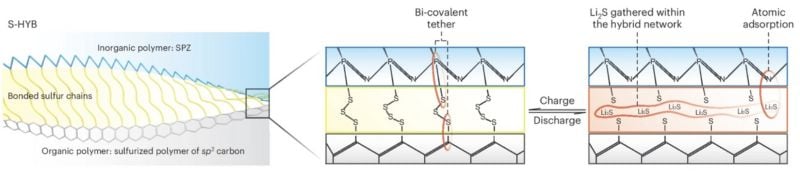
The hybrid polymer network cathode. Image used courtesy of Southern Methodist University
This improvement translates to a much higher energy density of approximately 300 Wh/kg. The 84.9% capacity retention of the Li-S pouch cell after 150 cycles makes it a promising option for applications in renewable energy storage and EVs. Moreover, the structural design of the cathode facilitates real-time re-bonding and adsorption of unbound sulfur species, effectively suppressing the deleterious effects of polysulfide migration into the electrolyte.
Charting the Future of Energy Storage
Integrating the hybrid polymer network cathode could be a major boon for the Li-S battery industry. By addressing many long-standing challenges, this research paves the way for more efficient, scalable energy solutions that could extend far beyond EVs and renewable energy systems.