Facebook
 Google
 GitHub
 Linkedin
Qi Standard has Significant Presence at Techno Frontier
Charging pads, wireless power systems, and related components were all on display at the Wireless Power Consortium’s (WPC) booth at Techno Frontier. Among the companies offering products complying with the WPC’s Qi Power Standard were TDK, Triune Systems, Hitachi Maxell, Convenient Power, Panasonic and RRC Power Solutions.
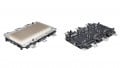
TDK was showing a first-generation wireless power transfer coil unit specifically designed for use in smartphones and other mobile devices. The receiving coil can be integrated into smartphones. The prototype has a height of 0.57 mm. The design of the coil reduces the tendency towards increasing resistance and attains power transfer efficiency so that the specifications set by the WPC "Qi" standard are cleared. This coil unit can be used in smartphones because of its low height. Currently, the coil produces an output current on the order of 0.5 to 0.6 A. The company is already developing even thinner 0.50 mm type coil which is expected to enter mass production during 2013.
Next to TDK, MCM Japan Ltd. was demonstrating the use of prototype power management ICs from Triune Systems in a wireless charging module measuring 25 x 4 x 1.55mm. Triune is developing two ICs for Qi charging modules, the TS51011 rated for 1.6A output current will be in a 2.2 x 3mm chip scale package and the TS51111 is expected to be rated for 3.2A in a 2.2 x 3.8mm chip scale package. According to Triune, the new ICs will offer several advantages including; support for both direct and indirect charging applications, improved system efficiency with direct charge, firmware-based programmable solutions for greater flexibility, and high efficiency.
On the other side of the booth, Hitachi Maxell and Panasonic were demonstrating wireless charging pads based on the Qi standard. Among the products offered by Panasonic are the QE-TM101 wireless charging pad, the QE-PL201-W and QE-PL101-W Qi-capable portable battery, and the QE-CV201-W wireless AA/AAA battery charger. The QE-TM101 is designed to charge any Qi-compatible devices. The QE-PL201-W and QE-PL101-W are portable batteries with 5400mAh and 2700mAh capacity, respectively. The QE-CV201-W is an AA/AAA battery charging case that gets power from the QE-TM101 Charge Pad. These devices are currently available in Japan.
Next to Panasonic, Hitachi Maxell was demonstrating its Air Voltage wireless Qi charging mat and sleeve. Offered in Japan and Europe, the Air Voltage system is initially targeted only at the iPhone4. In the near future, additional accessories will be offered for charging a variety of devices including digital cameras and other smart phones. The charging mat is offered in two models, with one and two charging locations, respectively.
While Panasonic and Hitachi Maxell were demonstrating complete charging solutions, WPC co-founder Convenient Power was showing its RX-6 Qi-compatible 5W charging module. The RX-6 measures 35mm square and 2.5mm thick and is a complete Qi charging subsystem ready for integration into consumer and OEM systems. According to the company, the RX-6 is supplies the wireless charging capability to the Energizer InductiveCharger system. It features two large inductive charging zones that don’t require locking the device into a precise position, so consumers can simply set down their phone and be sure that it will be charged and ready to go. It also has a USB port so it’s easy to charge an additional device such as a phone, headset, mp3 player, camera or GPS. Two LED charge lights indicate that the device is charging.
In a separate booth across the way from the WPC group booth, RCC Power Solutions was offering evaluation kits for wireless power and data transmission. The evaluations kit is composed of a power transmitter with a sender coil, a universal power supply with 19Vdc output voltage, a receiver module with a receiver coil and various headers and receptacles (for use in a developer environment). The receiver module provides a regulated output voltage of 5V and a maximum of 5W power output.
The RCC power transmitter has integrated safety functions such as automatic receiver detection, the continuous reception of status information from the receiver, foreign object detection, as well as monitoring of the input and output voltage. The receiver module has integrated safety functions such as for example, the continuous transfer of status information to the power transmitter, as well as surge and undervoltage protection. The compatibility with Qi standard is realized by a firmware update.
In addition to offering Qi-compatible systems, RCC offers higher-power systems providing up to 500W of charging power. The various RCC systems are being used across a wide range of applications from medical applications such as AEDs to center consoles for the next-generation of cars.