Facebook
 Google
 GitHub
 Linkedin
TI Intros 26-Cell Battery Monitor IC With Integrated Smart EIS Engine
Unveiled today at PCIM, TI’s new automotive-grade battery monitor IC increases channel density by 44% and embeds real-time EIS to detect internal cell faults and mitigate thermal runaway.
Today, at PCIM 2026 in Nuremberg, Germany, Texas Instruments introduced the BQ79826Z-Q1, the industry's highest-cell-count battery monitor featuring an integrated electrochemical impedance spectroscopy (EIS) engine. Tailored for electric vehicles (EVs) and industrial energy storage systems (ESSs), the device brings predictive intelligence, comprehensive data, and real-time diagnostics directly to battery monitoring architectures.
The primary advancement of this single-chip monitor is its capability to track up to 26 cells connected in series, delivering eight more cells per device than competing market solutions. This represents up to a 44% increase in monitoring channels compared to previous device generations.

TI’s new BQ79826Z-Q1 battery monitor IC enables increased safety and performance in EVs and ESSs.
To learn more about the new device, EEPower attended a pre-briefing with Texas Instruments spokespersons Wenjia Liu Vice President & General Manager - Battery Management Solutions and Brian Burk Systems Engineer and Product Manager, Battery Monitor Products.
By supporting more cells per device, the monitor significantly decreases the total number of components required within a high-voltage battery pack. This reduction in component density streamlines architectural complexity, reduces required board space, and lowers overall system bill-of-materials (BOM) costs without sacrificing pack quality or reliability.
"With 26 cells, designers can eliminate multiple monitors in the system, streamlining the architecture, cutting the bill of materials and freeing up that valuable board space within the system," said Brian Burk.
Integrated EIS Engine for Internal Cell Diagnostics
Wenjia Liu gave some background regarding the term electrochemical impedance spectroscopy (EIS) in the context of BMS. “EIS technology has been around for decades,” she said. “Only very recently has it become practical and been applied at scale in real-world applications like EVs and ESS.”
"In an oversimplified way, you can think of EIS as a battery's EKG,” continued Liu. “So instead of just measuring the surface level signals like voltage and temperature, it provides a deeper look into the battery's internal cell behaviors and enables early detection and predictive insights that traditional sensors weren’t able to provide."
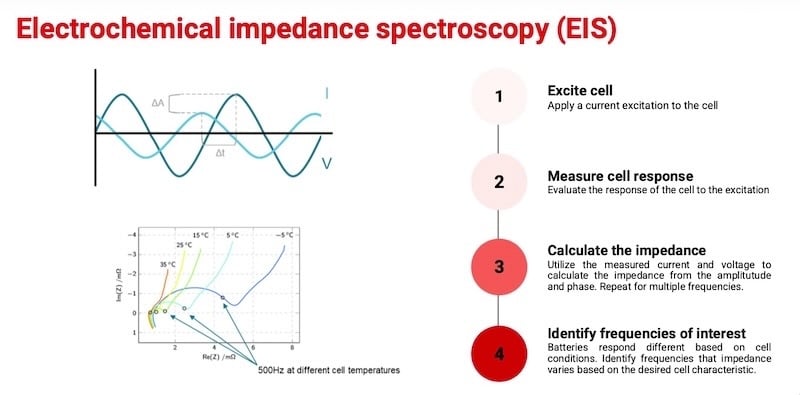
EIS technology is used to analyze chemical state-date from inside the battery cells, enabling early fault detection.
By analyzing rich chemical-state data from inside the cells, the system can detect internal fault conditions much earlier than conventional monitors. This enables an early warning system for severe vehicle and system hazards such as thermal runaway. These continuous diagnostic benefits extend across the grid-to-gate ecosystem, aiding engineers in tracking the state of charge (SoC) and state of health (SoH) of large battery installations required to meet the scaling power demands of artificial intelligence data centers.
"With TI's EIS technology, engineers can now reduce the number of temperature sensors, and actually get improved temperature accuracy by using superior battery core temperature readings,” says Burk.
According to its technical specifications, the embedded smart EIS engine achieves an impedance accuracy of 1% when utilizing a 1 A excitation current and a 200 µΩ cell impedance. The engine supports an excitation frequency range spanning from 0.01 Hz to 3.5 kHz, allowing for both local and global excitation topologies.
To ensure precise data correlation, the device maintains an internal current and voltage (I/V) synchronization of less than 5 µs from device to device. Meanwhile, the EIS measurement routine is five times faster than previous architectures, allowing the chip to deliver highly responsive functional safety voltage readings per cell.
High-Precision Sensing and Scalable Communication Topology
To address range anxiety for EV drivers, the monitor enables highly precise temperature and state-of-charge estimations. The BQ79826Z-Q1 delivers a cell voltage accuracy of less than 2 mV across a full automotive temperature range of –40°C to +125°C. It relies on a dedicated analog-to-digital converter (ADC) per channel alongside ultra-low noise filtering.
The monitor supports an absolute maximum voltage rating of 143 V, with a cell measurement range of 0 to 5.5 V and a busbar measurement capability of –2 V to 2 V on every channel except the first channel.
For high-voltage battery arrays, the BQ79826Z-Q1 features an upgraded daisy-chain interface that supports a 2 Mbps bus speed, which can scale up to 4 Mbps using dual SPI modes. Up to 128 devices can be stacked together in stack, ring, multidrop, or split-ring topologies via transformer or capacitor-only isolation barriers.
This interface maintains a device-to-device automatic communications balancing synchronization of under ±5 µs, yielding a Fault Detection and Isolation Time (FDTI) of less than 100 ms for 800 V packs or configurations with 250 cells. More information is available in the BQ79826Z-Q1 data sheet.
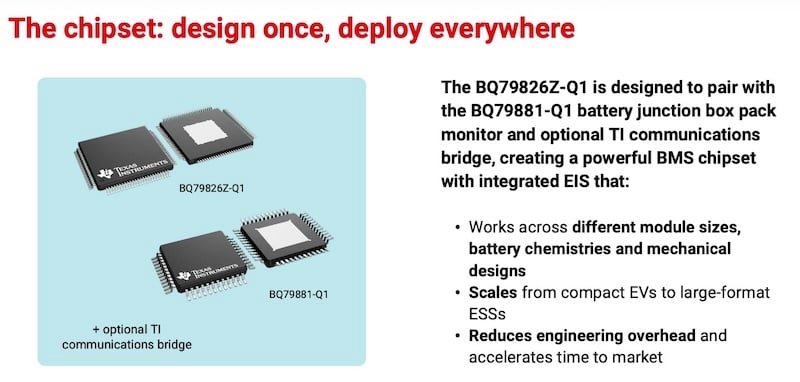
The BQ79826Z-Q1 is designed to be scalable, working across different module sizes, battery chemistries and mechanical designs.
When paired with the BQ79881-Q1 pack monitor and an optional communications bridge, these components form a flexible chipset that allows engineers to design a single platform and deploy it across varied module sizes and battery chemistries.
"This scalability gives engineers the flexibility to design once and deploy everywhere,” says Liu. “This provides savings in engineering overhead, drives shorter time to market, and also lower total BOM cost."
Safety, Balancing, and Power Management Features
Developed under strict ISO 26262 guidelines, the BQ79826Z-Q1 complies with Automotive Safety Integrity Level D (ASIL-D) requirements to provide a reliable path to functional safety. Protection mechanisms include autonomous hardware monitoring for cell over-voltage, under-voltage, over-temperature, and under-temperature conditions, complemented by open-wire detection and dual on-chip die temperature sensors.
To maintain charge equilibrium across the cell stack, the device incorporates passive cell balancing via integrated FETs. It supports up to 300 mA of odd/even balancing current with programmable pulse-width modulation (PWM) control and automatic diagnostics during balancing routines.
System power is optimized across three main operating modes: an active mode consuming less than 5 mA, a low-power monitoring sleep mode drawing as low as 20 µA, and a total shutdown state that consumes less than 10 µA.
For external system interfaces, the monitor provides 20 multi-purpose GPIO pins that handle temperature sensing (via NTC/PTC thermistors), general voltage measurements, and a dedicated sensor monitor with a peak-hold and pressure threshold detector. The entire system is housed in a 100-pin HTQFP package measuring 12 mm x 12 mm with an integrated bottom-side PowerPad for optimal thermal performance.
Market Availability
According to Texas Instruments, the BQ79826Z-Q1 represents a significant step forward in battery management intelligence. Preproduction quantities of the monitor are currently available on TI.com, with full production volumes anticipated by the end of 2026.
To support development, TI provides comprehensive evaluation modules (EVMs) and reference designs, which are being showcased alongside other high-voltage power innovations at the PCIM 2026 Expo and Conference this week in Nuremberg, Germany.
All images used courtesy of Texas Instruments.