Facebook
 Google
 GitHub
 Linkedin
Nanopower’s Sensor Monitoring IC Saves Power on Always-On Devices
Nanopower Semiconductor’s power-saving IC manages sensors and peripherals while keeping the host MCU off, with an idle current of just 200 nA.
Nanopower Semiconductor has expanded its nPZero family with the nPZ2100, an ultra-low-power IC for battery-powered and energy-harvesting sensor systems. The device handles sensor monitoring and peripheral control without keeping the main MCU powered.
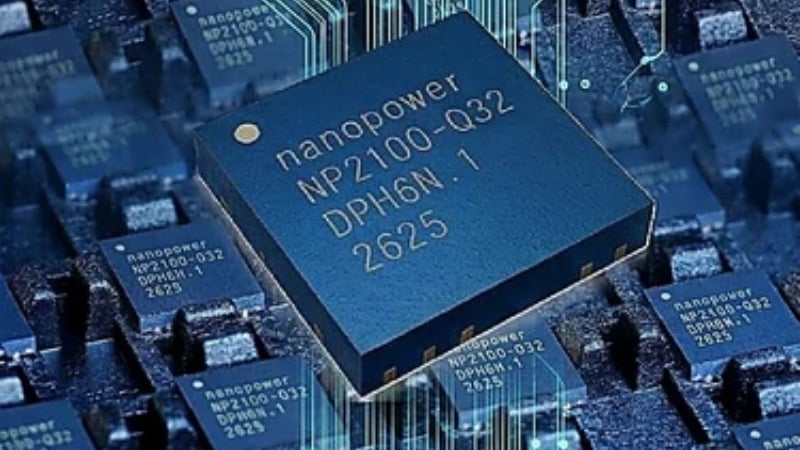
Nanopower Semiconductor’s nPZ2100 is an ultra-low-power IC for managing sensors and MCU wake-ups in battery-powered systems.
The nPZ2100 consumes 200 nA in idle operation and 1 µA while polling. It can autonomously manage up to six I²C or SPI sensors and wake the host MCU only when a configured event requires additional processing. This approach reduces overall system power by cutting both MCU run time and the power sensors consume while idle.
Keeping the MCU Off
The nPZ2100 (datasheet linked) takes over the basic monitoring jobs that would normally require the main MCU to wake up. In a typical sensor system, the MCU may periodically turn on just to read a sensor, check the value, and then go right back to sleep. Doing that throughout the day adds to the system's overall power consumption, even when most readings don't require any action.
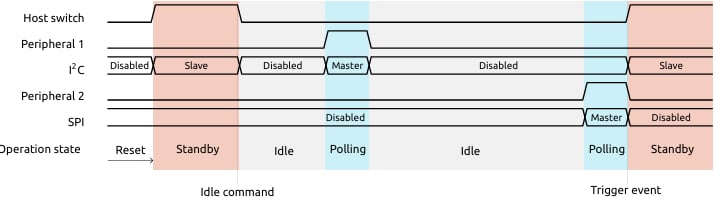
The nPZ2100 can poll connected peripherals while the host is off, then wake the MCU when a configured trigger occurs.
Instead, the nPZ2100 can monitor up to six sensors over I²C or SPI and compare the readings against programmed thresholds on its own. If a sensor crosses a threshold, an external interrupt occurs, or another trigger is detected, it can wake the host MCU to handle the event. This is particularly useful for edge AI systems, where the main processor or accelerator may draw considerably more power. Rather than waking that hardware for every sensor reading, the nPZ2100 can handle basic checks and bring the processor online only when there is something it actually needs to process.
Powering Sensors Only When Needed
Nanopower also includes four 1-mA power switches for connected sensors and peripherals, plus a separate 10-mA switch for the host. This lets the nPZ2100 shut down both the MCU and unused sensors, reducing the standby power they would otherwise draw between measurements.
The nPZ2100 operates from 1.7 V to 3.6 V and across -40°C to +85 °C. It includes 256 bytes of SRAM for sensor setup commands, data logging, and general storage. A three-channel 8-bit ADC can monitor two external signals and the battery voltage, with programmable thresholds that can wake the host when needed.
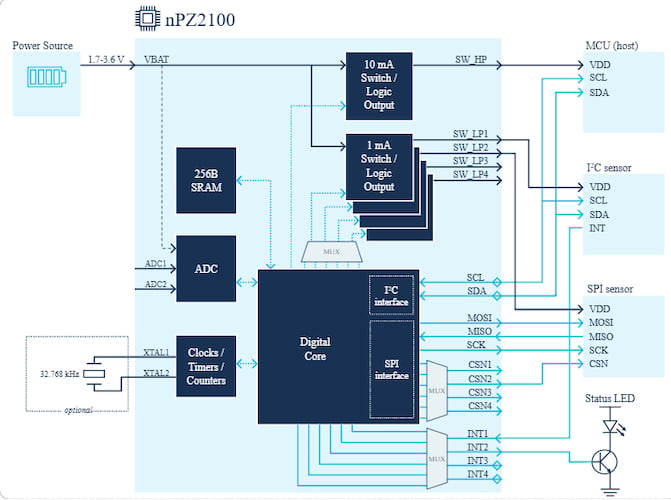
The nPZ2100 integrates host and peripheral power switches with I²C and SPI interfaces, an ADC, SRAM, timers, and counters.
Other built-in functions include a 36-bit time counter with an alarm, a watchdog, and a 32-bit event counter. The device has an internal oscillator and can also use an external 32.768-kHz crystal for more accurate timing. Package options include a 5 mm × 5 mm QFN32 and a smaller 2.5 mm × 2.5 mm WLCSP34.
Stretching the Power Budget
The nPZ2100's low current draw is especially useful in systems that spend most of their time waiting for something to happen. At 200 nA in idle and 1 µA while polling, the nPZ2100 can stay active while the main MCU remains off. Nanopower says this can cut total system power by up to 90% in some sensor-based applications.
The device also has a power-aware mode for energy-harvesting systems. If available energy starts to drop, it can reduce how often sensors are polled and how often the MCU is woken up. That helps stretch the available power in remote sensors, asset trackers, monitoring systems and other devices that may need to run for long periods on small batteries or harvested energy.
Battery life is also becoming more important with the EU Battery Regulation, which introduces new requirements for removable and replaceable portable batteries starting February 18, 2027. Even when a battery can be replaced, reducing unnecessary MCU and sensor activity can still extend the time between changes and reduce maintenance.
The nPZ2100 handles routine work in an always-on sensor system while keeping the main processor off as much as possible. With support for up to six sensors, integrated power switches, 200-nA idle current, and built-in timing and monitoring functions, it gives engineers another way to reduce power use without keeping the host MCU running constantly.
All images used courtesy of Nanopower Semiconductor.