Facebook
 Google
 GitHub
 Linkedin
Mean Well Serves Up 6 kW and 12 kW Energy Storage Inverters
The single-phase and three-phase inverters target high-efficiency residential and commercial photovoltaic applications with flexible grid-tied and off-grid operational modes.
Mean Well has introduced the ES-HSI series of energy storage inverters as a flexible power-conversion solution for residential and small commercial applications.
With dual maximum power point tracking (MPPT) inputs, multi-mode operational flexibility, and an IP66 rating, the Inverter could help power engineers optimize solar extraction and energy storage in on- and off-grid environments.
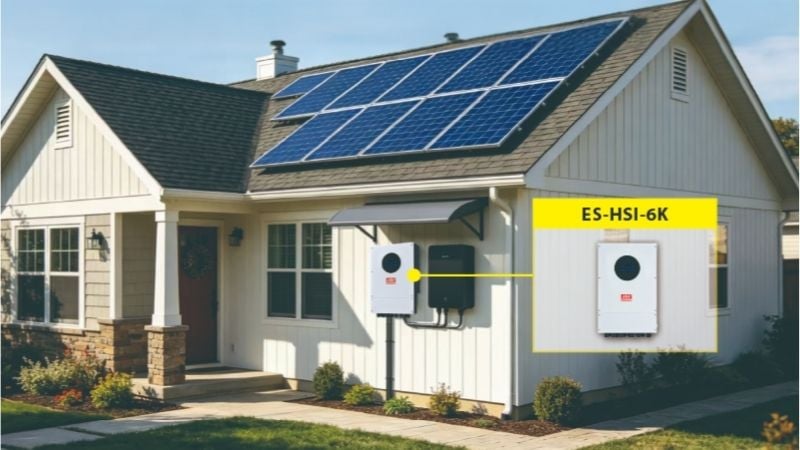
The ES-HSI-gK inverter. Image used courtesy of Mean Well
ES-HSI Series of Energy Storage Inverters
Mean Well configured the ES-HSI series to help designers choose the options that best fit their specific site requirements.
The single-phase ES-HSI-6K model provides 6 kW of power with a maximum DC input of 500 VDC, while the three-phase ES-HSI-12K model delivers 12 kW and accommodates up to 900 VDC. Both versions include dual MPPT inputs, allowing engineers to design power strings with different orientations or lengths to maintain high power generation efficiency under any solar condition. According to Mean Well, these units improve system reliability by supporting a maximum current of 21 A per string for the 6 kW model and 27 A for the 12 kW model.
The series also features integrated RS485 BMS communication, which facilitates hardware-level synchronization between the inverter and the battery plant. By dynamically modulating discharge parameters based on real-time cell telemetry, the system can maximize cycle life for lithium-ion and lead-acid strings.
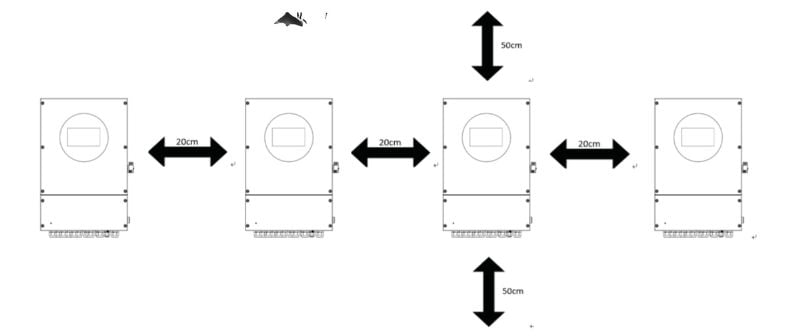
Setting up multiple devices of the single-phase inverter. Image used courtesy of Mean Well
For larger installations, the ES-HSI-6K supports parallel connections of up to nine units to achieve 54 kW, while the ES-HSI-12K allows up to six units to reach 72 kW. Power operators can monitor these configurations via the HMI LCD or the Energy-Mate mobile application.
Maximum Power Point Tracking in Solar Systems
MPPT is a high-frequency DC-to-DC conversion technology that optimizes the match between the solar array and the battery bank or utility grid.
Solar panels exhibit a non-linear output efficiency that varies with solar irradiance and cell temperature. On a power-voltage curve, no single point exists at which the combination of current and voltage results in the maximum power output. Because environmental changes constantly shift this point, MPPT controllers often use an observe-and-adjust algorithm to maintain the electrical load at peak efficiency.
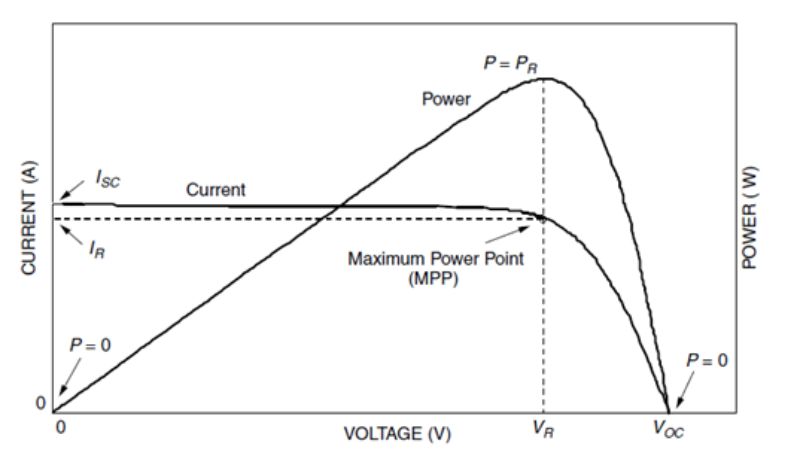
Current-voltage and power-voltage curves for a PV module. Image used courtesy of Northern Illinois University
The tracking process works by varying the inverter's input voltage to find the maximum power output for a given set of conditions. If the controller detects that increasing voltage increases power, it continues to adjust the voltage in that direction until power begins to drop. This continuous scanning helps the system extract the maximum possible energy even during sudden changes in cloud cover.
Research indicates that MPPT can increase a PV system’s energy yield by up to 30% compared to systems using simple pulse-width modulation controllers.
Moving Toward Localized Power Management
According to Mean Well, the ES-HSI series is helping power engineers build more adaptable and resilient power systems. The ES-HSI-6K and ES-HSI-12K series are currently available through Mean Well’s global distribution network, and each unit includes a five-year warranty covering grid-tied and off-grid configurations.