Facebook
 Google
 GitHub
 Linkedin
Ericsson Offers Digitally Controlled Power Module For MicroTCA Applications
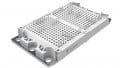
Ericsson Power Modules announced its MicroTCA power module. The digital control of the dc-dc converter that is embedded within the module is described as being truly unique to Ericsson and as providing cutting edge performance in terms of the level of control available, and efficiency.
The power module was initially announced during 2007 as an evaluative level product intended for interoperability testing. The results from numerous interoperability workshops together with MicroTCA component suppliers and system integrators have now been incorporated into the product, now called BMR 911 483/1. Two features that have been added are a USB interface that is accessible to the user via the faceplate, and redundant operation of payload and management power.
MicroTCA is for use in many different types of applications and kinds of Information and Communication Technology (ICT) equipment. Some of the most suitable ones will most likely be edge and access equipment. In addition to applications in the communications industry, this power module is also suitable for applications targeting enterprise, military, medical and industrial markets.
The company claims that open-architecture platforms such as MicroTCA, supported by commercial off-the-shelf (COTS) products, allow TEMs to reduce their investment in proprietary hardware that will shorten design cycles and provide economy of scale by reusing common building blocks. This is said to support the ongoing shift among TEMs in their added value focus move from hardware over to applications and services.
The BMR 911 483/1 requires a -48Vdc supply and is rated at 355W output power. Housed in a full size (6HP) single width form factor package, it provides 16 channels of 12V payload power and 16 channels of 3.3V management power. Designed to comply PICMG® specification MTCA.0 R1.0, it is a standards based product that minimizes interoperability testing when used in MicroTCA systems.
With its high efficiency figure of typically 95% at half load, the BMR 911 483/1 is said to offer reduced energy consumption, lower cost of operation and reduced environmental impact. The single board design offers a cost efficient solution and good thermal performance. The integral USB interface is said to allow the user to debug and monitor operation during evaluation and system integration. Redundant payload and management power operation features provide for improved system level reliability by N+1 redundant power module implementation. Technology-wise the module includes an FPGA based Enhanced Module Management Controller (EMMC).