 Facebook
 Google
 GitHub
 Linkedin
Diodes Inc. Rolls Out Compact Hall-Effect Current Sensors for EV Charging
These automotive-compliant sensors integrate differential Hall sensing and galvanic isolation in an SO-8 footprint to cut power losses and save PCB space across EV, industrial, and communications power systems.
Diodes Incorporated has expanded its automotive-compliant sensing portfolio with the release of the AHC1724Q and AHC1725Q Hall-effect current sensor ICs. Engineered as an economical, high-precision solution for AC and DC current measurement, the devices target space-constrained automotive, industrial, commercial, and communications systems where minimizing printed circuit board (PCB) area reduces overall bill-of-materials costs.
By combining a low-resistance primary conduction path with built-in galvanic isolation in a low-profile surface-mount package, the sensors simplify high-side current measurement and eliminate the need for bulky external isolation components.
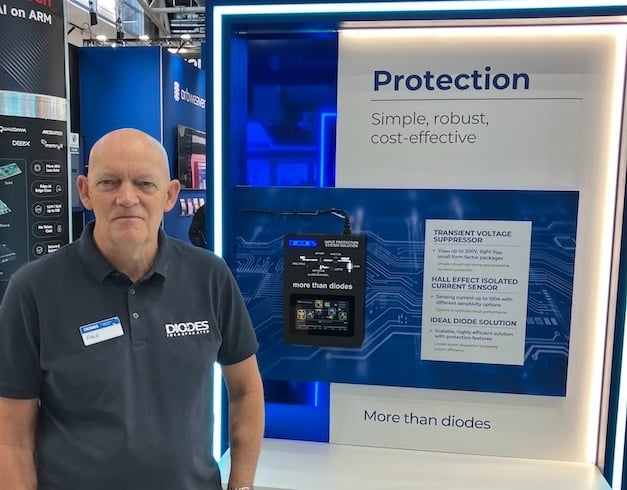
At the company’s Electronica booth last week, Paul Mitchell, Director - Industrial System Solutions at Diodes Inc. talked to us about the new sensors from a systems point of view.
Differential Hall Architecture and High Accuracy
The AHC1724Q and AHC1725Q integrate a low-offset, linear Hall sensor circuit with a copper conduction path positioned close to the surface of the die. As current flows through this primary copper path, it generates a magnetic field that the integrated Hall IC detects and converts into a proportional analog voltage.
To maintain measurement integrity in magnetically noisy power electronics environments, the devices sense current differentially to reject common-mode stray magnetic fields. Inherent measurement precision is maximized by the close physical proximity between the current-carrying copper path and the Hall transducer, alongside a chopper-stabilized architecture that is programmed for accuracy after packaging.
For high-speed control loops and fault detection, the sensors deliver a 120kHz high-bandwidth analog output that supports rapid response times. Both devices provide a ratiometric output tailored to standard system rails—the AHC1725Q operates from a 3.3V nominal supply (3.0V to 3.6V), while the AHC1724Q operates from a 5V nominal supply (4.5V to 5.5V)—across unidirectional and bidirectional sensing options spanning ±2.5A to ±50A. More information can be found in the data sheets for the AHC1724Q and AHC1725Q.
Low Conduction Loss and Galvanic Isolation
Efficiency and thermal management are anchored by a primary copper conduction path with a typical internal resistance of just 1. 2mΩ. Routed from pins 1 and 2 to pins 3 and 4, this low-impedance path produces a positive output voltage slope as current increases while keeping I2RI^2RI2R power dissipation minimal and providing high inrush current withstand capability.
In addition to reducing conduction losses, the package architecture simplifies circuit isolation. The terminals of the primary conductive path are electrically isolated from the sensor leads on pins 5 through 8. This built-in galvanic isolation enables engineers to deploy the AHC1724Q and AHC1725Q directly in high-side current-sensing topologies without external high-side differential amplifiers or complex isolation circuitry.
Automotive Qualification and System Integration
Housed in an industrial-standard, low-profile SO-8 (Type CJ2) surface-mount package, the sensors feature a 100% matte-tin-plated lead-frame compatible with standard lead-free PCB assembly processes. Both devices are fully RoHS compliant, totally lead-free, and classified as halogen- and antimony-free "Green" components.
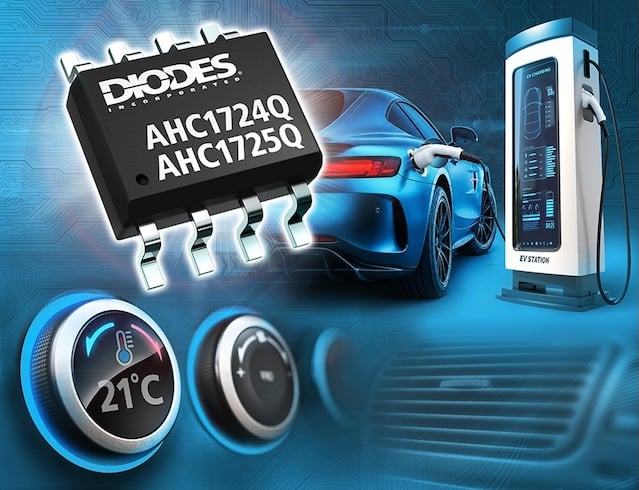
The AHC1724Q and AHC1725Q Hall-effect current sensor ICs target space-constrained automotive, industrial, commercial, and communications systems. Image used courtesy of Diodes Inc.
Built for harsh operating environments, the ICs are AEC-Q100 qualified across an ambient temperature range of -40°C to +150°C and incorporate robust electrostatic discharge (ESD) protection rated at 6kV Human Body Model (HBM) and 2kV Charged Device Model (CDM). To support automotive programs with strict change-control requirements, both parts are PPAP-capable and manufactured in IATF16949-certified facilities.
With their compact footprint and isolated high-bandwidth sensing, the AHC1724Q and AHC1725Q are well suited a wide range of power conversion and protection designs, including xEV onboard chargers (OBCs) and EV charging stations, motor control, load detection and management, switched-mode power supplies, overcurrent fault protection, solar microinverters, base station radio power amplifiers, and server power infrastructure (PSUs, PDUs, and UPS systems). In 4,000-piece quantities, the AHC1724Q is priced at $1.30 per unit and the AHC1725Q at $2.20 per unit.