Facebook
 Google
 GitHub
 Linkedin
The Grid America Needs: 765 kV, SF₆-Free, and Built for the Future
A new generation of circuit breakers is becoming the future backbone of the United States’ energy transition.
The American power grid is at a threshold, uncomfortable but unavoidable. After nearly fifteen years of almost flat electricity demand, consumption is on the uptick again. The rise is driven by the exponential growth of data centers, electric vehicles, semiconductor fabrication facilities, and reshored manufacturing. What’s clear is that even the most conservative growth trajectories forecast massive grid expansion that far outstrips current construction.
The infrastructure we have was designed for lightbulbs, basic appliances, and industrial machinery, not for today’s world of data centers and electric vehicles. The American Society of Civil Engineers pointed to this deepening mismatch between grid capacity and need. It rated America’s energy sector a D+ in its 2025 Infrastructure Report Card, as reported by Renewable Energy World. The grid has barely kept pace. For example, in a recent year, the US added just 888 miles of new 345 kV-and-above transmission lines nationally, according to the Niskanen Center. This is a fraction of what analysts say is needed.
Something has to give. It’s becoming increasingly evident that the answer is to go up — in voltage.
The Case for 765 kV
Compared to conventional 362 kV lines, 765 kV transmission lines carry about twice the power across the same right-of-way and suffer approximately half the energy losses. For a landscape like America that needs to transport massive amounts of renewable energy from wind-swept prairies and sun-drenched deserts to urban consumers hundreds of miles away, this efficiency premium is pivotal.
The nation’s Regional Transmission Operators (RTOs) are paying attention. According to Hitachi Energy’s analysis of public RTO planning documents — including MISO’s Long Range Transmission Planning Tranche 2.1, ERCOT’s 2024 Regional Transmission Plan, PJM’s TEAC recommendations, and SPP’s 2025 Integrated Transmission Planning Assessment — the US 765 kV grid is poised for dramatic expansion. Mileage is expected to grow from approximately 2,300 miles today to more than 8,000 miles by 2034. In December 2024, MISO approved a portfolio that includes a 3,631-mile, 765 kV backbone across the Midwest. PJM, SPP, and ERCOT are following suit with planned expansions across the South, the Great Plains, and the mid-Atlantic.
The buildout is real and pressing forward. But transmission lines are only one part of the story. Less visible, and equally important, is what happens at the substations where that power is switched, controlled, and protected.
The Hidden Environmental Liability Inside Every Substation
For many decades, the high-voltage equipment industry has relied on sulfur hexafluoride (SF₆) as its insulating gas of choice. SF₆ has extraordinary electrical capabilities: it is an exceptional insulating gas and arc-quencher. It is also one of the most potent greenhouse gases ever synthesized. SF₆ has a global warming potential 24,300 times that of carbon dioxide and an atmospheric residence time of at least a thousand years. Its overall effect is equivalent to approximately 0.6% of global carbon dioxide emissions.
That number sounds small. But when you do the math for the 765 kV buildout and keep in mind the highly specialized character of such equipment, you may have second thoughts on the topic. Hitachi Energy estimates that the new 765 kV circuit breakers needed for the US grid expansion — 300 units or more — would require 340 to 550 metric tons of SF₆ if built with conventional technology. That volume represents a banked carbon “liability” of 8 to 13 million tons of CO₂. If it were released, or slowly leaked, this amount would equal putting nearly three million gasoline cars on the road for a year.
The regulations to remove SF₆ are gaining momentum. In California, the Air Resources Board’s regulation on SF₆ emissions from gas-insulated equipment began phasing out new installations at voltages up to 145 kV, with full prohibition across all voltages by January 1, 2033 (CARB). In New York, the Department of Environmental Conservation has adopted parallel timelines (NYSDEC). Under the European Union’s revised F-Gas Regulation (EU 2024/573), new high-voltage switchgear using SF₆ will be prohibited starting in 2028 for equipment between 52 kV and 145 kV (details). The ban expands to equipment above 145 kV in 2032 (EU F-Gas Regulation). The writing is on the wall.
The question that grid planners face is not whether to move away from SF₆. It is how to do it while maintaining the performance and reliability established by conventional high-voltage equipment. And is the technology ready to make that leap right up to 765 kV?
Engineering a Cleaner Breaker
It is difficult to replace SF₆. An alternative gas has to combine very low global warming potential, high dielectric strength, and arc-quenching capability. Given these demanding requirements, it is unsurprising that after more than a century of search, no single gas has been found to match SF₆'s combination of these unique properties.
Hitachi Energy did get there, though. It developed a carefully engineered gas mixture rather than a single replacement. This solution is the result of more than fifteen years of basic research and has been validated through the deployment of over 3,200 EconiQ® units across 33 countries. For metal-enclosed switchgear, including dead tank circuit breakers, the solution is a blend of 86.5% CO₂, 10% O₂, and 3.5% C4-FN (a synthetic fluoronitrile compound). This mixture reduces the CO₂-equivalent lifecycle emissions by more than 99% while replicating the dielectric and arc-quenching performance of SF₆. By introducing this gas mixture, the carbon footprint of the insulating gas becomes only a negligible fraction of the circuit breaker’s overall footprint, rather than the primary contributor as it is in SF₆ circuit breakers.
For those curious about the underlying science, it is the small percentage of C4-FN that is at the root of the scalability to the highest voltages. Fluorine’s position in the periodic table of chemical elements leads to its extraordinary electronegativity and makes it essential for gas mixtures with high dielectric strength and equipment with a compact footprint. The well-proven technology of gas circuit breakers could be tuned to the properties of the new gas mixture, inheriting the scalability, statistical predictability, and long-term reliability of its older SF₆ counterparts.
Using this technology, the company delivered the world's first SF₆-free 420 kV dead tank circuit breaker in December 2023, which has been installed in Connecticut, United States. EconiQ dead tank breakers now range from 72.5 kV to 500 kV at current ratings up to 80 kA. There is also parallel maturity in the gas handling ecosystem, including monitoring, analysis, leak detection, and service equipment.
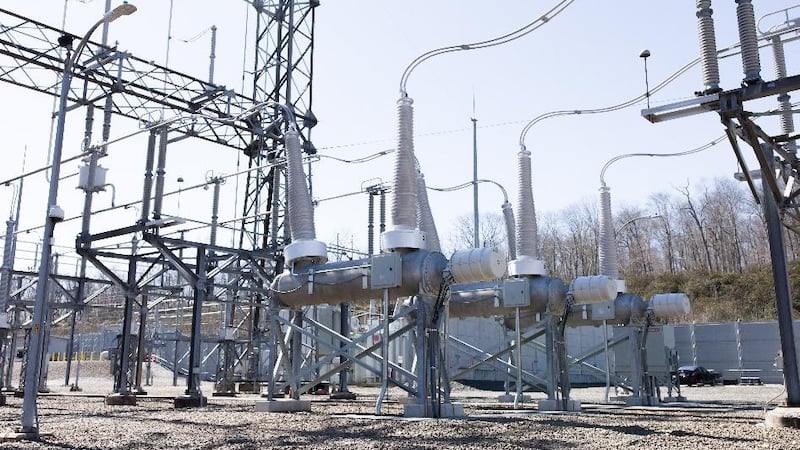
The world’s first SF₆-free 420 kV Dead Tank Circuit Breaker was installed in Connecticut, United States. Image used courtesy of Hitachi Energy.
Scaling this technology to 765 kV is the next frontier. The key engineering insight is that increasing the voltage in a dead tank breaker does not necessarily require exposing each and every interrupter unit to a proportionally higher stress, but rather involves adding more interrupter units in series. Where a 550 kV EconiQ breaker uses two interrupter units plus an optional pre-insertion resistor, a 765 kV circuit breaker uses three interrupter units in series plus a pre-insertion resistor. Ideally, the voltage would be distributed by 1/3 across each interrupter unit; due to tolerances, it can be slightly higher on the individual unit. Nevertheless, the equivalent stress on a single interrupter unit at 765 kV is slightly lower than that in a 500 kV design — 440 kV versus 449 kV for the peak transient recovery voltage case.
The EconiQ 800 kV Dead Tank Circuit breaker will meet all aspects of IEEE C37 requirements for dielectric, switching, mechanical, and thermal performance. It operates over an ambient temperature range of -30°C to +50°C (with tank heaters extending the range further), carries a rated continuous current of up to 5,000 Amperes, and handles a rated short-circuit breaking current of 63 kA. Scaling the EconiQ technology from 500 kV to 765 kV is not a speculative aspiration. It is an industrial product development that will soon become a commercial reality.
The Downstream Effect of More Upstream Power
Lurking beneath the groundbreaking news of 765 kV grid expansion is a subtler challenge that deserves more attention: what happens to the lower-voltage networks that will receive power from these new ultra-high-voltage lines?
When a large, low-impedance 765 kV system comes online and integrates into an existing 362 kV network, prospective fault current levels at 362 kV will often rise. They can sometimes surpass the standard 63 kA rating for existing circuit breakers in those networks. A breaker designed for today’s fault levels may not be able to withstand a 765 kV interconnection going live upstream of it.
More than half of the states with planned or existing 765 kV infrastructure rely on 362 kV as their primary transmission voltage below 765 kV. More than one-fourth of them combine 500 kV and 362 kV infrastructure. Preparing these downstream networks for the consequences of the 765 kV expansion is an obvious responsibility for grid planning.
Hitachi Energy has designed an SF₆-free solution for this problem: the EconiQ 362 kV/80 kA dead tank circuit breaker. The higher fault-current capability is achieved through a combination of techniques: line-to-ground capacitors to delay the onset of transient recovery voltage in short-line fault scenarios, and adjusted contact timing to manage higher asymmetrical current energy. The outcome is a breaker that can protect a receiving 362 kV network that has been "stiffened" by an upstream 765 kV connection — without any SF₆.
A Moment of Genuine Choice
There is some irony in the current situation of the American grid. The energy transition that calls for a stronger transmission grid is part of the solution to the climate challenge, according to the IPCC. Yet it is incomplete if we don’t “walk the talk” and build that transmission grid without adding decades of greenhouse gas emissions inside the switchgear. Every SF₆-filled breaker installed today is a climate liability that will stay for forty years or longer.
The good news is that utilities now have choices. We have the technology to build a 765 kV grid that is both robust and environmentally responsible. The regulatory landscape in California, New York, and, increasingly, the rest of the US is shifting to align with that technology. While the economics still need some adjustment, it is coming together: SF₆-free solutions eliminate a long-term liability, reduce carbon tax exposure, and simplify end-of-life decommissioning. They potentially offer a lower total cost of ownership over the asset lifecycle.
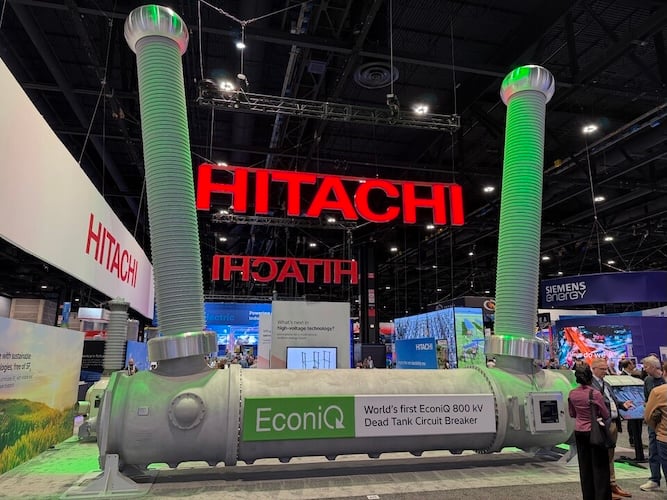
At the IEEE PES T&D Conference in Chicago, Hitachi Energy unveiled the world’s first 800 kV, 63 kA Dead Tank Circuit Breaker, completely free of SF₆. Image used courtesy of Hitachi Energy.
What remains to make it happen is will — the engineering courage of utilities, transmission operators, and regulators to specify SF₆-free equipment at 765 kV. The grid that America is building for the next fifty years does not need to exacerbate the environmental impact of the last fifty.
The American grid transformation is, at its core, a story about the future we are choosing to build. The circuit breakers may be invisible to the public, hidden inside substations along remote rights-of-way. But they are not incidental. They are load-bearing elements of the energy future, structurally, electrically, and environmentally. Getting them right matters.
The technology is ready. Let’s put it to work.