 Facebook
 Google
 GitHub
 Linkedin
EPC Displays High-Density GaN Solutions for AI, Robotics, and Space at Electronica
EPC highlighted next-gen GaN power architectures at Electronica 2026 last week, driving efficiency and density across AI data centers, humanoid robotics, and space electronics.
Efficient Power Conversion (EPC) was one of the first companies to develop and industrialize enhancement-mode gallium nitride (GaN) technology and has since been an active driver of the industry’s transition from silicon MOSFETs to GaN FETs.
Since entering the GaN market, EPC has stood out for helping to bring what was then an emerging technology to full maturity, delivering electrical and reliability performance superior to that of much more established technologies. Its portfolio has progressively expanded from discrete power devices to integrated power stages, application-specific ICs and complete reference designs, some of which were showcased at the Electronica tradeshow, held last week in Munich from November 10 through 13.
The company’s proprietary technology can successfully address most of today’s most stringent power-conversion requirements, such as power density, efficiency and switching frequency in low- to medium-voltage applications.
Interesting Demo’s at EPC’s Booth
During my visit to the company's booth, EPC's Vice President, Jason Zhang, walked me through a series of demos illustrating the company's approach to three rapidly growing markets: AI power data centers, physical AI and robotics, and space electronics.
Rather than focusing exclusively on individual semiconductor components, the demos highlighted the role of GaN across complete power-conversion architectures, from high-voltage distribution to low-voltage processor supply and high-performance motor drive. This reflects an important evolution in EPC's strategy and mission: moving beyond the advantages of the individual GaN transistor to demonstrate how the technology brings improvements to the entire ecosystem.
GaN Caters to the Growing Power Needs of AI Infrastructure
AI was one of the major themes at Electronica, and EPC embraced it across several of its demos and technology showcases.
The rapid expansion of AI computing is placing unprecedented demands on data-center power infrastructure, particularly as the power consumption of next-generation processors continues to increase. Delivering large amounts of power efficiently, while minimizing conversion losses and reducing the system footprint, has therefore become a major engineering feat.
EPC's demos addressed this challenge across the different stages of the power-delivery chain, from high-voltage DC distribution to the point-of-load (POL) conversion stages supplying individual AI accelerators and processors.
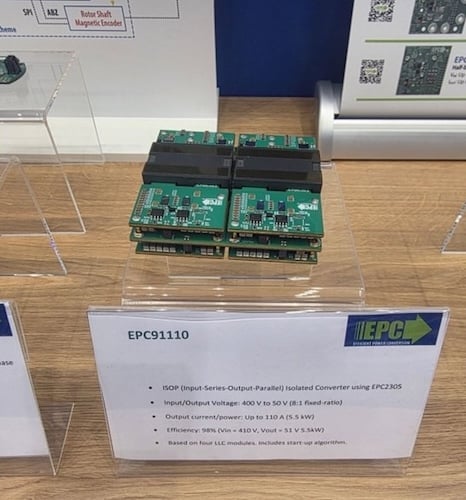
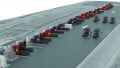
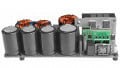
Figure 1. EPC91110 evaluation board on display at Electronica, showcasing a 5.5 kW, 400 V-to-50 V isolated GaN DC-DC converter designed for high-density data center power architectures.
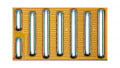
A key example was the EPC91123, a 6 kW, 800 V-to-12.5 V isolated LLC converter (Figure 2). This reference design illustrates how GaN devices can support high-power-density conversion in architectures based on 800 VDC distribution. Particularly noteworthy is its ISOP (Input-Series Output-Parallel) topology, which combines eight self-balancing modules based on 150 V GaN FETs. This approach enables the use of lower-voltage devices with low on-resistance (2.2 mΩ), offering potential conduction-loss advantages over competing solutions based on higher-voltage power switches.
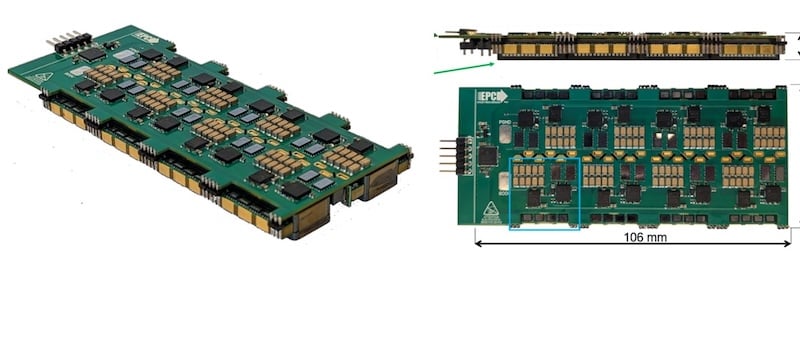
Figure 2. The EPC91123 is a 6 kW, 800 V-to-12.5 V converter measuring 106 mm × 47 mm (4,982 mm²) with a height of 8 mm.
EPC also showcased a 6 kW, 800 V-to-6 V converter designed for next-generation AI processors. As rising current demands make it hard to re-design traditional low-voltage power-delivery networks, moving the conversion stage closer to the processor minimizes distribution losses and simplifies high-current delivery.
Another important piece of EPC's AI strategy is Gen8 GaN power-stage technology. Designed for ultra-high-frequency, low-voltage conversion, Gen8 targets direct conversion from approximately 6.25 V to sub-1 V processor supply rails at multi-megahertz switching frequencies, potentially eliminating an intermediate voltage-regulation stage.
The technology integrates half-bridge power switches, high-speed gate drivers, bootstrap circuitry, level shifters and logic on a single GaN chip. By reducing parasitic inductances and simplifying the power-conversion architecture, this approach aims to increase current density while improving efficiency and reducing the footprint of processor-side power delivery.
This architecture is particularly relevant to modern AI processors, which require extremely low operating voltages and very high currents. At these voltage levels, even small resistive losses in the power-delivery network can become significant. Higher switching frequencies can also enable smaller passive components, potentially reducing the overall size of the power-conversion stage.
Physical AI, Humanoid Robots, and Drones: Bringing Gan Into Intelligent Motion Systems
Beyond data centers, EPC is targeting another rapidly expanding application domain: physical AI. As AI transitions from digital environments into machines that can interact with the physical world, the requirements for power electronics are evolving to reflect this change.
Humanoid robots, drones and autonomous machines require compact, efficient and responsive motor-drive systems. Their power electronics must operate within increasingly constrained mechanical envelopes while supporting precise motion control and torque, high power density and efficient energy conversion.
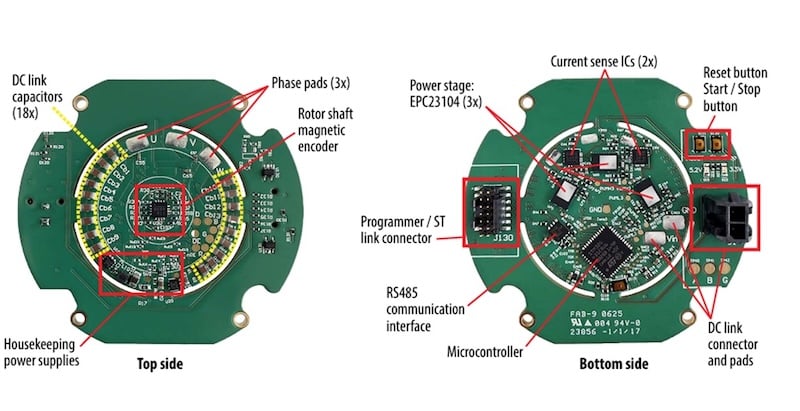
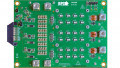
Figure 3. EPC91118 evaluation board featuring a wide input DC voltage ranging from 15 V to 60 V.
One evaluation board on display for space-constrained motor drives was the EPC91118, see Figure 3. This is a 3-phase BLDC motor drive inverter board featuring the EPC23104 ePower Stage IC, rated at 100 V, 15 A, capable of delivering 10 ARMS in steady-state and up to 20 ARMS in transient operation.
This evaluation board contains all the necessary circuitry, including a microcontroller, motor shaft angular sensor, regulated auxiliary power rails for housekeeping supplies, voltage sense, accurate current sense, protection functions, and RS485 interface. It addresses higher-torque robotic joints—such as humanoid knee, hips, or shoulder actuators—and heavier-lift drones.
EPC's demos included the EPC33110, a 100 V three-phase integrated ePower Stage IC, suitable for compact, high-performance motor drives in robotic joints such as wrists and elbows, drone propulsion, and industrial servos.
EPC also presented the new EPC33111 in preview. This new device targets further miniaturization, addressing highly compact applications, while the EPC23108/09 and EPC23110/11 100 V integrated ePower Stage IC families are in mass production, supporting up to 35 A and 20 A, respectively.
Several motor-drive reference designs were also highlighted, including platforms based on the EPC33110 and the latest Gen7 GaN devices. These reference platforms provide engineers with practical starting points for developing motor-control systems, helping them evaluate the advantages of GaN at the application level.
The growing importance of physical AI could create significant opportunities for GaN technology. As robotic systems perform more complex tasks, the demand for compact motor drives, efficient power conversion and high-performance actuation is likely to increase. EPC is positioning its integrated solutions to address these requirements.
Space Electronics: Extending Gan Into Radiation Environments
The third application area highlighted at Electronica was space electronics, through EPC’s joint venture, EPC Space.
Power electronics used in satellites and other space vehicles face particularly demanding operating conditions. In addition to usual requirements for high efficiency, reliability and compactness, semiconductor devices must withstand high radiation doses that can progressively degrade conventional electronic components or cause immediate functional disruptions.
EPC Space showcased its radiation-hardened GaN technology for DC-DC converters, point-of-load and intermediate-voltage-regulator (POL/IVR) applications, and space computing.
Among the devices presented were the EPC7011 and EPC7009, together with the radiation-tolerant EPC7050PCSH, EPC7066PCSH and EPC7065PCSH.
The use of GaN in space power systems is particularly interesting because of the technology's potential to combine high switching performance with reduced volume and weight—valuable characteristics in all satellite platforms.
Radiation tolerance is equally important. Space-qualified semiconductor devices must be screened and validated according to the radiation environment and mission profiles. EPC Space's portfolio addresses this specialized market, extending the company's GaN expertise beyond conventional terrestrial power-conversion applications.
From Semiconductor Devices to Complete Power Architectures
A common feature of EPC's demos at Electronica was the emphasis on system-level integration. Whether addressing the power requirements of AI compute, the motor drives powering humanoid robots or the extreme conditions of space electronics, EPC is increasingly positioning its technology around complete application ecosystems.
This strategy mirrors the broader evolution of the GaN power semiconductor market. As the technology matures, competitive differentiation is no longer based on transistor-level performance specifications. Integration, thermal management, packaging, reference designs and ease of implementation are becoming equally important factors in helping customers translate the advantages of GaN into practical solutions.
EPC's portfolio is in line with this transition, combining discrete eGaN FETs with integrated power stages and application-specific platforms.
The demos at Electronica 2026 therefore offered a snapshot of a company leveraging its early position in enhancement-mode GaN technology to access new and rapidly expanding markets. Importantly, these opportunities do not necessarily lie in traditional high-volume segments such as adaptors and general-purpose power supplies, but rather in high-growth, high-value applications such as AI data centers and physical AI, where power density, efficiency, integration and performance are considered key differentiating factors.
EPC's approach suggests that GaN will be instrumental in meeting these requirements, not as a mere replacement of silicon power devices, but as an enabling technology for entirely new system architectures.
All images used courtesy of EPC.