Facebook
 Google
 GitHub
 Linkedin
Industry White Papers
Using YMIN Capacitors in DC/DC Converter Applications
Feb 03, 2025 by Shanghai Yongming (YMIN)
Capacitors are essential discrete components used in various power conversion applications, such as renewables for DC/DC converter output power regulation and motor drives for reactive power compensation. The design’s electrical performance, the installation budget, and space constraints determine the type of capacitor deployed. This article describes how YMIN capacitors are commonly used in these applications and how to determine whether electrolytic or film capacitor technology is best for you.
The Next-Generation Power Grid
Renewable energy sources, primarily solar and wind, are quickly becoming part of the modern-day energy grid. The phenomenon has led to a more decentralized power generation approach.
You can see in Figure 1 how this method supplements the existing power infrastructure, which includes:
- Conventional central power plant
- Transmission substations
- Distribution substations
- Transformers
- High- and low-voltage transmission lines.
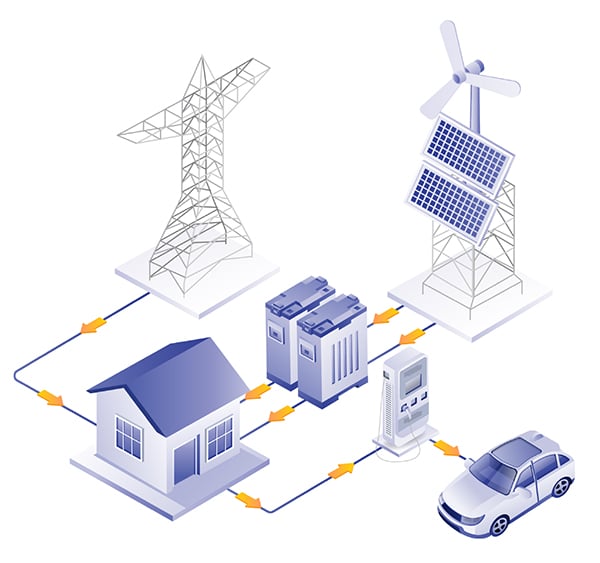
Figure 1. Power signal interactions between the various subsystems of a modern residence.
The shift from fossil-fuel-based power generation increasingly relies on the use of batteries in energy storage systems (ESSs), where both solar and wind energy utilize batteries to store electricity during low power output. The electric vehicle (EV) is another factor that contributes to the distributed energy infrastructure and the popularity of high-voltage batteries for energy storage. Battery EVs (BEVs) and Hybrid EVs (HEVs) have become the foundation for alternative forms of mobility, creating a gradual shift away from internal combustion engine (ICE) vehicles. The energy-dense BEV is now an option for vehicle-to-grid (V2G) power, with the bidirectional in-home charger capable of supplying energy to both the car’s battery and the residence.
The power and control circuitry coordinates the renewable energy systems, EV charging stations, EV, ESS, residence, and grid. The underlying converters, rectifiers, and inverters must smoothly transmit power to and from each system within the overall network, ensuring effective operation without unwanted harmonics, ripples, or surges, and preventing degradation, damage, or failures. At the output of converters (DC/DC) and rectifiers (AC/DC), the required DC-link capacitor with the appropriate capacitance density is often present to dampen low-frequency impedance resonances in output filters and smooth out current and voltage ripples. This is done before converting into AC via an inverter (DC/AC) to power a residence or send power back to the grid.
Capacitor Applications
V2G
Figure 2 shows the V2G and G2V power flow. The incoming AC supply is sent to the DC link where a rectifier provides high voltage and high-efficiency DC to the vehicle’s bidirectional DC/DC converter for battery charging. This bidirectional AC/DC conversion often requires a large capacitor at the output to minimize harmonics under unbalanced conditions and prevent a high pulse voltage from being generated on the impedance of the DC link.

Figure 2. Block diagram of V2G use case.
Solar
Whether a residential PV installation or a large solar farm, the underlying power conversion system (Figure 3) for solar power leverages a digitally-controlled DC/DC converter that ensures the maximum power is extracted from the panel through an embedded maximum power point tracking (MPPT) algorithm. At this point, the signal is sent to an inverter and converted from DC into a clean AC signal via a DC link capacitor to filter noise, smooth out the converter’s ripple current, and stabilize the DC bus voltage. A relatively high capacitance and a high DC voltage rating can buffer the downstream inverter from ripple and prevent the transmission of DC-link voltage variabilities into the PV voltage, which would render the MPPT algorithm unstable.

Figure 3. Block diagram of PV installation and how capacitors are utilized at many points in the power chain.
Wind
The block diagram in Figure 4 illustrates how smaller wind installations convert the frequency-variable AC products by the permanent magnet synchronous generator (PMSG) within the turbine in DC. Similar to solar installations, the changes in wind speed profiles can cause voltage ripples at the output of the AC/DC converter. This calls for a DC-link capacitor large enough to handle the ripple current stress before transmitting the signal to the DC/AC inverter for main power.

Figure 4. Block diagram of wind installation.
Motor Drives
Inductive loads such as motors, lamps, transformers, and generators have a lagging power factor and require reactive power to build a magnetic field and reach a steady state. Contrary to active power, reactive (or inductive) power oscillates between the source of power, such as a capacitor, and that which is draining power, such as a motor. Capacitors provide reactive power compensation in inductive loads to stabilize voltage and improve motor performance. Capacitors can store this reactive energy through an electric field, and a motor can store the reactive energy in the form of a magnetic field.

Figure 5. Reactive power compensation of motor with parallel-connected capacitor. Group compensation can also be performed with multiple motors connected in parallel.
What To Look for in a DC-Link and Reactive Power Capacitor
Ultimately, the choice of capacitor used in DC-link and reactive power applications depends upon the capacitance density, rated voltage, and maximum ripple current required for the application. These are the primary capacitor parameters to consider for the application, with secondary consideration given to lifetime, ESR, cost, and size. All parameters are important when deciding on a capacitor, but it is essential to first establish the necessary level of capacitance and working voltage. A high ESR will eventually lead to more system loss in the form of heat and ripple current since the capacitor will not be able to sink, or source, the required current. Electrolytic capacitors are a common choice for many of these applications due to their high work voltage, capacitance density, and cost-effectiveness. However, they can come with lifetime considerations and are often the reason why a system might fail prematurely. These capacitors leak electrolytes when exposed to high temperatures, which leads to a decrease in capacitance and an increase in ESR. Electrolytic capacitors' operating lifetimes are generally specified from 1,000 to 10,000 hours at a temperature of either 85°C or 105°C. YMIN capacitors can function at the maximum end of this range, with capacitors that last from 6,000 hours to 10,000 hours at 105°C. These capabilities make them high-reliability electrolytic capacitors with stable operation in harsh environments, which are essential factors for long-term, uninterrupted energy storage applications.
The widely accepted end-of-life criterion for these capacitors is a 20% drop in capacitance or a doubling of the ESR. For film capacitors, however, this drops to a 2% to 5% reduction in capacitance. Film capacitors have a longer lifetime with more stable capacitance, but they generally have less capacitance density. YMIN’s DC-link film capacitors (MDP) have a higher voltage transient (dv/dt) tolerance and longer life than other film capacitors on the market. These are important factors for fast-switching power circuits that leverage wide-bandgap technologies such as SiC and GaN.
Conclusion
Power circuits in renewable energy applications, including V2G and solar/ wind installations, rely on capacitors to filter out harmonics, smooth voltage ripple, and stabilize the DC bus voltage. This could be in the form of an input or output filter capacitor or a DC-link capacitor. Furthermore, capacitors are necessary for reactive power compensation in motor drives.
DC-link capacitors and capacitors for reactive power compensation generally require a high capacitance density and high working voltage to effectively suppress the ripples from the inherently variable voltage produced by renewables. YMIN offers both electrolytic and film capacitors for these applications. These capacitors are manufactured for high reliability, ensuring maximum performance at high temperatures without degradation in capacitance.